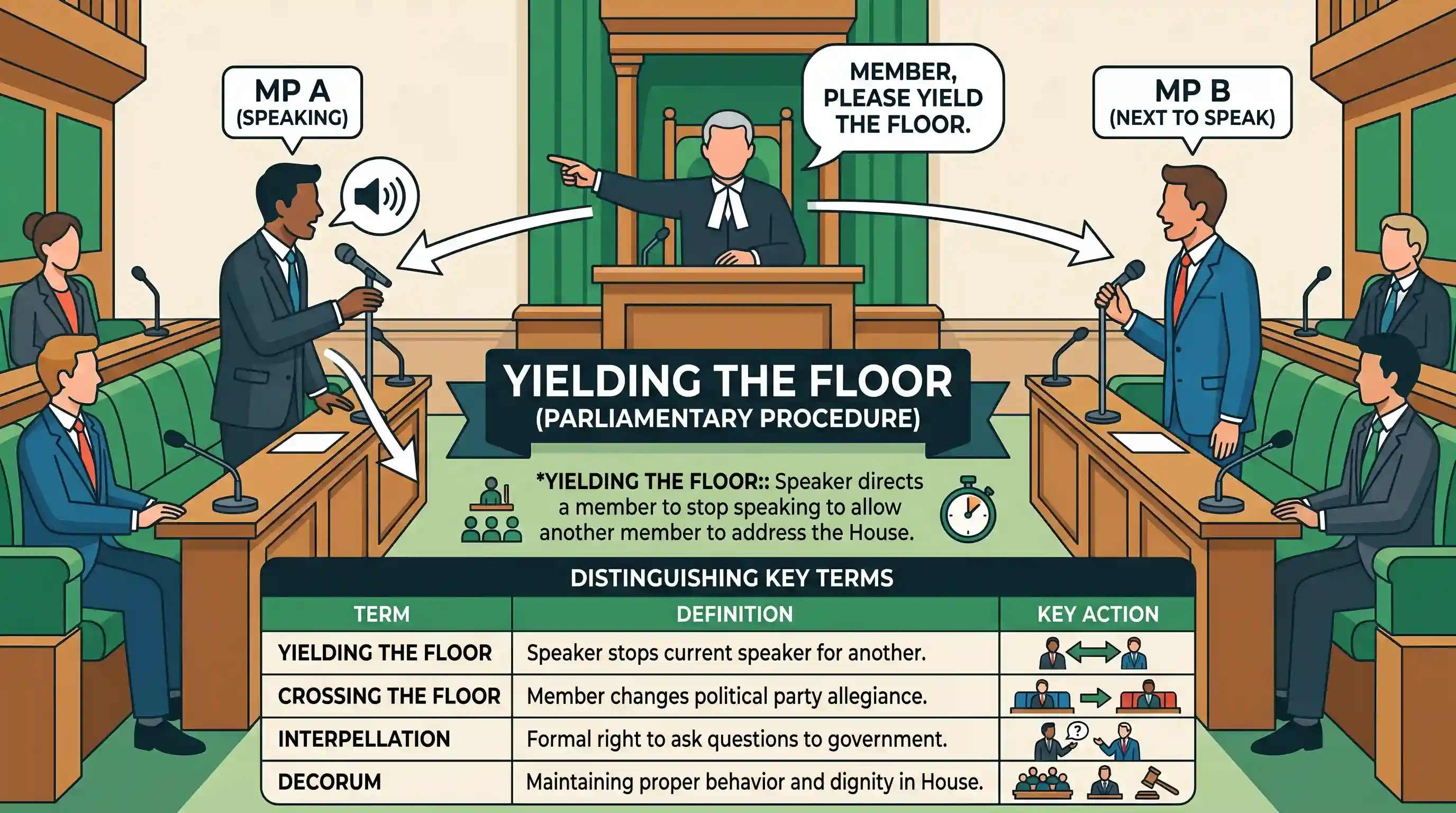
The Speaker can ask a member of the House to stop speaking and let another member speak. This phenomenon is known as

- Adecorum
- Bcrossing the floor
- Cinterpellation
- Dyielding the floorCorrect
Explanation
The correct answer is D, yielding the floor.
Yielding the floor is a parliamentary practice where the Speaker directs a member to stop speaking to allow another member to address the House. This ensures the orderly conduct of business and manages the time allocated for debates.
The other options are incorrect because: A) Decorum refers to maintaining proper behavior and dignity in the House. B) Crossing the floor refers to a member changing their party allegiance. C) Interpellation is the formal right of a member to ask a question to the government.
Related questions
More UPSC Prelims practice from the same subject and topic.
- Prelims 2000GS1polity-and-governance
Match List I with List II and select the correct answer using the codes given below the Lists: List I List II >> (Institute) (Location) I. Central Institute of Higher Tibetan Studies A) Hyderabad II. …
- Prelims 2000GS1polity-and-governance
A college student desires to get elected to the Municipal Council of his city. The validity of his nomination would depend on the important condition, among others, that
- Prelims 2000GS1polity-and-governance
Match List I with List II and select the correct answer using the codes given below the Lists: List I List II (Local bodies) (States as in 1999) I. Zila Parishads at the sub-divisional level A) Andhra…
- Prelims 2000GS1polity-and-governance
Which one of the following is not a feature of the Government of India Act of 1935?
- Prelims 2000GS1polity-and-governance
The 73rd Constitution Amendment Act, 1992 refers to the
- Prelims 2000GS1polity-and-governance
A, B, C, D, E and F, not necessarily in that order, are sitting in six chairs regularly placed around a round table. It is observed that A is between D and F. C is opposite D. D and E are not on neigh…