A, B, C, D, E and F, not necessarily in that order, are sitting in six chairs regularly placed around a round table. It is observed that A is between D and F. C is opposite D. D and E are not on neighbouring chairs. Which one of the following must be true?

- AA is opposite B
- BD is opposite E
- CC and B are neighbours
- DB and E are neighboursCorrect
Explanation
To solve this, place the individuals in a circle based on the given conditions.
-
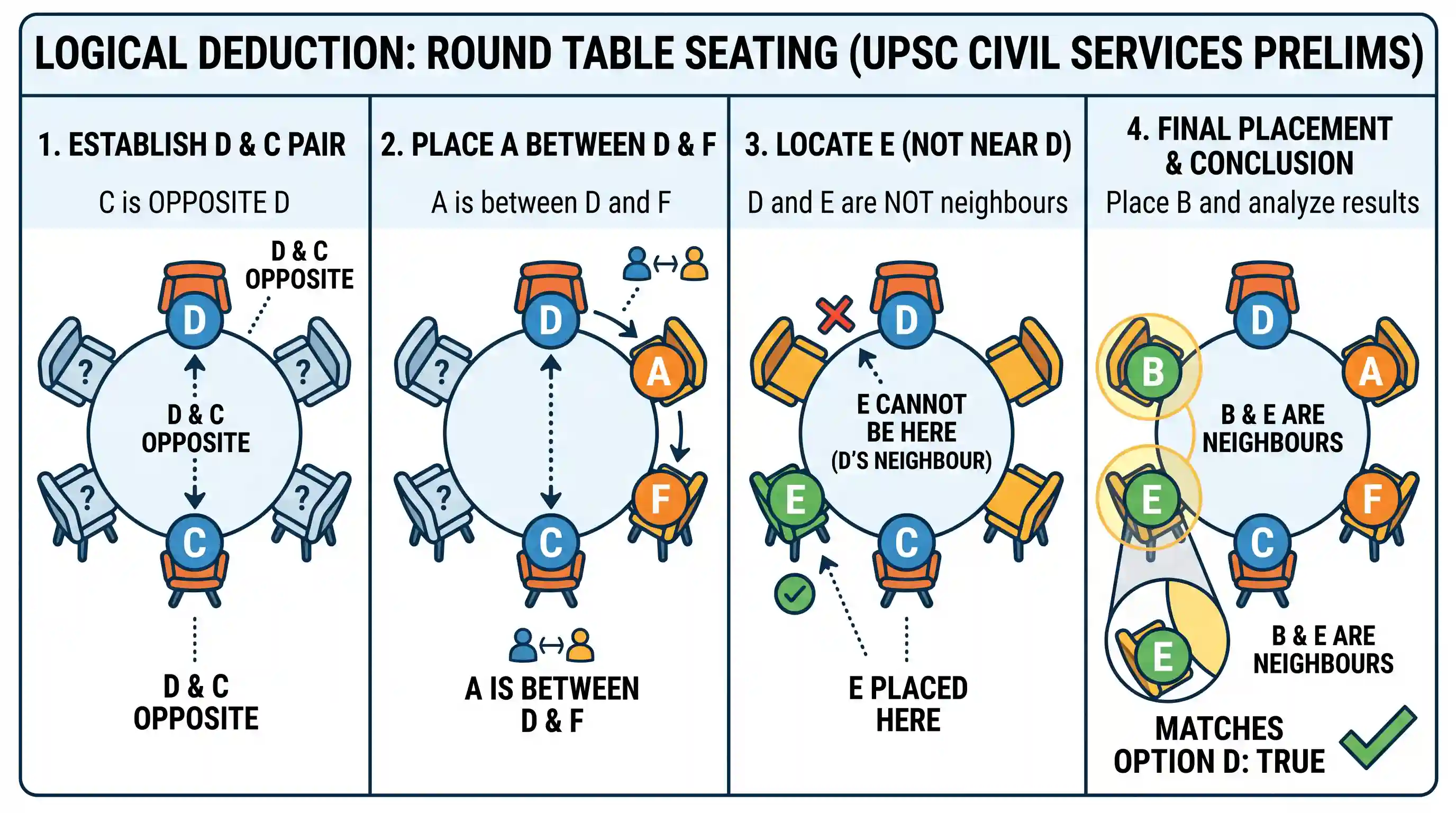
First, place D and its opposite chair, which is occupied by C.
-
The condition A is between D and F means A and F must take the two chairs on one side of the D-C axis. Specifically, if we place D at the top, A must be next to D, and F must be next to A.
-
We are told D and E are not neighbours. Since D is already next to A on one side, E cannot be on the other side of D. Therefore, the only available spot for E is next to C.
-
This leaves only one chair remaining for B, which must be the chair between D and C that is not occupied by E.
-
Looking at the resulting arrangement, the neighbors of E are C and B. Therefore, B and E must be neighbours. This makes option D the only logically certain conclusion.
Related questions
More UPSC Prelims practice from the same subject and topic.
- Prelims 2000GS1polity-and-governance
The Speaker can ask a member of the House to stop speaking and let another member speak. This phenomenon is known as
- Prelims 2000GS1polity-and-governance
Match List I with List II and select the correct answer using the codes given below the Lists: List I List II >> (Institute) (Location) I. Central Institute of Higher Tibetan Studies A) Hyderabad II. …
- Prelims 2000GS1polity-and-governance
A college student desires to get elected to the Municipal Council of his city. The validity of his nomination would depend on the important condition, among others, that
- Prelims 2000GS1polity-and-governance
Match List I with List II and select the correct answer using the codes given below the Lists: List I List II (Local bodies) (States as in 1999) I. Zila Parishads at the sub-divisional level A) Andhra…
- Prelims 2000GS1polity-and-governance
Which one of the following is not a feature of the Government of India Act of 1935?
- Prelims 2000GS1polity-and-governance
The 73rd Constitution Amendment Act, 1992 refers to the