Consider the following events: I. Reign of Krishna Deva Raya of Vijayanagara. II. Construction of Qutab Minar. III. Arrival of Portuguese in India. IV. Death of Firoz Tughlaq.

- AII, IV, III, ICorrect
- BII, IV, I, III
- CIV, II, I, III
- DIV, II, III, I
Explanation
To solve this question, we must look at the specific dates or periods of each event to establish the correct chronological order.
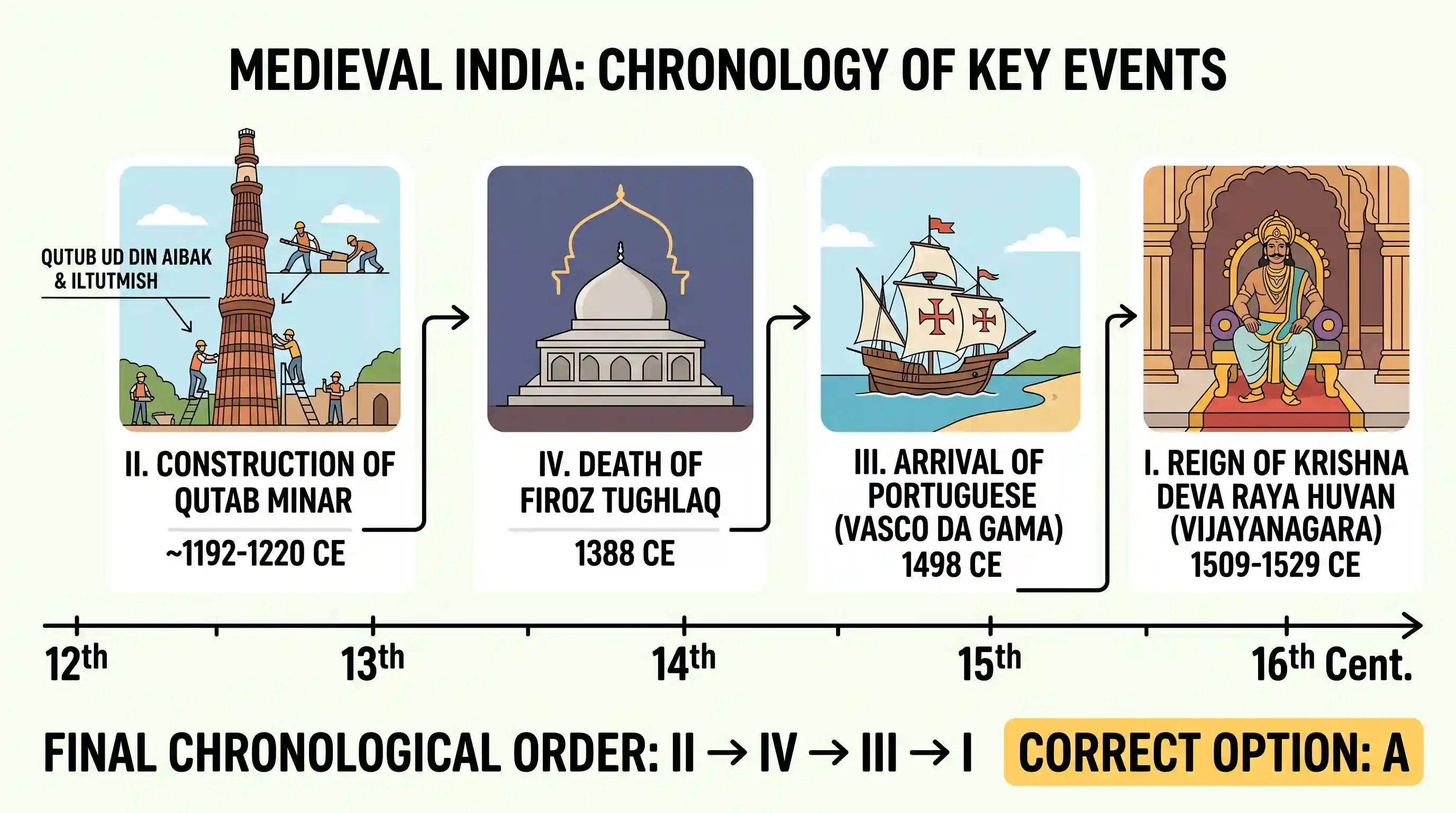
I. Reign of Krishna Deva Raya of Vijayanagara: He ruled from 1509 to 1529.
II. Construction of Qutab Minar: Construction was started by Qutub ud din Aibak around 1192 and completed by Iltutmish around 1220.
III. Arrival of Portuguese in India: Vasco da Gama reached Calicut in 1498.
IV. Death of Firoz Tughlaq: He was a Sultan of the Tughlaq dynasty who died in 1388.
Chronological Order: The earliest event is the construction of the Qutab Minar in the early 13th century (II). This is followed by the death of Firoz Tughlaq in the late 14th century (IV). Next is the arrival of the Portuguese at the end of the 15th century (III). Finally, the reign of Krishna Deva Raya occurs in the early 16th century (I).
Therefore, the correct sequence is II, IV, III, I, which matches Option A.
Related questions
More UPSC Prelims practice from the same subject and topic.
- Prelims 2000GS1history
Who among the following streamlined the Maratha administration after Sambhaji?
- Prelims 2000GS1history
Match List I with List II and select the correct answer using the codes given below the Lists: List I I. Iqta A) Marathas II. Jagir B) Delhi Sultans III. Amaram C) Mughals IV. Mokasa D) Vijayanagara C…
- Prelims 2000GS1history
Which one of the following Muslim rulers was hailed as the ‘Jagadguru’ by his Muslim subjects because of his belief in secularism?
- Prelims 2000GS1history
At the time of partition of India, which one of the following provinces of the British India came forward with a plan for a united and independent existence?
- Prelims 2000GS1history
The Balkan Plan for fragmentation of India was the brain-child of
- Prelims 2000GS1history
The practice of military governorship was first introduced in India by the