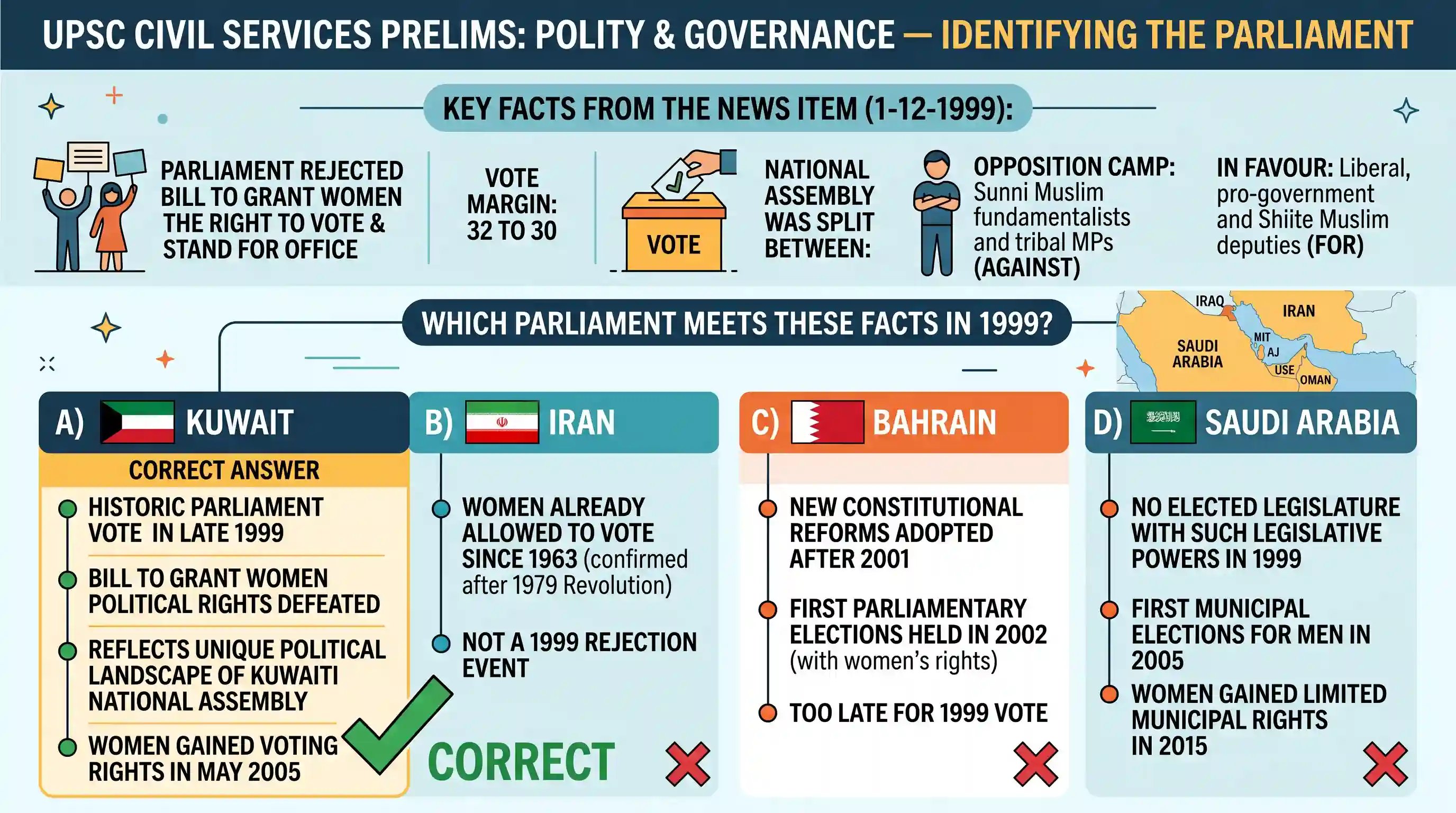
The following news item appeared in a National daily dated 1-12-1999: “…Parliament today rejected a Bill to grant women the right to vote and stand for office in parliamentary elections, by a margin of 32 to 30. The National Assembly was split between liberal, pro-government and Shiite Muslim deputies who were in favour of women’s rights, while the opposition camp grouped Sunni Muslim fundamentalists and tribal MPs. A total of 64 MPs and Ministers were present, of whom two abstained.” The Parliament referred to in this quotation is that of

- AKuwaitCorrect
- BIran
- CBahrain
- DSaudi Arabia
Explanation
The correct answer is Kuwait.
The news item refers to a historic vote in the Kuwaiti National Assembly in November 1999. At that time, Kuwait had a unique political landscape where the parliament, consisting of elected members and appointed cabinet ministers, was divided over granting political rights to women.
The specific details mentioned in the text align with Kuwaiti politics of that era: the ruler Emir Sheikh Jaber al-Ahmad al-Sabah had issued a decree to grant women the right to vote, but the National Assembly, dominated by a coalition of conservative tribal members and fundamentalist lawmakers, narrowly defeated the bill. Kuwaiti women eventually gained the right to vote and run for office in May 2005.
Other options are incorrect because Iran already allowed women to vote, Saudi Arabia did not have an elected parliament with such legislative powers at that time, and Bahrain did not hold its first parliamentary elections under its new constitutional reforms until 2002.
Related questions
More UPSC Prelims practice from the same subject and topic.
- Prelims 2000GS1polity-and-governance
The Speaker can ask a member of the House to stop speaking and let another member speak. This phenomenon is known as
- Prelims 2000GS1polity-and-governance
Consider the following functionaries: I. Cabinet Secretary II. Chief Election Commissioner III. Union Cabinet Ministers IV. Chief Justice of India Their correct sequence, in the Order of Precedence is
- Prelims 2000GS1polity-and-governance
The primary function of the Finance Commission in India is to
- Prelims 2000GS1polity-and-governance
The State which has the largest number of seats reserved for the Scheduled Tribes in Lok Sabha is
- Prelims 2000GS1polity-and-governance
Match List I with List II and select the correct answer using the codes given below the Lists: List I List II >> (Institute) (Location) I. Central Institute of Higher Tibetan Studies A) Hyderabad II. …
- Prelims 2000GS1polity-and-governance
A college student desires to get elected to the Municipal Council of his city. The validity of his nomination would depend on the important condition, among others, that