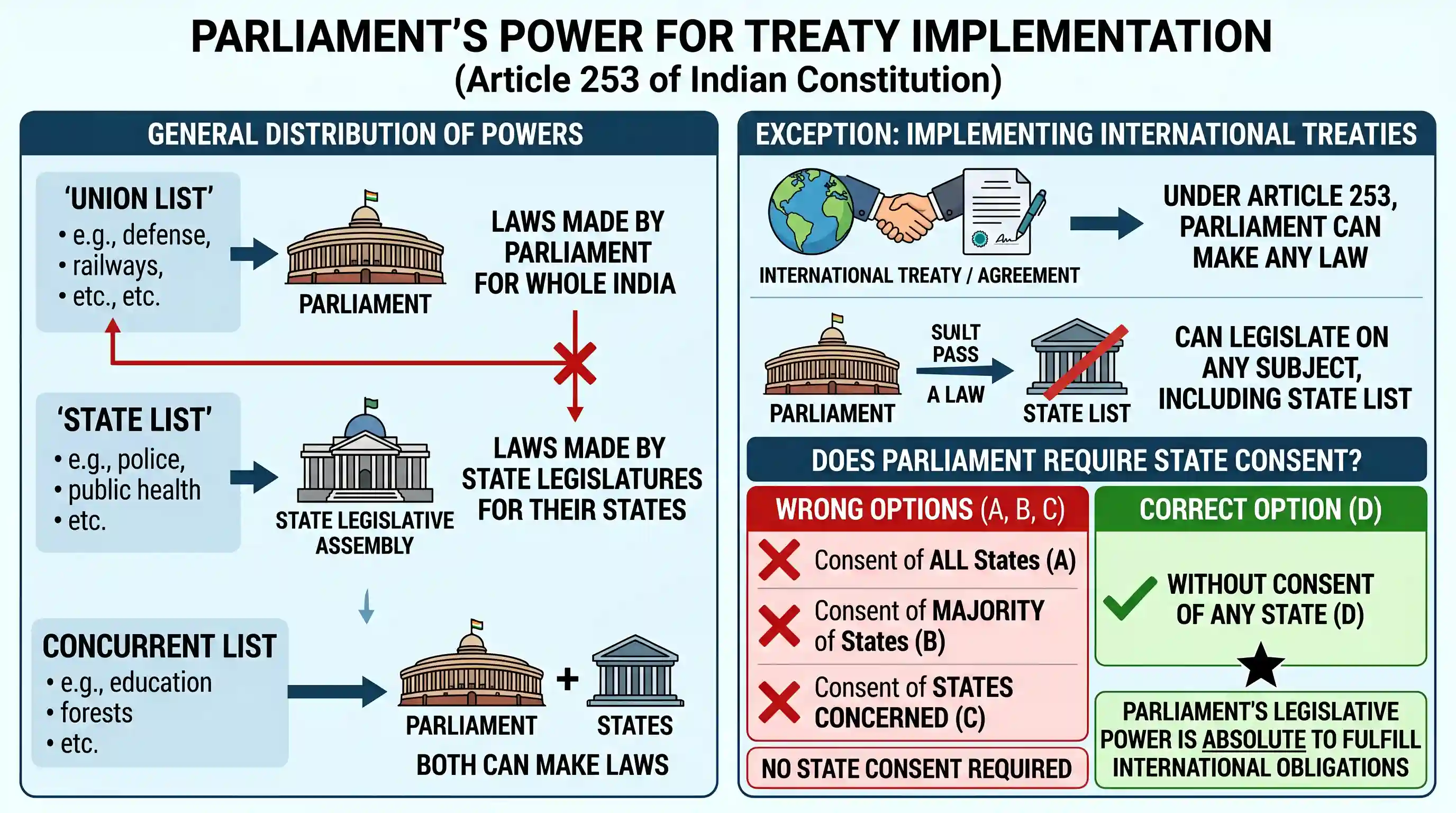
The Parliament can make any law for the whole or any part of India for implementing international treaties

- Awith the consent of all the States
- Bwith the consent of the majority of States
- Cwith the consent of the States concerned
- Dwithout the consent of any StateCorrect
Explanation
The correct answer is D because of the specific provisions mentioned in Article 253 of the Indian Constitution. This Article empowers the Parliament to make laws for the whole or any part of India to implement any treaty, agreement, or convention with any other country or international body.
Under this Article, the legislative power of the Parliament is absolute and overrides the distribution of powers between the Union and the States. This means the Parliament can legislate even on subjects listed in the State List if it is necessary to fulfill international obligations. To exercise this power, the Parliament does not require the consent of any state, regardless of whether the law affects one state or all of them. This ensures that the Union government can effectively represent the country and fulfill its commitments on the global stage.
Related questions
More UPSC Prelims practice from the same subject and topic.
- Prelims 2000GS1polity-and-governance
The primary function of the Finance Commission in India is to
- Prelims 2000GS1polity-and-governance
Which one of the following statements is incorrect?
- Prelims 2000GS1polity-and-governance
The Speaker can ask a member of the House to stop speaking and let another member speak. This phenomenon is known as
- Prelims 2000GS1polity-and-governance
Consider the following functionaries: I. Cabinet Secretary II. Chief Election Commissioner III. Union Cabinet Ministers IV. Chief Justice of India Their correct sequence, in the Order of Precedence is
- Prelims 2000GS1polity-and-governance
The State which has the largest number of seats reserved for the Scheduled Tribes in Lok Sabha is
- Prelims 2000GS1polity-and-governance
Match List I with List II and select the correct answer using the codes given below the Lists: List I List II >> (Institute) (Location) I. Central Institute of Higher Tibetan Studies A) Hyderabad II. …