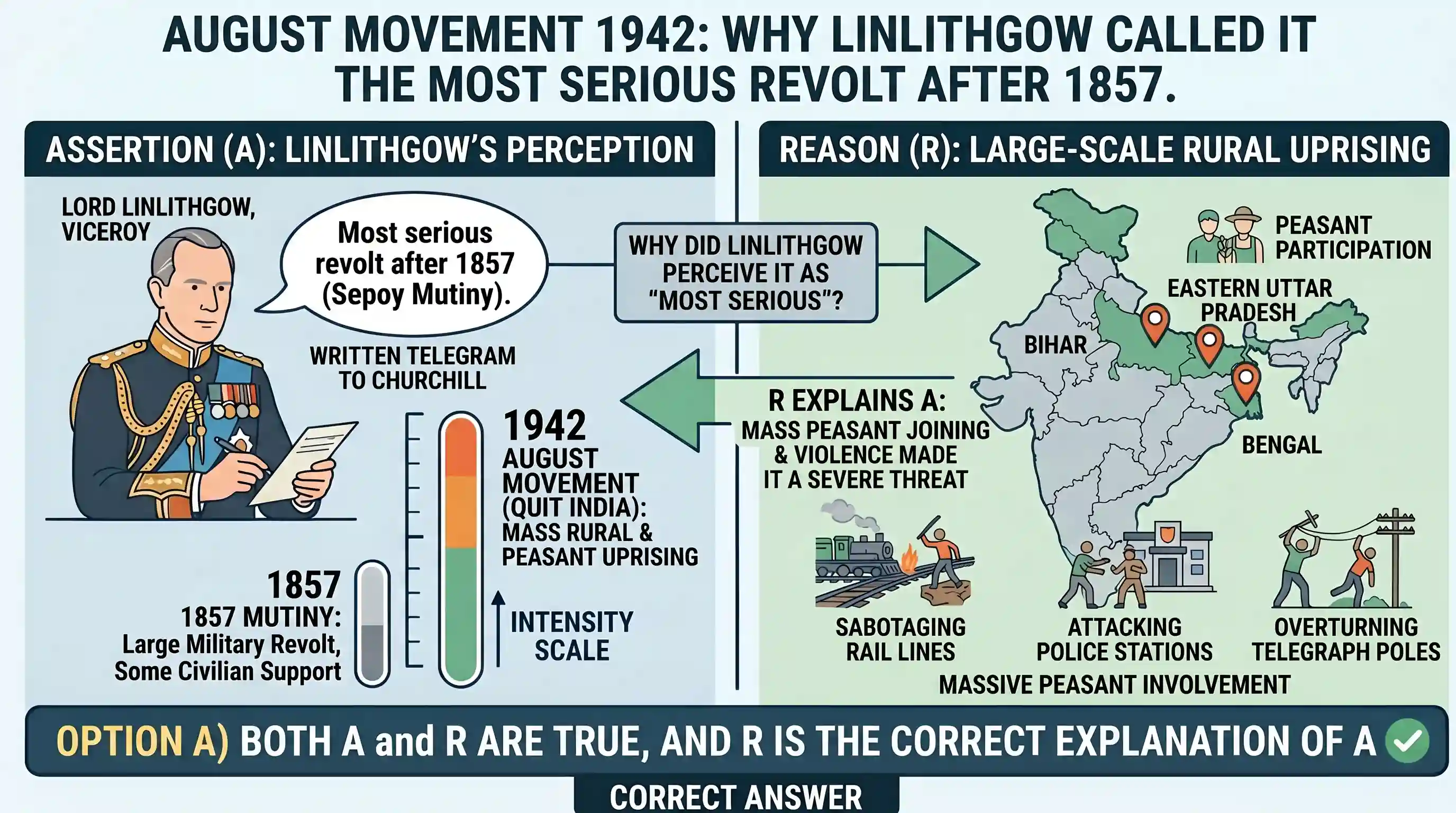
Assertion (A): Lord Linlithgow described the August Movement of 1942 as the most serious revolt after the Sepoy mutiny. Reason (R): Peasants joined the movement in large number in some places.

- ABoth A and R are true, and R is the correct explanation of ACorrect
- BBoth A and R are true, but R is not a correct explanation of A
- CA is true, but R is false
- DA is false, but R is true
Explanation
The correct option is A because both statements are historically accurate and the reason directly justifies the assertion.
Assertion A is true because Lord Linlithgow, the then Viceroy of India, wrote a telegram to Prime Minister Winston Churchill describing the Quit India Movement also known as the August Movement as by far the most serious rebellion since that of 1857.
Reason R is true because the movement saw massive participation from the peasantry, especially in regions like Bihar, Eastern Uttar Pradesh, and Bengal. The Reason is the correct explanation of the Assertion because it was precisely this large scale mass participation and the violent nature of the rural uprisings which included attacking police stations and sabotaging rail lines that made the British authorities perceive it as a threat comparable to the 1857 mutiny.
Related questions
More UPSC Prelims practice from the same subject and topic.
- Prelims 2000GS1history
At the time of partition of India, which one of the following provinces of the British India came forward with a plan for a united and independent existence?
- Prelims 2000GS1history
The Balkan Plan for fragmentation of India was the brain-child of
- Prelims 2000GS1history
Consider the following statements about the Indian National Congress I. Sarojini Naidu was the first woman to be the President of the Congress. II. C.R. Das was in prison when he functioned as the Pre…
- Prelims 2000GS1history
“In this instance we could not play off the Mohammedans against the Hindus”. To which one of the following events did this remark of Aitchison relate?
- Prelims 2000GS1history
The Indian National Army (INA) came into existence in 1943 in
- Prelims 2000GS1history
The last major extension of British Indian territory took place during the time of