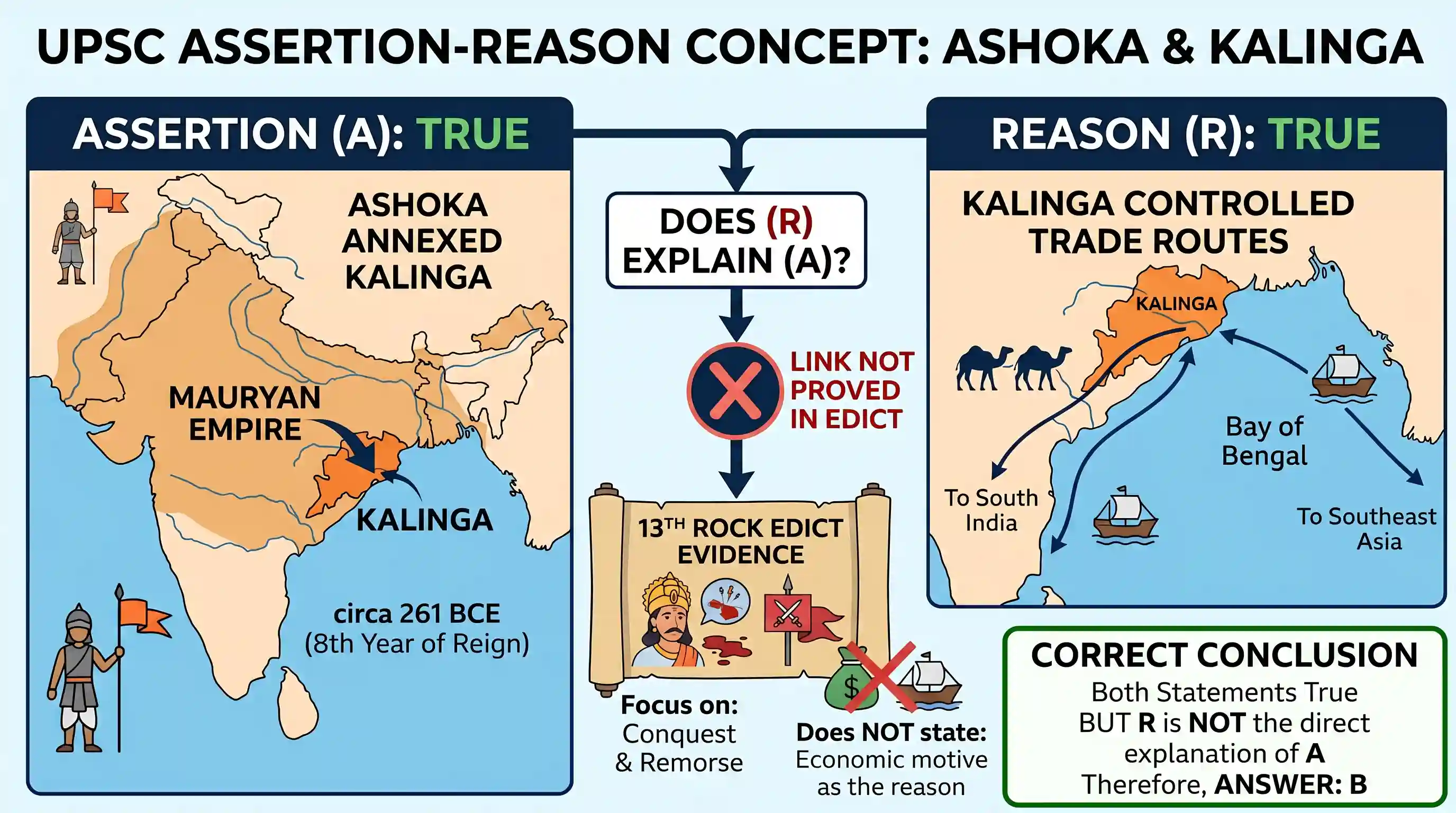
Assertion (A): Ashoka annexed Kalinga to the Mauryan Empire. Reason (R): Kalinga controlled the land and sea routes to South India.

- ABoth A and R are true, and R is the correct explanation of A
- BBoth A and R are true, but R is not a correct explanation of ACorrect
- CA is true, but R is false
- DA is false, but R is true
Explanation
The correct answer is B because both statements are individually true, but the reason provided does not explain the assertion.
Assertion A is true because Ashoka famously conquered Kalinga in the eighth year of his reign, which was a turning point in his life.
Reason R is also true because Kalinga occupied a strategic geographic position that controlled both land and sea trade routes leading to South India and Southeast Asia.
However, historical records, specifically Ashoka’s 13th Rock Edict, do not explicitly state that he annexed Kalinga specifically to control these trade routes. While economic and strategic factors were likely underlying motives, the edict focuses on the conquest itself and the subsequent remorse he felt due to the massive loss of life. Since the causal link between the strategic location and the motive for annexation is an inference rather than a stated historical fact in this context, R is not considered the direct explanation for A.
Related questions
More UPSC Prelims practice from the same subject and topic.
- Prelims 2000GS1history
The practice of military governorship was first introduced in India by the
- Prelims 2000GS1history
Which one of the following dynasties was ruling over North India at the time of Alexander’s invasion?
- Prelims 2000GS1history
Assertion (A): The origin of feudal system in ancient India can be traced to military campaigns. Reason (R): There was considerable expansion of the feudal system during the Gupta period.
- Prelims 2000GS1history
At the time of partition of India, which one of the following provinces of the British India came forward with a plan for a united and independent existence?
- Prelims 2000GS1history
The Balkan Plan for fragmentation of India was the brain-child of
- Prelims 2000GS1history
Consider the following statements about the Indian National Congress I. Sarojini Naidu was the first woman to be the President of the Congress. II. C.R. Das was in prison when he functioned as the Pre…