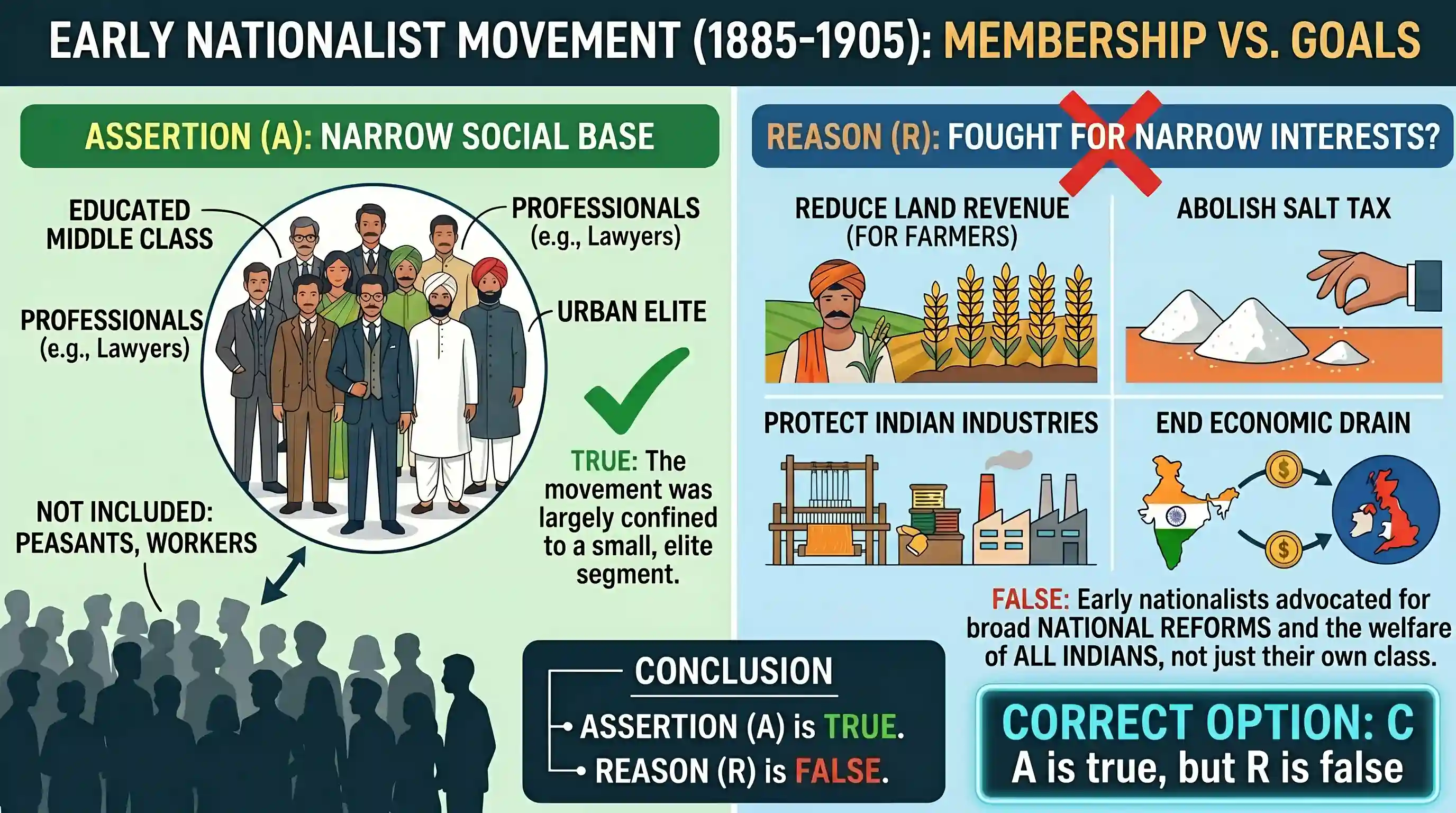
Assertion (A): The basic weakness of the early nationalist movement lay in its narrow social base. Reason (R): It fought for the narrow interests of the social groups which joined it.

- ABoth A and R are true, and R is the correct explanation of A
- BBoth A and R are true, but R is not a correct explanation of A
- CA is true, but R is falseCorrect
- DA is false, but R is true
Explanation
Assertion A is true because the early nationalist movement, led by the Moderates from 1885 to 1905, was largely confined to the educated middle class, professionals, and the urban elite. It had not yet evolved into a mass movement involving the peasantry or the working class.
Reason R is false because although the social base was narrow, the early nationalists did not fight only for their own narrow interests. They advocated for the interests of the entire Indian nation. They demanded the reduction of land revenue for farmers, the abolition of the salt tax, the protection of Indian industries, and an end to the economic drain of India. Their political and economic critiques were aimed at national welfare rather than just the benefit of the educated classes who led the movement. Therefore, while the movement lacked broad participation, its goals were national in scope.
Related questions
More UPSC Prelims practice from the same subject and topic.
- Prelims 2000GS1history
At the time of partition of India, which one of the following provinces of the British India came forward with a plan for a united and independent existence?
- Prelims 2000GS1history
The Balkan Plan for fragmentation of India was the brain-child of
- Prelims 2000GS1history
Consider the following statements about the Indian National Congress I. Sarojini Naidu was the first woman to be the President of the Congress. II. C.R. Das was in prison when he functioned as the Pre…
- Prelims 2000GS1history
“In this instance we could not play off the Mohammedans against the Hindus”. To which one of the following events did this remark of Aitchison relate?
- Prelims 2000GS1history
The Indian National Army (INA) came into existence in 1943 in
- Prelims 2000GS1history
The last major extension of British Indian territory took place during the time of