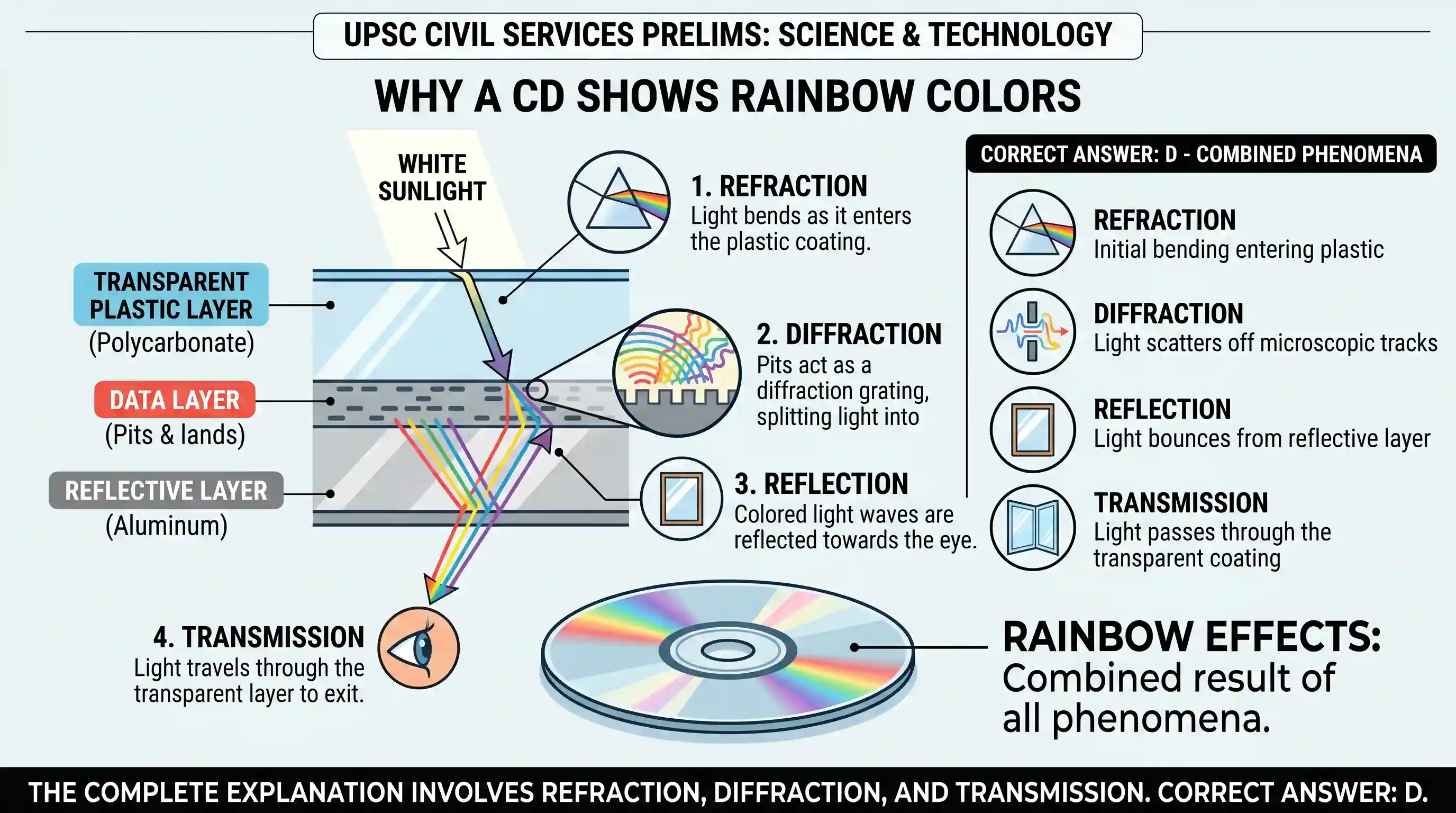
When a CD (Compact Disc used in audio and video systems) is seen in sunlight, rainbow like colours is seen. This can be explained on the basis of the phenomenon of

- Areflection and diffraction
- Breflection and transmission
- Cdiffraction and transmission
- Drefraction, diffraction and transmissionCorrect
Explanation
The rainbow like colors on a CD are primarily caused by three phenomena working together. First, the surface of a CD contains millions of tiny pits and tracks that act as a diffraction grating. When sunlight hits these tracks, it undergoes diffraction, which means the light waves bend and spread out. Second, these diffracted light waves are reflected back to our eyes from the shiny aluminum layer of the disc. Third, as the light travels through the thin protective plastic coating of the CD, transmission occurs. The combination of diffraction and reflection causes different wavelengths of light to interfere with each other, separating white light into its component colors. Therefore, the most comprehensive explanation involves refraction, diffraction, and transmission.
Related questions
More UPSC Prelims practice from the same subject and topic.
- Prelims 2000GS1science-and-technology
A noise level of 100 decibels would correspond to
- Prelims 2000GS1science-and-technology
A ‘black hole’ is a body in space which does not allow any radiation to come out. This property is due to its
- Prelims 2000GS1science-and-technology
Consider the following features of newer models of motor cars: I. Radial tyres II. Streamlined body III. Multipoint fuel injection IV. Catalytic converter with exhaust Which of these features make the…
- Prelims 2000GS1science-and-technology
Fluorescent tubes are fitted with a choke. The choke coils
- Prelims 2000GS1science-and-technology
Assertion (A): A man standing on a completely frictionless surface can propel himself by whistling. Reason (R): If no external force acts on a system, its momentum cannot change.
- Prelims 2000GS1science-and-technology
Assertion (A): In a motion picture, usually 24 frames are projected every second over the whole length of the film. Reason (R): An image formed on the retina of eye persists for about 0.1 s after the …