Assertion (A): A man standing on a completely frictionless surface can propel himself by whistling. Reason (R): If no external force acts on a system, its momentum cannot change.

- ABoth A and R are true, and R is the correct explanation of ACorrect
- BBoth A and R are true, but R is not a correct explanation of A
- CA is true, but R is false
- DA is false, but R is true
Explanation
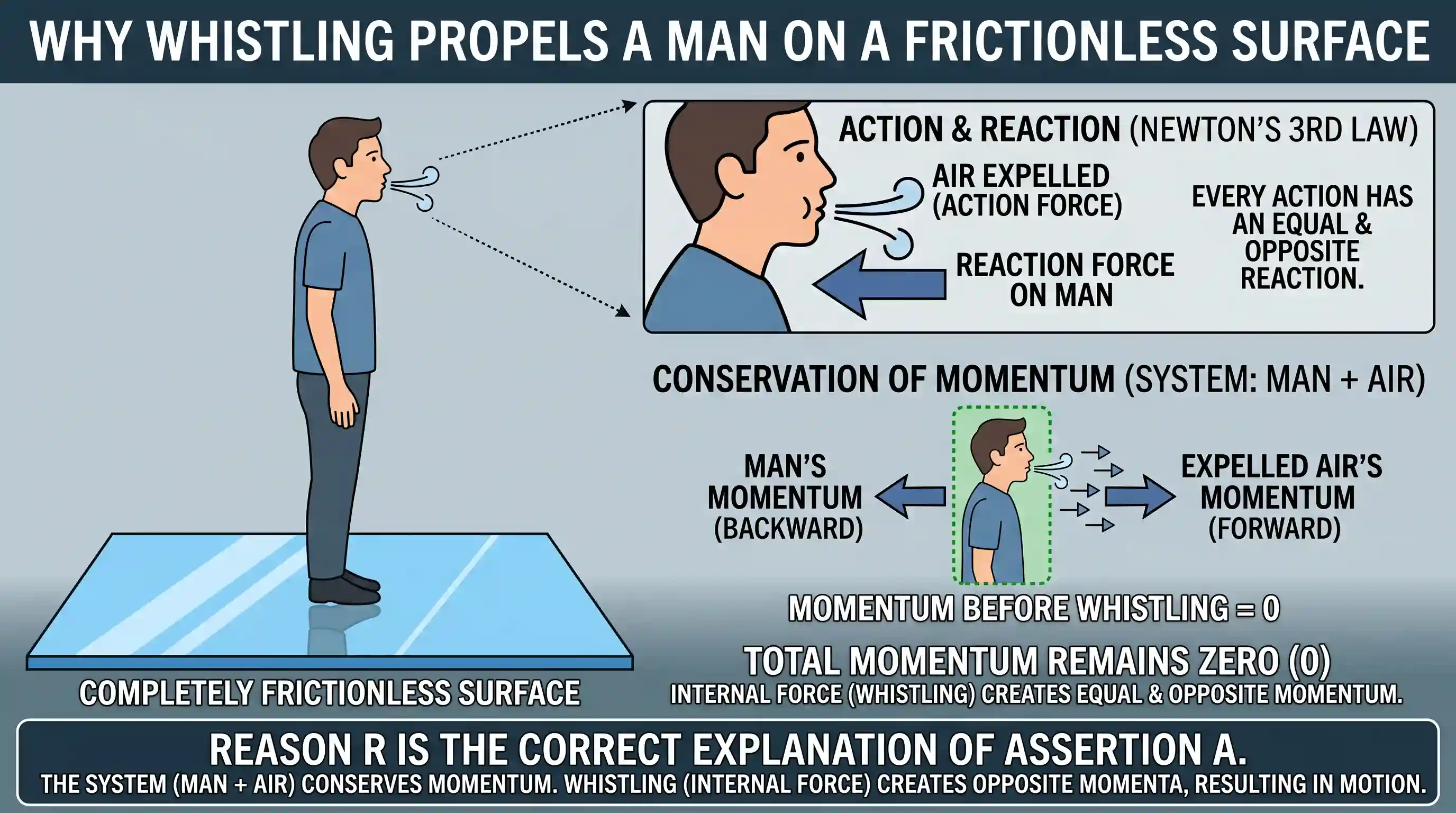
Assertion A is true because when a man whistles, he expels air from his mouth. According to Newtons Third Law of Motion, for every action, there is an equal and opposite reaction. The air pushed out provides a backward force on the man, allowing him to move even on a frictionless surface.
Reason R is true as it states the Law of Conservation of Momentum. This law explains that the total momentum of a system remains constant if no external force acts on it.
Reason R is the correct explanation for Assertion A because the system consists of the man and the air inside him. When the air is expelled, it gains momentum in one direction. To keep the total momentum of the system constant at zero, the man must gain momentum in the opposite direction. Therefore, the internal force of whistling results in movement due to the conservation of momentum.
Related questions
More UPSC Prelims practice from the same subject and topic.
- Prelims 2000GS1science-and-technology
A noise level of 100 decibels would correspond to
- Prelims 2000GS1science-and-technology
A ‘black hole’ is a body in space which does not allow any radiation to come out. This property is due to its
- Prelims 2000GS1science-and-technology
Consider the following features of newer models of motor cars: I. Radial tyres II. Streamlined body III. Multipoint fuel injection IV. Catalytic converter with exhaust Which of these features make the…
- Prelims 2000GS1science-and-technology
Fluorescent tubes are fitted with a choke. The choke coils
- Prelims 2000GS1science-and-technology
When a CD (Compact Disc used in audio and video systems) is seen in sunlight, rainbow like colours is seen. This can be explained on the basis of the phenomenon of
- Prelims 2000GS1science-and-technology
Assertion (A): In a motion picture, usually 24 frames are projected every second over the whole length of the film. Reason (R): An image formed on the retina of eye persists for about 0.1 s after the …