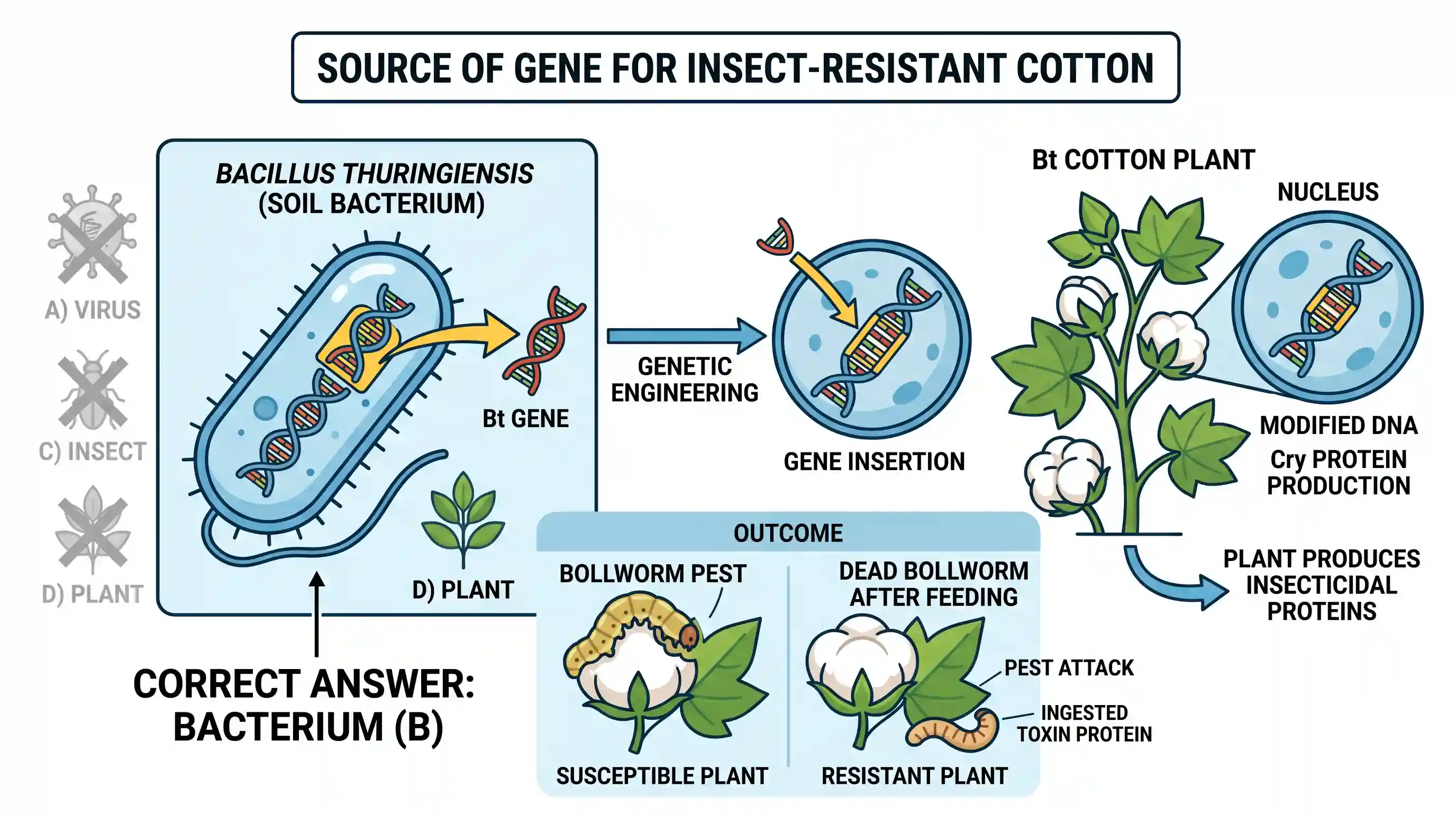
Insect resistant cotton plants have been genetically engineered by inserting a gene from a/an

- Avirus
- BbacteriumCorrect
- Cinsect
- Dplant
Explanation
The correct answer is B because the gene used to create insect resistant cotton, commonly known as Bt cotton, is derived from a soil bacterium called Bacillus thuringiensis.
This bacterium naturally produces specific proteins that are toxic to certain types of insects, such as bollworms. By inserting the gene responsible for these toxic proteins into the cotton plant DNA, the plant is able to produce its own pesticide, making it resistant to pest attacks without the need for excessive chemical sprays.
Related questions
More UPSC Prelims practice from the same subject and topic.
- Prelims 2000GS1science-and-technology
Hybridoma technology is a new biotechnological approach for commercial production of
- Prelims 2000GS1science-and-technology
Assertion (A): “DNA Finger-printing” has become a powerful tool to establish paternity and identity of criminals in rape and assault cases. Reason (R): Trace evidences such as hairs, saliva and dried …
- Prelims 2000GS1science-and-technology
Which one of the following does a TV remote control unit use to operate a TV set?
- Prelims 2000GS1science-and-technology
A noise level of 100 decibels would correspond to
- Prelims 2000GS1science-and-technology
A ‘black hole’ is a body in space which does not allow any radiation to come out. This property is due to its
- Prelims 2000GS1science-and-technology
The memory of a computer is commonly expressed in terms of Kilobytes or Megabytes. A byte is made up of