Hybridoma technology is a new biotechnological approach for commercial production of

- Amonoclonal antibodiesCorrect
- Binterferon
- Cantibodies
- Dalcohol
Explanation
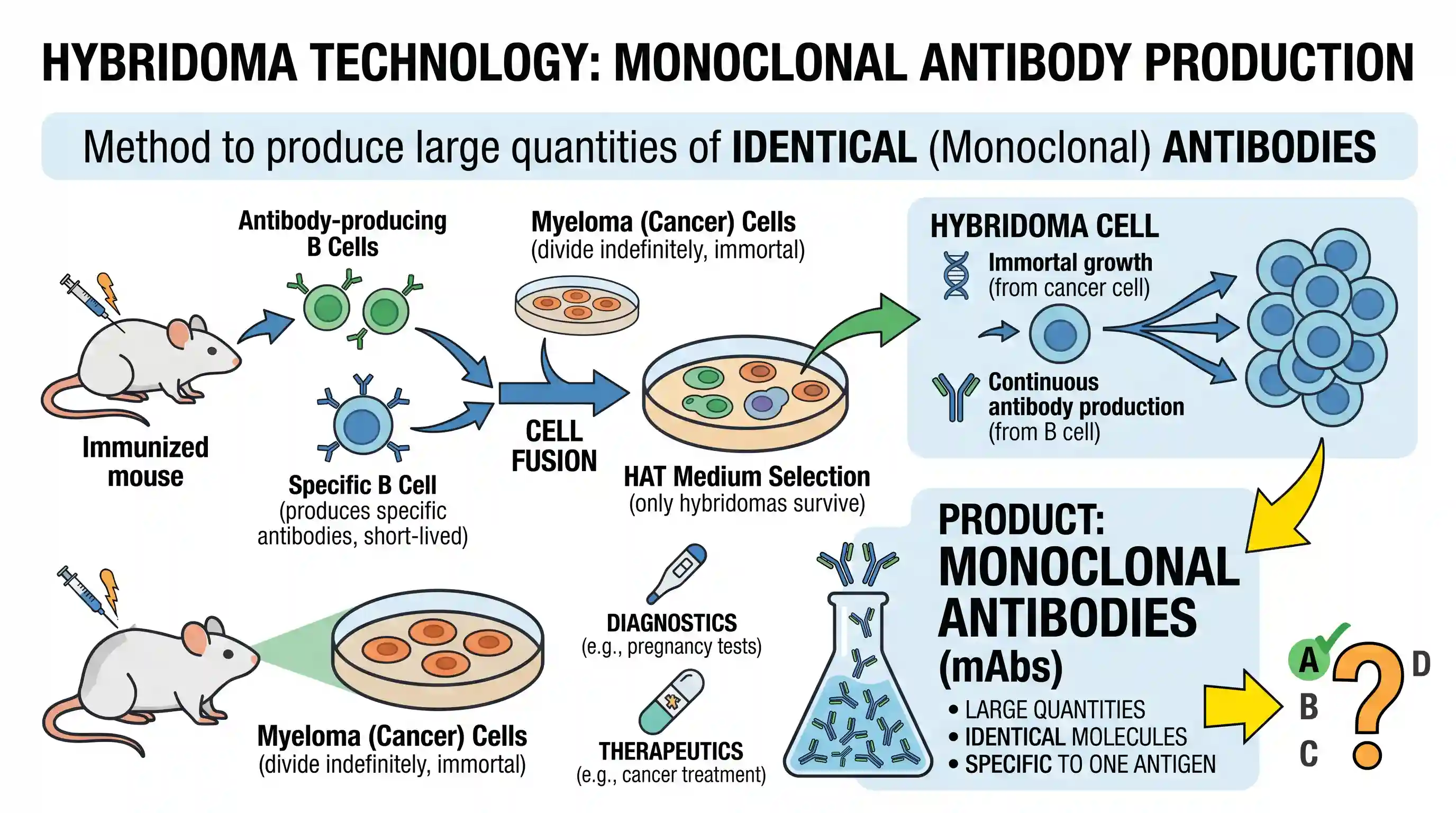
Hybridoma technology is a method used to produce monoclonal antibodies in large quantities. The process involves fusing short lived antibody producing B cells from a mammal with immortal myeloma cancer cells. The resulting hybrid cells, called hybridomas, possess the ability to produce a specific type of antibody continuously while growing indefinitely in a laboratory culture. This technology is essential for medical diagnostics, cancer treatment, and various therapeutic applications because it ensures a consistent supply of identical antibodies that target a single specific antigen.
Related questions
More UPSC Prelims practice from the same subject and topic.
- Prelims 2000GS1science-and-technology
Insect resistant cotton plants have been genetically engineered by inserting a gene from a/an
- Prelims 2000GS1science-and-technology
Assertion (A): “DNA Finger-printing” has become a powerful tool to establish paternity and identity of criminals in rape and assault cases. Reason (R): Trace evidences such as hairs, saliva and dried …
- Prelims 2000GS1science-and-technology
Which one of the following does a TV remote control unit use to operate a TV set?
- Prelims 2000GS1science-and-technology
A noise level of 100 decibels would correspond to
- Prelims 2000GS1science-and-technology
A ‘black hole’ is a body in space which does not allow any radiation to come out. This property is due to its
- Prelims 2000GS1science-and-technology
The memory of a computer is commonly expressed in terms of Kilobytes or Megabytes. A byte is made up of