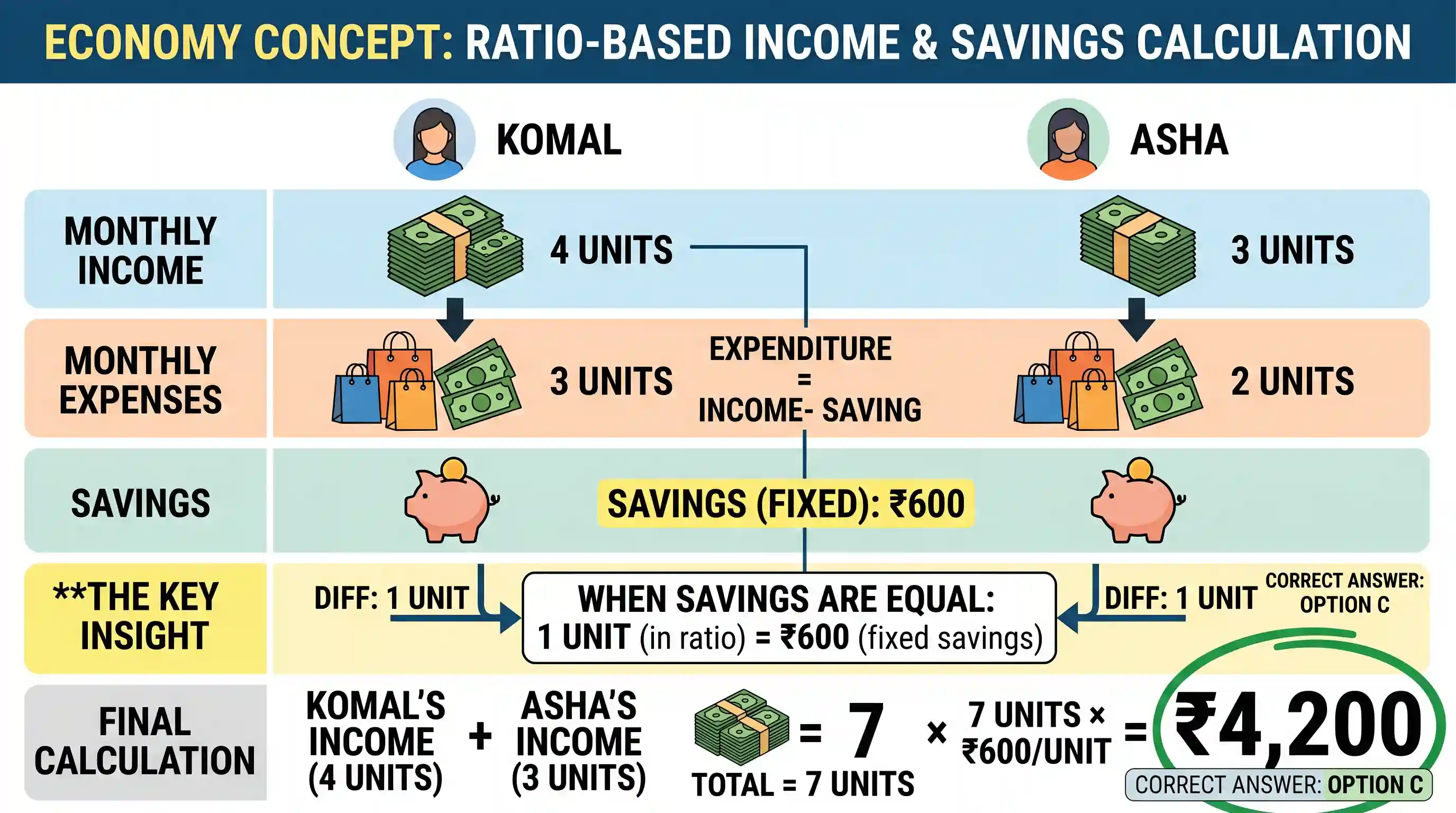
The monthly income of Komal and Asha are in the ratio of 4: 3. Their monthly expenses are in the ratio of 3: 2. However, both save Rs. 600 per month. What is their total monthly income?

- ARs. 8,400
- BRs. 5,600
- CRs. 4,200Correct
- DRs. 2,800
Explanation
Let the monthly income of Komal and Asha be 4x and 3x respectively. Their savings are equal at Rs. 600 each.
Since Income minus Savings equals Expenditure, we can represent their expenses as 4x minus 600 and 3x minus 600. The problem states the ratio of their expenses is 3 to 2.
Setting up the equation: 4x minus 600 divided by 3x minus 600 equals 3 divided by 2.
By cross-multiplying: 2 times (4x minus 600) equals 3 times (3x minus 600) 8x minus 1200 equals 9x minus 1800 Subtracting 8x from 9x and adding 1800 to minus 1200 gives x equals 600.
Komal's income is 4 times 600, which is 2400. Asha's income is 3 times 600, which is 1800. Total monthly income is 2400 plus 1800, which equals 4200.
Therefore, Option C is correct.
Related questions
More UPSC Prelims practice from the same subject and topic.
- Prelims 2000GS1economy
Match List I with List II and select the correct answer using the codes given below the Lists: I. Development Programme
- Prelims 2000GS1economy
The growth rate of per capita income at current prices is higher than that of per capita income at constant prices, because the latter takes into account the rate of
- Prelims 2000GS1economy
The upper part of the graph is a hypothetical movement in the BSE Sensex over a few months and the lower part is the fluctuation in the average value of automobile shares in the same period (actual va…
- Prelims 2000GS1economy
A rise in ‘SENSEX’ means
- Prelims 2000GS1economy
The new Gross Domestic Product (GDP) series released by the Central Statistical Organisation (CSO) in February 1999 is with reference to base price of
- Prelims 2000GS1economy
Match List I with List II and select the correct answer using the codes given below the Lists: List I List II I. Boom A) Business activity at high level with increasing income, output and employment a…