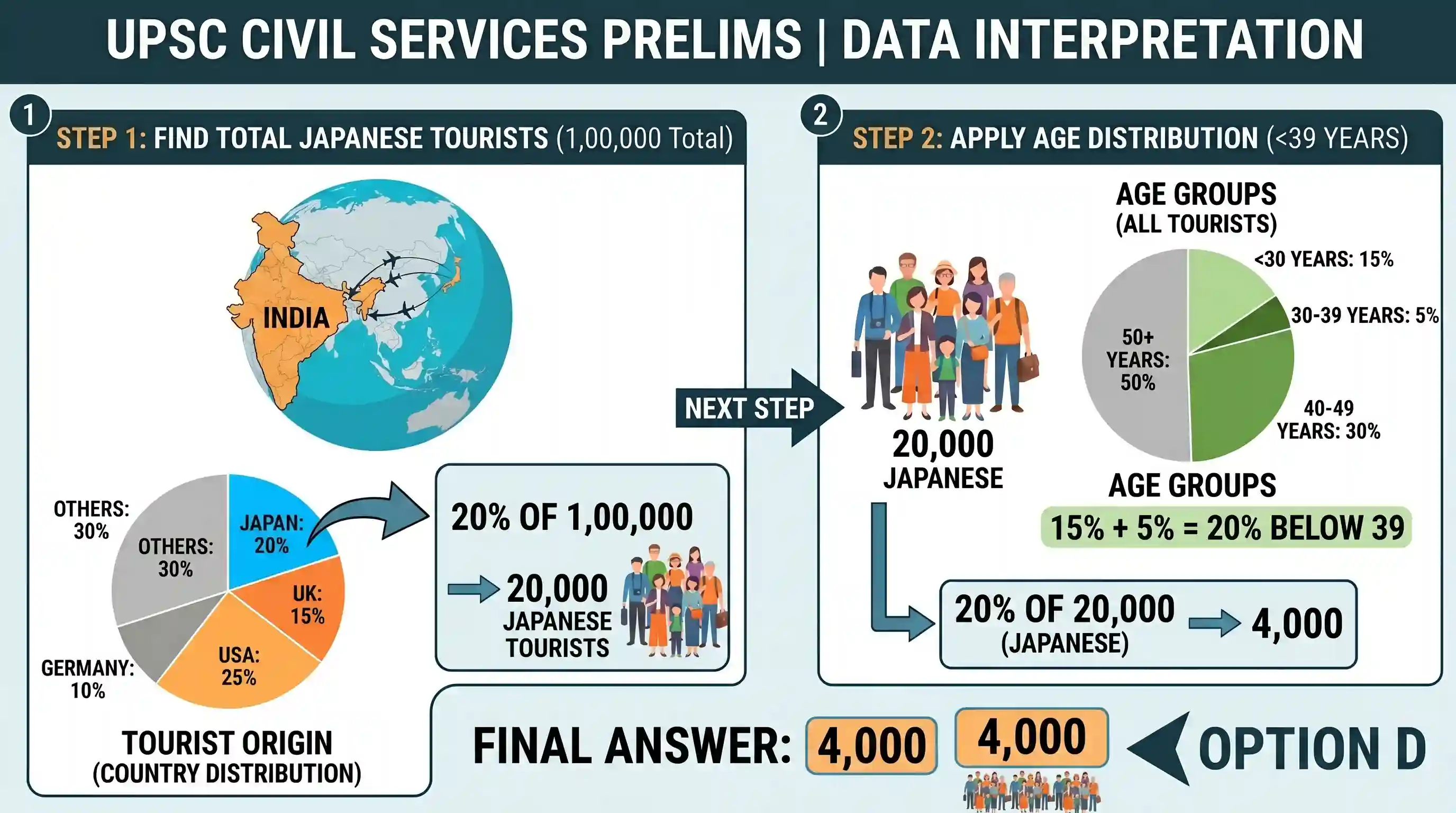
The distribution of 1,00,000 tourists who visited India during a particular year is shown in the given charts. Based on this, the number of Japanese tourists below the age of 39 who visited India in the year concerned is

- A10,000
- B8,000
- C6,000
- D4,000Correct
Explanation
To solve this question, we follow a two step calculation based on the data provided in the charts.
First, identify the total number of Japanese tourists. The chart for country distribution shows that Japanese tourists account for 20 percent of the total 1,00,000 tourists. Therefore, 20 percent of 1,00,000 equals 20,000 Japanese tourists.
Second, identify the age distribution for these Japanese tourists. The question asks for those below the age of 39. According to the age distribution chart, the age group under 30 accounts for 15 percent and the age group between 30 to 39 accounts for 5 percent. Combined, the percentage of tourists below 39 is 20 percent.
Finally, calculate 20 percent of the 20,000 Japanese tourists. This equals 4,000. Thus, 4,000 Japanese tourists below the age of 39 visited India. The correct option is D.
Related questions
More UPSC Prelims practice from the same subject and topic.
- Prelims 2000GS1geography
Match List I with List II and select the correct answer using the codes given below the Lists: List I (Minerals) I. Mineral oil II. Copper III. Manganese IV. Bauxite List II (Major producer) A) Zambia…
- Prelims 2000GS1geography
Which one of the following is known as the “Coffee port” of the world?
- Prelims 2000GS1geography
Consider the following statements about the megacities of India: I. Population of each megacity is more than 5 million. II. All the megacities are important sea ports. III. Megacities are either natio…
- Prelims 2000GS1geography
Which one of the following pairs of primitive tribes and places of their inhabitation is not correctly matched?
- Prelims 2000GS1geography
Consider the following statements about the megacities of India: I. Population of each megacity is more than 5 million. II. All the megacities are important sea ports. III. Megacities are either natio…
- Prelims 2000GS1geography
The best performance in terms of Human Development among the Asian countries is by