A person starts from a point A and travels 3 km eastwards to B and then turns left and travels thrice that distance to reach C. He again turns left and travels five times the distance he covered between A and B and reaches his destination D. The shortest distance between the starting point and destination is

- A18 km
- B16 km
- C15 kmCorrect
- D12 km
Explanation
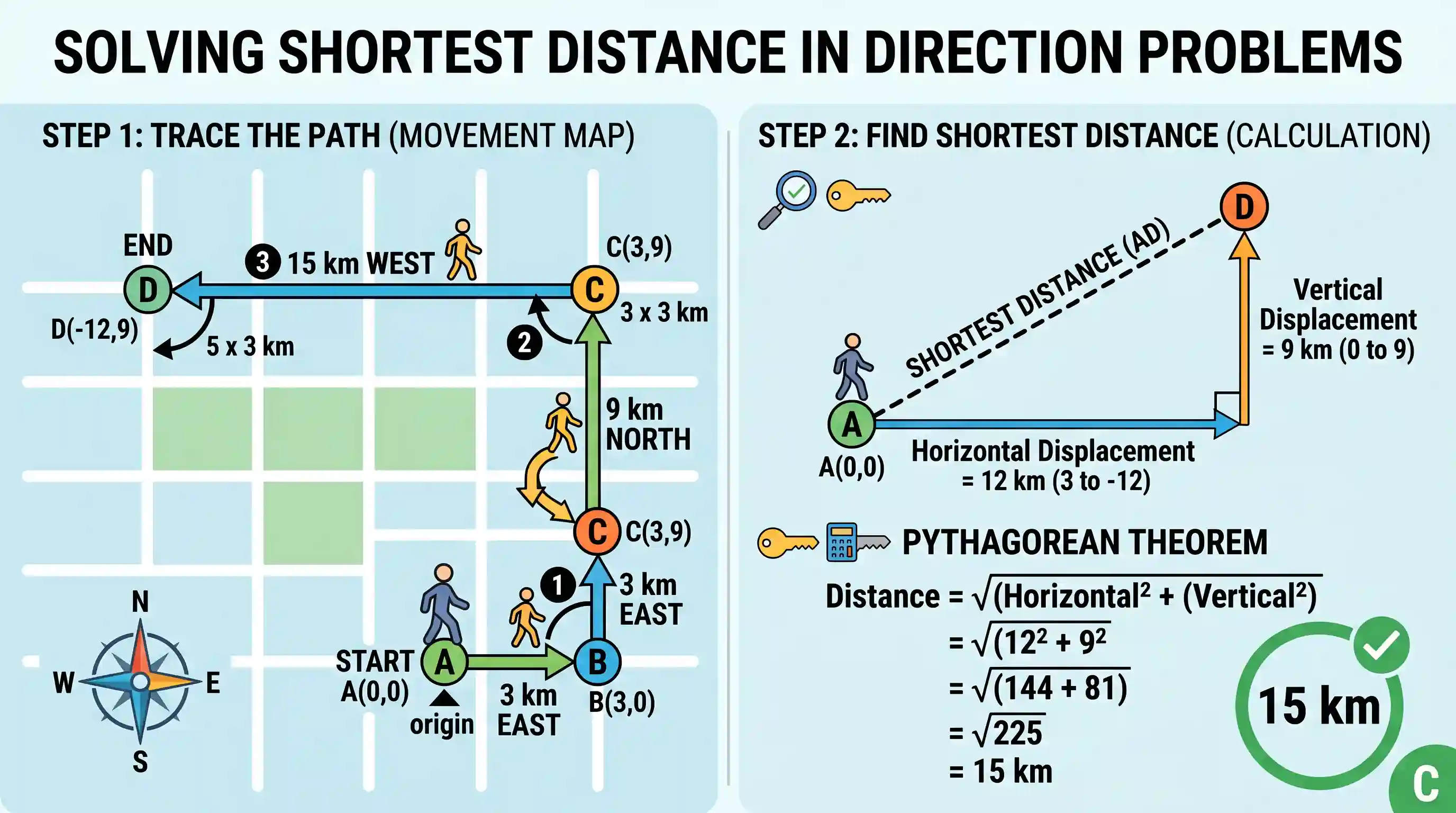
To solve this problem, we can track the movement of the person on a coordinate plane starting from point A at 0, 0.
Step 1: The person travels 3 km east to point B. The coordinates of B are 3, 0.
Step 2: He turns left north and travels thrice that distance 3 times 3 equals 9 km to reach C. The coordinates of C are 3, 9.
Step 3: He turns left west and travels five times the original distance 5 times 3 equals 15 km to reach D. Since he starts this leg at x coordinate 3 and moves 15 units west, his final x coordinate is 3 minus 15 which equals negative 12. The coordinates of D are negative 12, 9.
Step 4: The shortest distance between point A 0, 0 and point D negative 12, 9 is calculated using the Pythagorean theorem.
Distance equals the square root of the sum of the squares of the horizontal and vertical displacements. Horizontal displacement is 12 km. Vertical displacement is 9 km. Distance equals square root of 12 squared plus 9 squared. Distance equals square root of 144 plus 81. Distance equals square root of 225. Distance equals 15 km.
Therefore, the shortest distance is 15 km. Correct option is C.
Related questions
More UPSC Prelims practice from the same subject and topic.
- Prelims 2000GS1geography
Consider the following statements: I. Tides are of great help in navigation and fishing. II. High tide enables big ships to enter or leave the harbour safely. III. Tide prevents siltation in the harbo…
- Prelims 2000GS1geography
Which one of the following lakes forms an international boundary between Tanzania and Uganda?
- Prelims 2000GS1geography
A rectangular water tank measures 15 m x 6 m at top and is 10 m deep. It is full of water. If water is drawn out lowering the level by 1 metre, how much of water has been drawn out?
- Prelims 2000GS1geography
Along which one of the following meridians did India experience the first light of the sunrise of the new millennium?
- Prelims 2000GS1geography
Match List I with List II and select the correct answer using the codes given below the Lists: List I (Oceanic Trench) (Location) I. Aleutian A) Indian Ocean II. Kermadec B) North Pacific Ocean III. S…
- Prelims 2000GS1geography
Match the drainage basins labelled as A, B, C and D with the names listed below and select the correct answer using the codes given below the names of the drainage basins. 1. Ganga Brahmaputra 2. Indu…