In what way does the Indian Parliament exercise control over the administration?

- AThrough Consultative Committees of various ministries
- BThrough Parliamentary CommitteesCorrect
- CBy making the administrators send periodic reports
- DBy compelling the executive to issue writs
Explanation
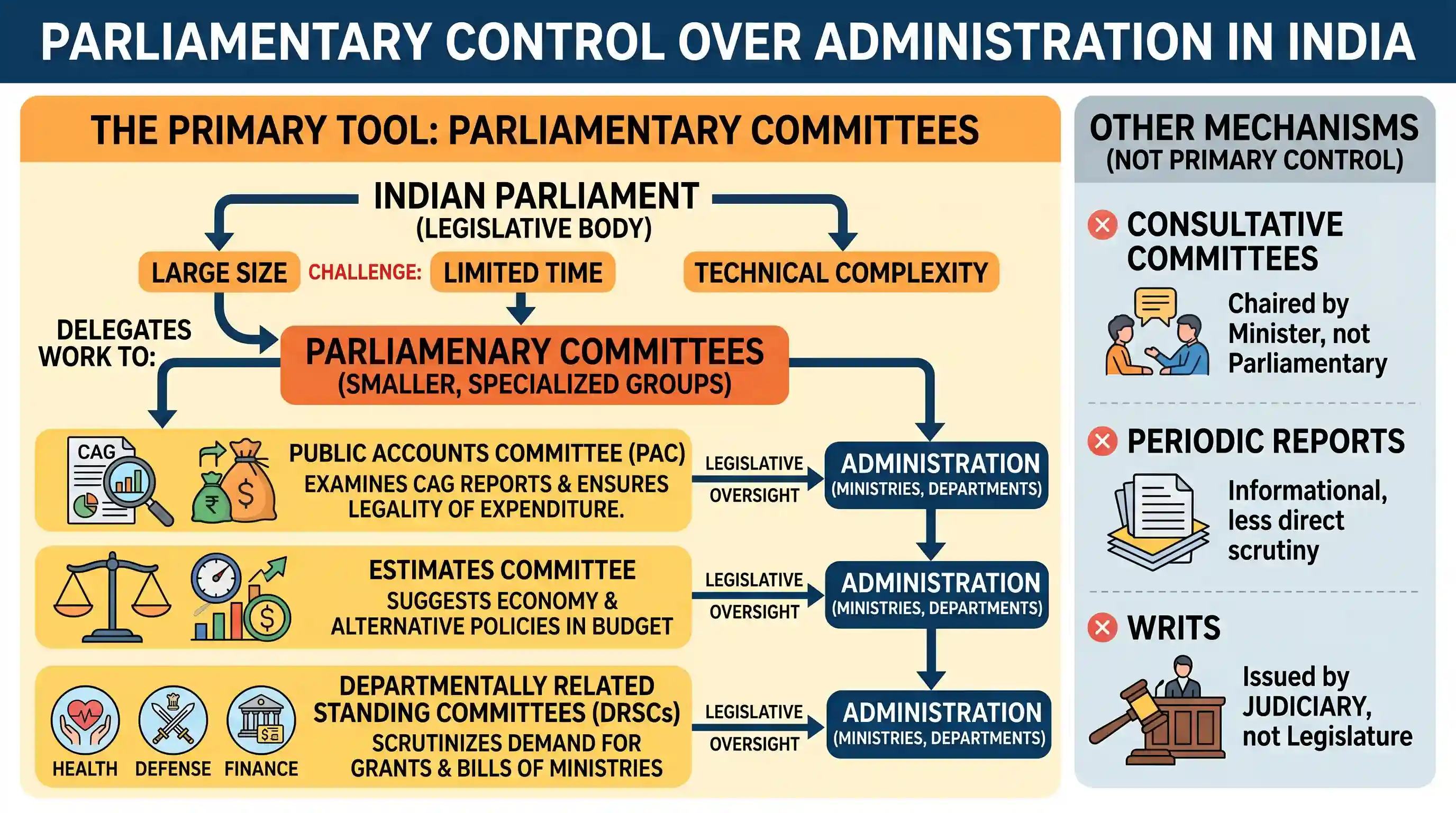
The Indian Parliament exercises control over the administration primarily through Parliamentary Committees. Since the Parliament is a large body and cannot oversee every day-to-day administrative action, it delegates this work to smaller committees such as the Public Accounts Committee, the Estimates Committee, and Departmentally Related Standing Committees. These committees examine the functioning of various ministries, scrutinize public expenditure, and hold the executive accountable for its actions. While Consultative Committees also exist, they are not parliamentary committees and do not have the same oversight powers. Similarly, administrators do not send periodic reports directly to Parliament as a primary control mechanism, and writs are issued by the judiciary, not the legislature. Therefore, Parliamentary Committees are the most direct and effective tool for legislative control over the administration.
Related questions
More UPSC Prelims practice from the same subject and topic.
- Prelims 2001GS1polity-and-governance
In which one of the following areas does the State Government NOT have control over its local bodies?
- Prelims 2001GS1polity-and-governance
Consider the following statements regarding the Armed Forces: I. First batch of women pilots was commissioned in Indian Air Force in 1996. II. Officers’ Training Academy is located in Nagpur. III. Sou…
- Prelims 2001GS1polity-and-governance
Which one of the following duties is NOT performed by the Comptroller and Auditor General of India?
- Prelims 2001GS1polity-and-governance
Consider the following statements about the minorities in India: I. The Government of India has notified five communities, namely, Muslims, Sikhs, Christians, Buddhists and Zoroastrians as Minorities.…
- Prelims 2001GS1polity-and-governance
Consider the following statements regarding the High Courts in India: I. There are eighteen High Courts in the country. II. Three of them have jurisdiction over more than one State. III. No Union Terr…
- Prelims 2001GS1polity-and-governance
Mekong Ganga Cooperation Project is