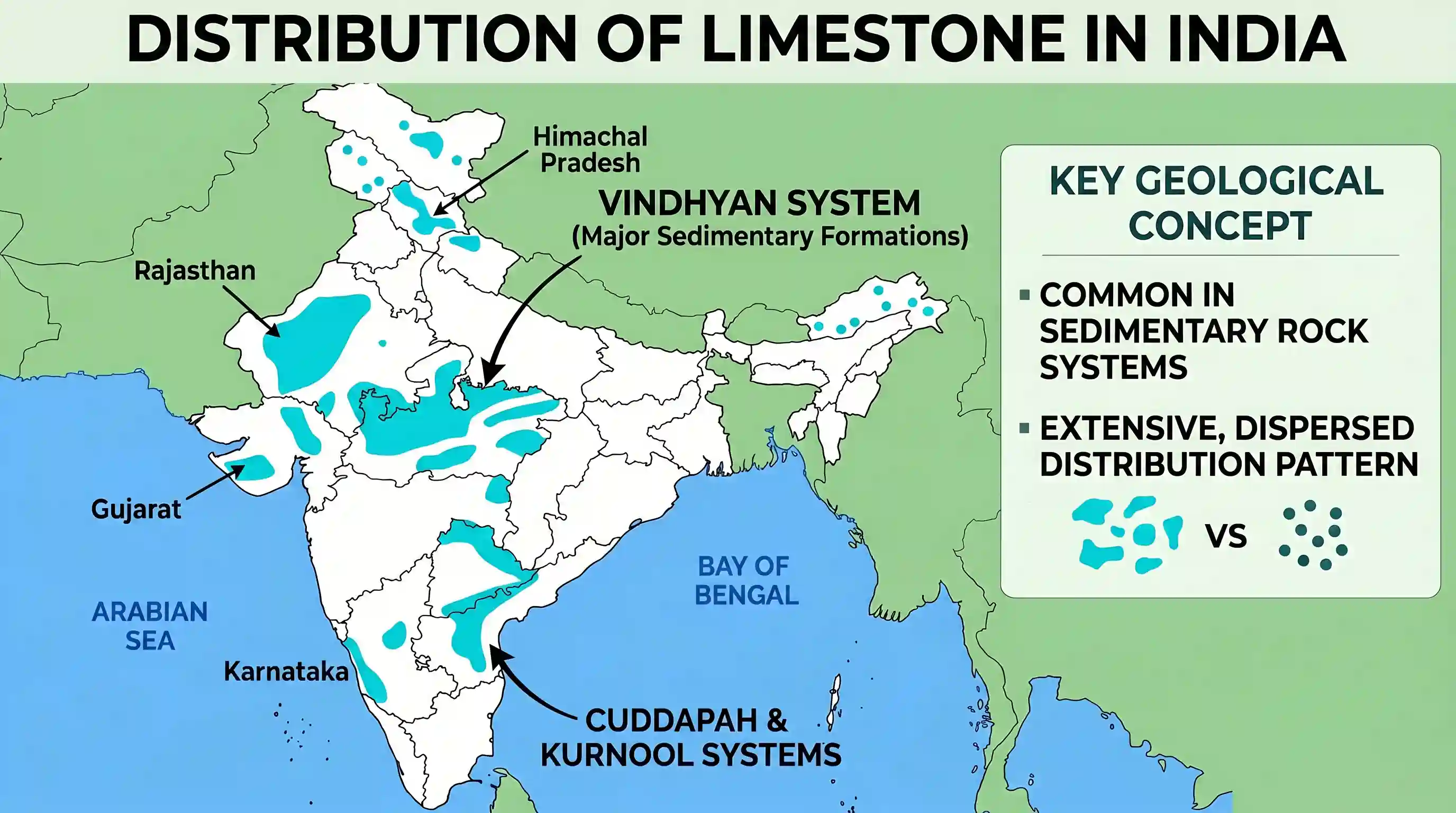
In the above map, the black marks show the distribution of

- AAsbestos
- BGypsum
- CLimestoneCorrect
- DMica
Explanation
The map represents the distribution of Limestone in India. This is because the highlighted areas coincide with major sedimentary rock formations across the country. Limestone is primarily found in the Cuddapah and Kurnool systems of Andhra Pradesh, the Vindhyan system in Madhya Pradesh and Rajasthan, and parts of Karnataka, Gujarat, and Himachal Pradesh. The other minerals listed, such as Mica or Asbestos, have much more localized and specific distribution patterns that do not cover the extensive regions shown in the map.
Related questions
More UPSC Prelims practice from the same subject and topic.
- Prelims 2001GS1geography
The above map is the Union Territory of
- Prelims 2001GS1geography
Consider the decadal Census data given below: Decadal Population (in millions) Population 1961 10.7 1971 14.3 1981 16.2 1991 18.9 The above data refer to which one of the ‘Population by Religion’ Grou…
- Prelims 2001GS1geography
Identify the correct order of the processes of soil erosion from the following:
- Prelims 2001GS1geography
The temperature and rainfall of a meteorological station are given below: J F M A M J J A S O N D Temperature (°C) 9.4 10.6 11.7 12.2 13.3 13.9 13.9 14.4 15.6 15.0 13.3 10.6 Rainfall (cm) 12.2 9.1 7.9…
- Prelims 2001GS1geography
Match List I with List II and select the correct answer using the codes given below the Lists: List I (Local Wind) (Region) I. Fohn A) Argentina II. Samun B) Kurdistan III. Santa Ana C) California IV.…
- Prelims 2001GS1geography
The largest number of Buddhists is found in