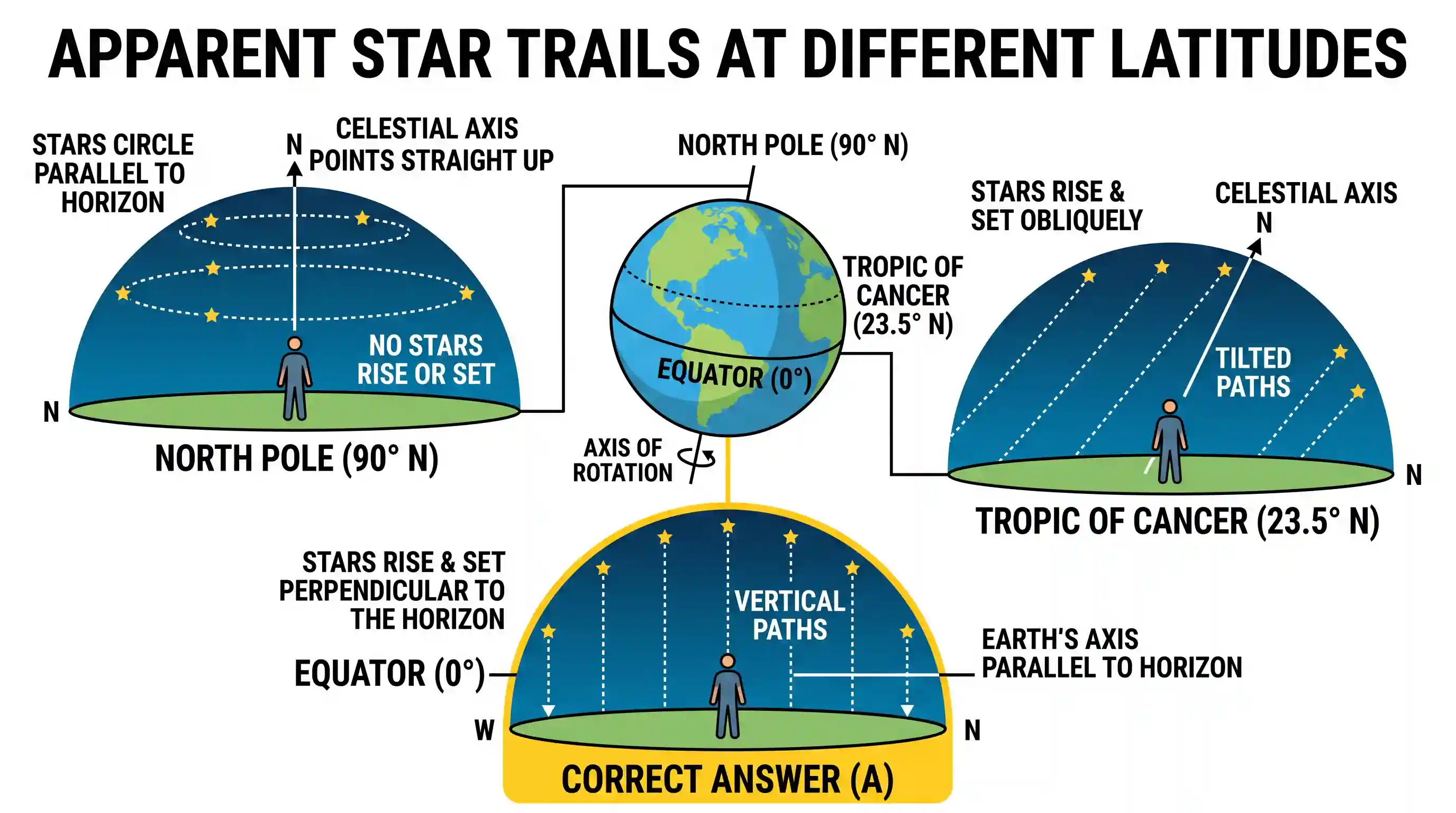
If the stars are seen to rise perpendicular to the horizon by an observer, he is located on the

- AEquatorCorrect
- BTropic of Cancer
- CSouth Pole
- DNorth Pole
Explanation
The movement of stars across the sky is a reflection of the Earths rotation on its axis. At the Equator, the Earths axis of rotation is parallel to the horizon. Because stars move in paths that are parallel to the celestial equator, an observer at the Equator sees them rising vertically or perpendicular to the horizon. In contrast, at the Poles, stars appear to move in circles parallel to the horizon, and at mid latitudes, they rise at an oblique angle. Therefore, the Equator is the only location where all stars rise and set perpendicular to the horizon.
Related questions
More UPSC Prelims practice from the same subject and topic.
- Prelims 2001GS1geography
A great landslide caused by an earthquake killed hundreds of people in January 2001 near
- Prelims 2001GS1geography
A class of animals known as Marsupials is a characteristic feature of
- Prelims 2001GS1geography
A person travels from X to Y at a speed of 40 kmph and returns by increasing his speed by 50%. What is his average speed for both the trips?
- Prelims 2001GS1geography
Consider the decadal Census data given below: Decadal Population (in millions) Population 1961 10.7 1971 14.3 1981 16.2 1991 18.9 The above data refer to which one of the ‘Population by Religion’ Grou…
- Prelims 2001GS1geography
The above map is the Union Territory of
- Prelims 2001GS1geography
Identify the correct order of the processes of soil erosion from the following: