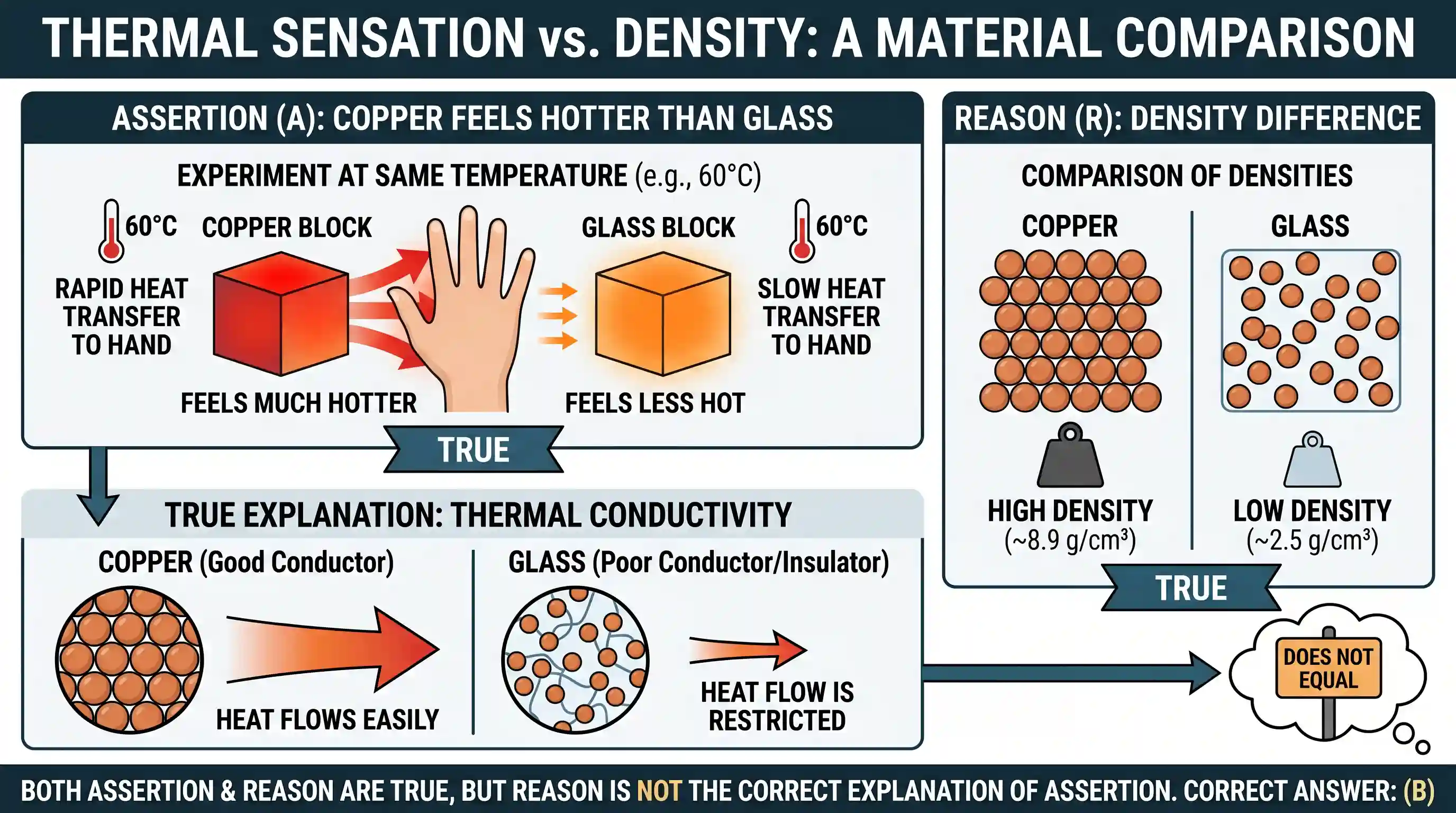
Assertion (A): A piece of copper and a piece of glass are heated to the same temperature. When touched, thereafter, the copper piece appears hotter than the glass piece. Reason (R): The density of copper is more than that of glass.

- ABoth A and R are individually true and R is the correct explanation of A
- BBoth A and R are individually true but R is NOT a correct explanation of ACorrect
- CA is true but R is false
- DA is false but R is true
Explanation
The assertion is true because copper is a much better conductor of heat than glass. When you touch both materials at the same high temperature, copper transfers heat to your hand much faster than glass does, making it feel hotter.
The reason is also factually true as the density of copper (approximately 8.9 g/cm³) is indeed higher than that of glass (approximately 2.5 g/cm³). However, density is not the property that determines how hot an object feels when touched. Thermal conductivity is the property responsible for this sensation. Therefore, while both the assertion and the reason are individually true, the reason is not the correct explanation for the assertion.
Related questions
More UPSC Prelims practice from the same subject and topic.
- Prelims 2001GS1science-and-technology
Consider the following organisations: I. Atomic Minerals Directorate for Research and Exploration II. Heavy Water Board III. Indian Rare Earths Limited IV. Uranium Corporation of India Which of these …
- Prelims 2001GS1science-and-technology
Who amongst the following was the Chairman of ISRO when INSAT3B was launched?
- Prelims 2001GS1science-and-technology
The theme of Indian Science Congress, 2001 was
- Prelims 2001GS1science-and-technology
Match List I with List II and select the correct answer using the codes given below the Lists: List I List II (Institute) (Location) I. Central Institute of Medicinal and Aromatic Plants A) Chandigarh…
- Prelims 2001GS1science-and-technology
The range of Agni-II missile is around
- Prelims 2001GS1science-and-technology
Two wires have their lengths, diameters and resistivities, all in the ratio of 1: 2. If the resistance of the thinner wire is 10 ohms, the resistance of the thicker wire is