Consider the following statements: I. Tapeworm is a hermaphrodite. II. Round-worm has separate sexes. III. Filaria is caused by a nematode. IV. Guinea worm is an annelid. Which of these are correct?

- AI and II
- BI, II and IIICorrect
- CIII and IV
- DII, III and IV
Explanation
The correct answer is B because the first three statements are biologically accurate while the fourth is incorrect.
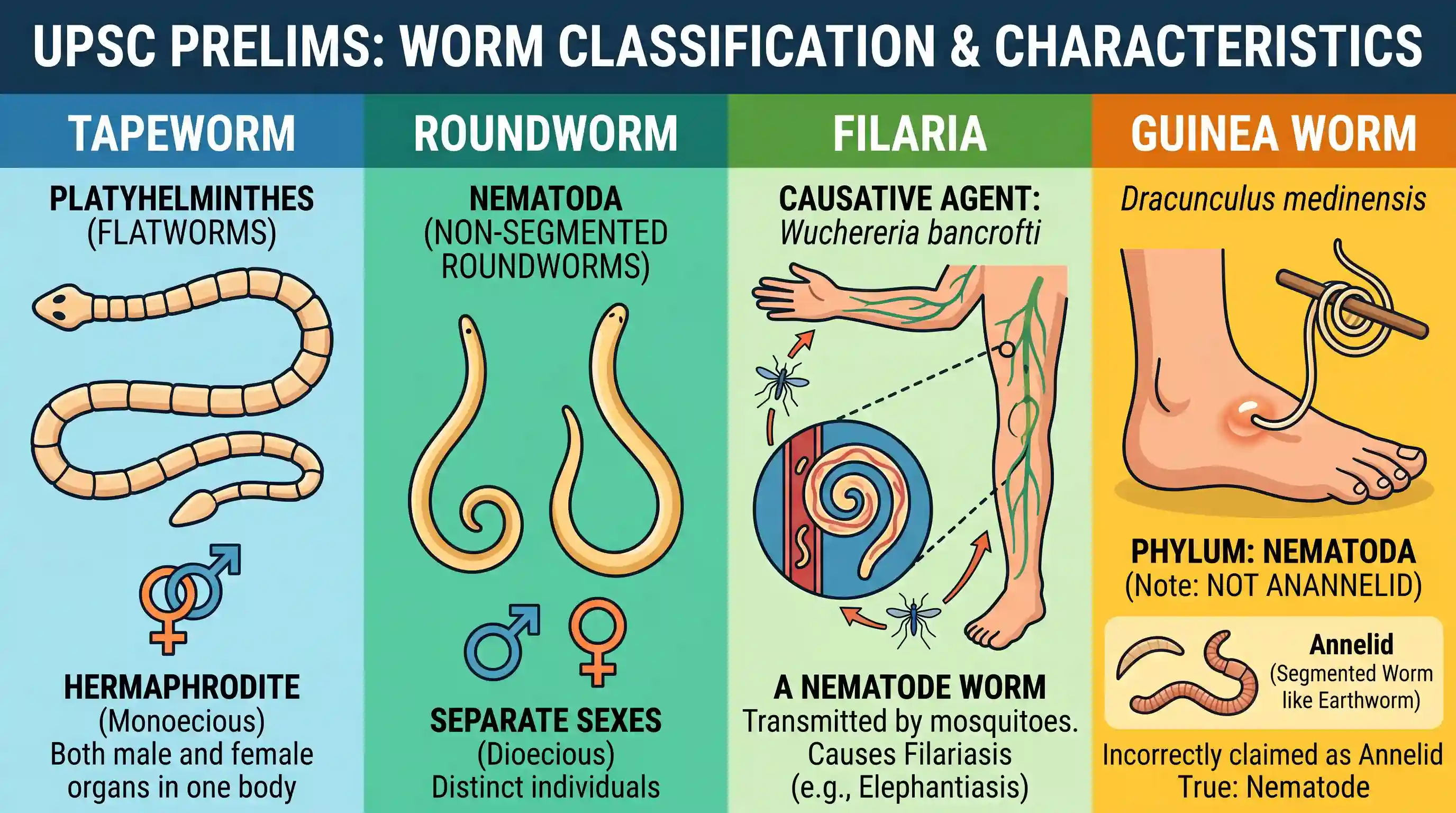
Statement I is correct because Tapeworms belong to the phylum Platyhelminthes and possess both male and female reproductive organs in the same body, making them hermaphrodites.
Statement II is correct because Roundworms belong to the phylum Nematoda and typically have distinct male and female individuals, a condition known as dioecious.
Statement III is correct because Filaria is caused by Wuchereria bancrofti, which is a type of nematode or roundworm.
Statement IV is incorrect because Guinea worm, or Dracunculus medinensis, is actually a nematode and not an annelid. Annelids are segmented worms like earthworms and leeches.
Related questions
More UPSC Prelims practice from the same subject and topic.
- Prelims 2001GS1science-and-technology
The theme of Indian Science Congress, 2001 was
- Prelims 2001GS1science-and-technology
Match List I with List II and select the correct answer using the codes given below the Lists: List I List II (Institute) (Location) I. Central Institute of Medicinal and Aromatic Plants A) Chandigarh…
- Prelims 2001GS1science-and-technology
Two wires have their lengths, diameters and resistivities, all in the ratio of 1: 2. If the resistance of the thinner wire is 10 ohms, the resistance of the thicker wire is
- Prelims 2001GS1science-and-technology
Assertion (A): A stick is dipped in water in a slanting position. If observed sideways, the stick appears short and bent at the surface of water. Reason (R): The light coming from the stick undergoes …
- Prelims 2001GS1science-and-technology
When light waves pass from air to glass, the variables affected are
- Prelims 2001GS1science-and-technology
When water is heated from 0°C to 10°C, its volume