A man whose blood group is not known meets with a serious accident and needs blood transfusion immediately. Which one of the blood groups mentioned below and readily available in the hospital will be safe for transfusion?

- AO, Rh-
- BO, Rh+Correct
- CAB, Rh-
- DAB, Rh+
Explanation
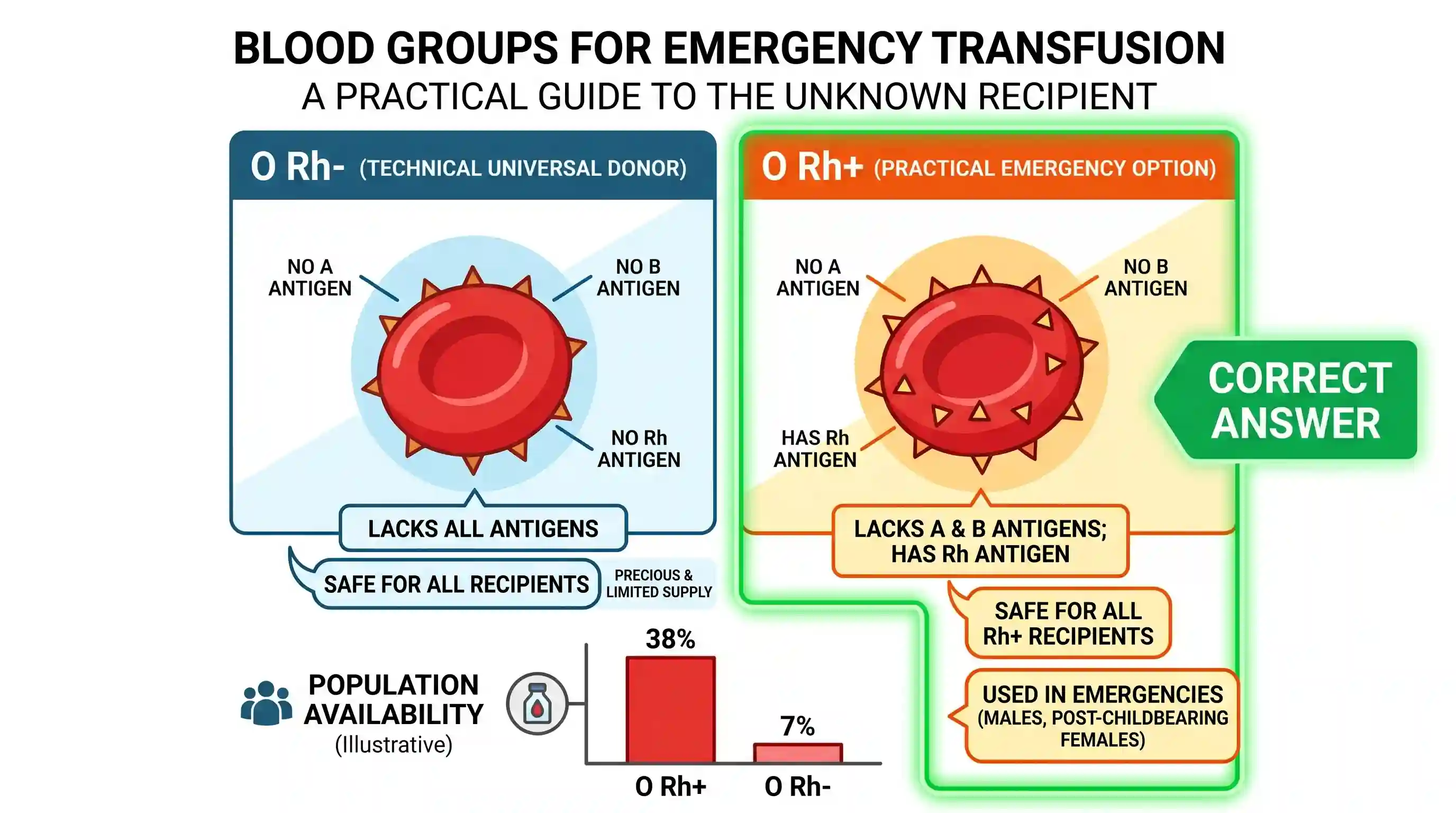
The correct answer is B. Blood group O negative is traditionally known as the universal donor because it lacks A, B, and Rh antigens, meaning it can be given to anyone regardless of their blood type. However, in emergency medical scenarios where the exact blood type is unknown, O positive is often the most readily available and practical choice. While O negative is technically the safest for everyone, O positive is much more common in the population and is used in emergency situations for males or females past childbearing age to preserve the limited supply of O negative blood. Therefore, in the context of standard hospital availability and emergency protocols, O positive is frequently used as the immediate safe option for stabilization.
Related questions
More UPSC Prelims practice from the same subject and topic.
- Prelims 2001GS1science-and-technology
The theme of Indian Science Congress, 2001 was
- Prelims 2001GS1science-and-technology
Match List I with List II and select the correct answer using the codes given below the Lists: List I List II (Institute) (Location) I. Central Institute of Medicinal and Aromatic Plants A) Chandigarh…
- Prelims 2001GS1science-and-technology
Two wires have their lengths, diameters and resistivities, all in the ratio of 1: 2. If the resistance of the thinner wire is 10 ohms, the resistance of the thicker wire is
- Prelims 2001GS1science-and-technology
Assertion (A): A stick is dipped in water in a slanting position. If observed sideways, the stick appears short and bent at the surface of water. Reason (R): The light coming from the stick undergoes …
- Prelims 2001GS1science-and-technology
When light waves pass from air to glass, the variables affected are
- Prelims 2001GS1science-and-technology
When water is heated from 0°C to 10°C, its volume