Solve the given equations: x2 + y2 = 34 x4 - y4 = 544 The values of x and y are

- A±4, ±3
- B±5, ±3Correct
- C±3, ±5
- D±3, ±4
Explanation
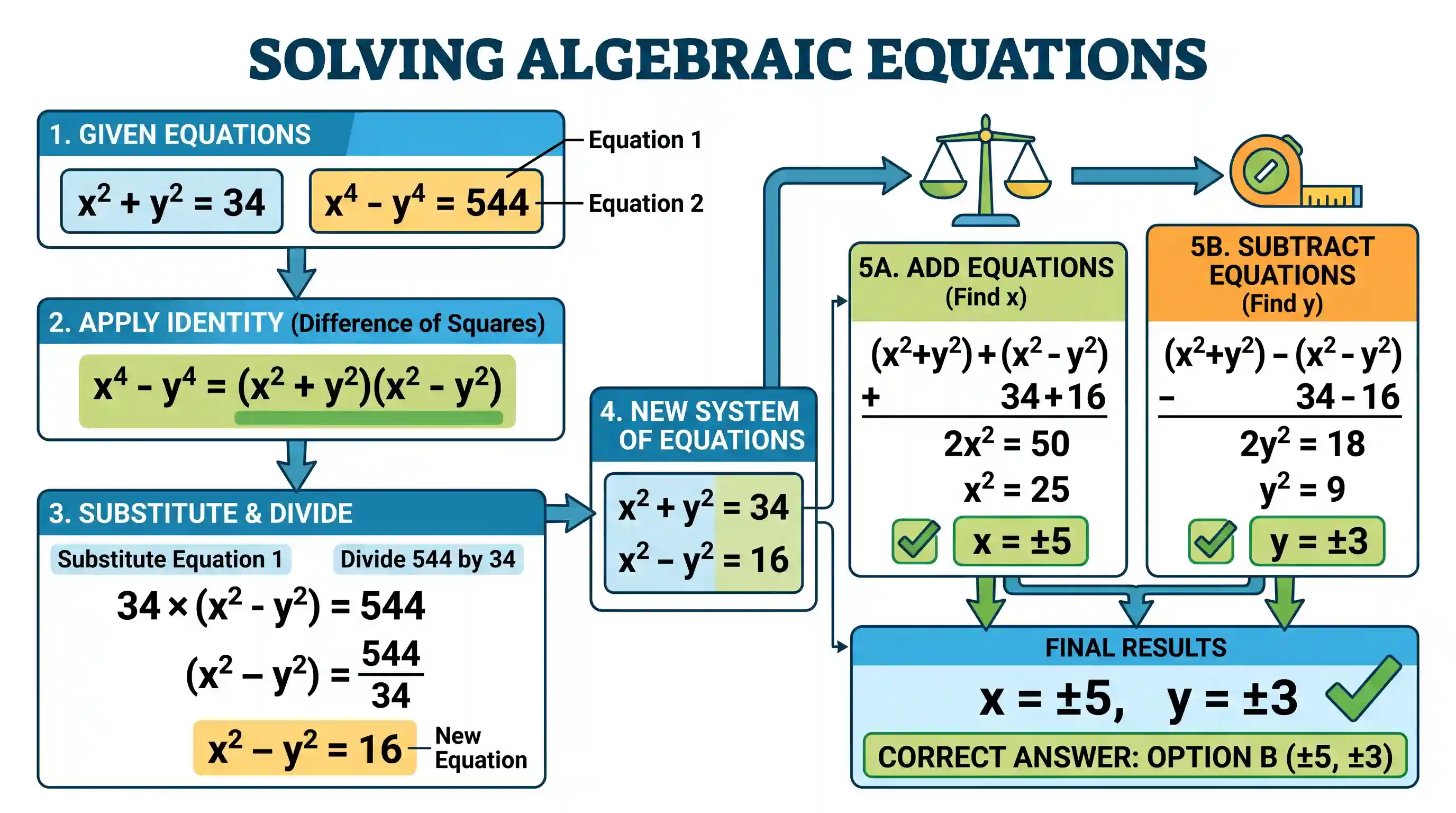
To solve this problem, use the algebraic identity for the difference of squares: x raised to the power of 4 minus y raised to the power of 4 can be written as the product of x squared plus y squared and x squared minus y squared.
Given that x squared plus y squared equals 34, substitute this into the equation 544 equals 34 times the quantity x squared minus y squared. Dividing 544 by 34 gives 16. Therefore, x squared minus y squared equals 16.
Now you have two simple equations:
- x squared plus y squared equals 34
- x squared minus y squared equals 16
Adding these two equations gives 2 times x squared equals 50, so x squared equals 25. This means x equals plus or minus 5.
Subtracting the second equation from the first gives 2 times y squared equals 18, so y squared equals 9. This means y equals plus or minus 3.
Thus, the values are x equals plus or minus 5 and y equals plus or minus 3, which corresponds to option B.
Related questions
More UPSC Prelims practice from the same subject and topic.
- Prelims 2001GS1science-and-technology
The theme of Indian Science Congress, 2001 was
- Prelims 2001GS1science-and-technology
Match List I with List II and select the correct answer using the codes given below the Lists: List I List II (Institute) (Location) I. Central Institute of Medicinal and Aromatic Plants A) Chandigarh…
- Prelims 2001GS1science-and-technology
Two wires have their lengths, diameters and resistivities, all in the ratio of 1: 2. If the resistance of the thinner wire is 10 ohms, the resistance of the thicker wire is
- Prelims 2001GS1science-and-technology
Assertion (A): A stick is dipped in water in a slanting position. If observed sideways, the stick appears short and bent at the surface of water. Reason (R): The light coming from the stick undergoes …
- Prelims 2001GS1science-and-technology
When light waves pass from air to glass, the variables affected are
- Prelims 2001GS1science-and-technology
When water is heated from 0°C to 10°C, its volume