Consider the volumes of the following: 1. A parallelepiped of length 5 cm, breadth 3 cm and height 4 cm 2. A cube of each side 4 cm 3. A cylinder of radius 3 cm and length 3 cm 4. A sphere of radius 3 cm The volumes of these in the decreasing order is

- Aa) I, III, II, IV
- Bb) IV, II, III, I
- Cc) I, II, III, IV
- Dd) IV, III, II, ICorrect
Explanation
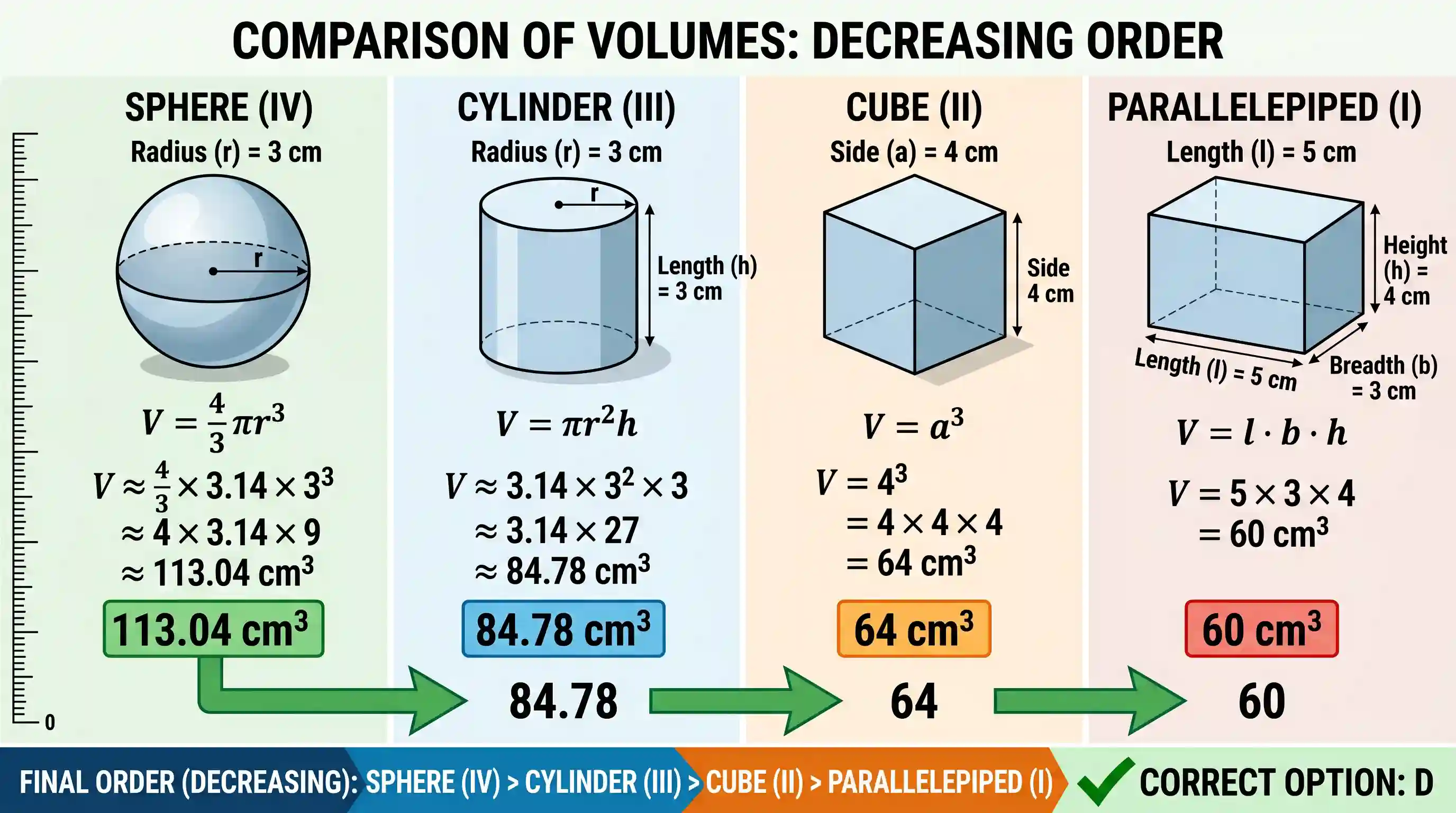
To find the decreasing order of the volumes, we calculate each individually using the approximate value of pi as 3.14.
-
Parallelepiped volume is length times breadth times height. 5 times 3 times 4 equals 60 cubic cm.
-
Cube volume is side cubed. 4 times 4 times 4 equals 64 cubic cm.
-
Cylinder volume is pi times radius squared times length. 3.14 times 3 squared times 3 equals 3.14 times 27, which is approximately 84.78 cubic cm.
-
Sphere volume is four-thirds times pi times radius cubed. 4/3 times 3.14 times 3 cubed equals 4 times 3.14 times 9, which is approximately 113.04 cubic cm.
Comparing the results: Sphere (113.04) is greater than Cylinder (84.78), which is greater than Cube (64), which is greater than Parallelepiped (60).
The decreasing order is IV, III, II, I. Therefore, option D is correct.
Related questions
More UPSC Prelims practice from the same subject and topic.
- Prelims 2002GS1science-and-technology
A complete cycle of a traffic light takes 60 seconds. During each cycle the light is green for 25 second, yellow for 5 second and red for 30 second. At a randomly chosen time, the probability that the…
- Prelims 2002GS1science-and-technology
A solid cube just gets completely immersed in water when a 0.2 kg mass is placed on it. If the mass is removed, the cube is 2 cm about the water level. What is the length of each side of the cube?
- Prelims 2002GS1science-and-technology
Ticks and mites are actually
- Prelims 2002GS1science-and-technology
With reference to the blood in a normal person, which one of the following statements is correct?
- Prelims 2002GS1science-and-technology
Which one of the following statements is correct?
- Prelims 2002GS1science-and-technology
Consider the following plants: 1. Bougainvillea 2. Carnations 3. Cocoa 4. Grapes Which of these plants are propagated by stem cuttings?