A solid cube just gets completely immersed in water when a 0.2 kg mass is placed on it. If the mass is removed, the cube is 2 cm about the water level. What is the length of each side of the cube?

- A12 cm
- B10 cmCorrect
- C8 cm
- D6 cm
Explanation
Let the side of the cube be L centimeters.
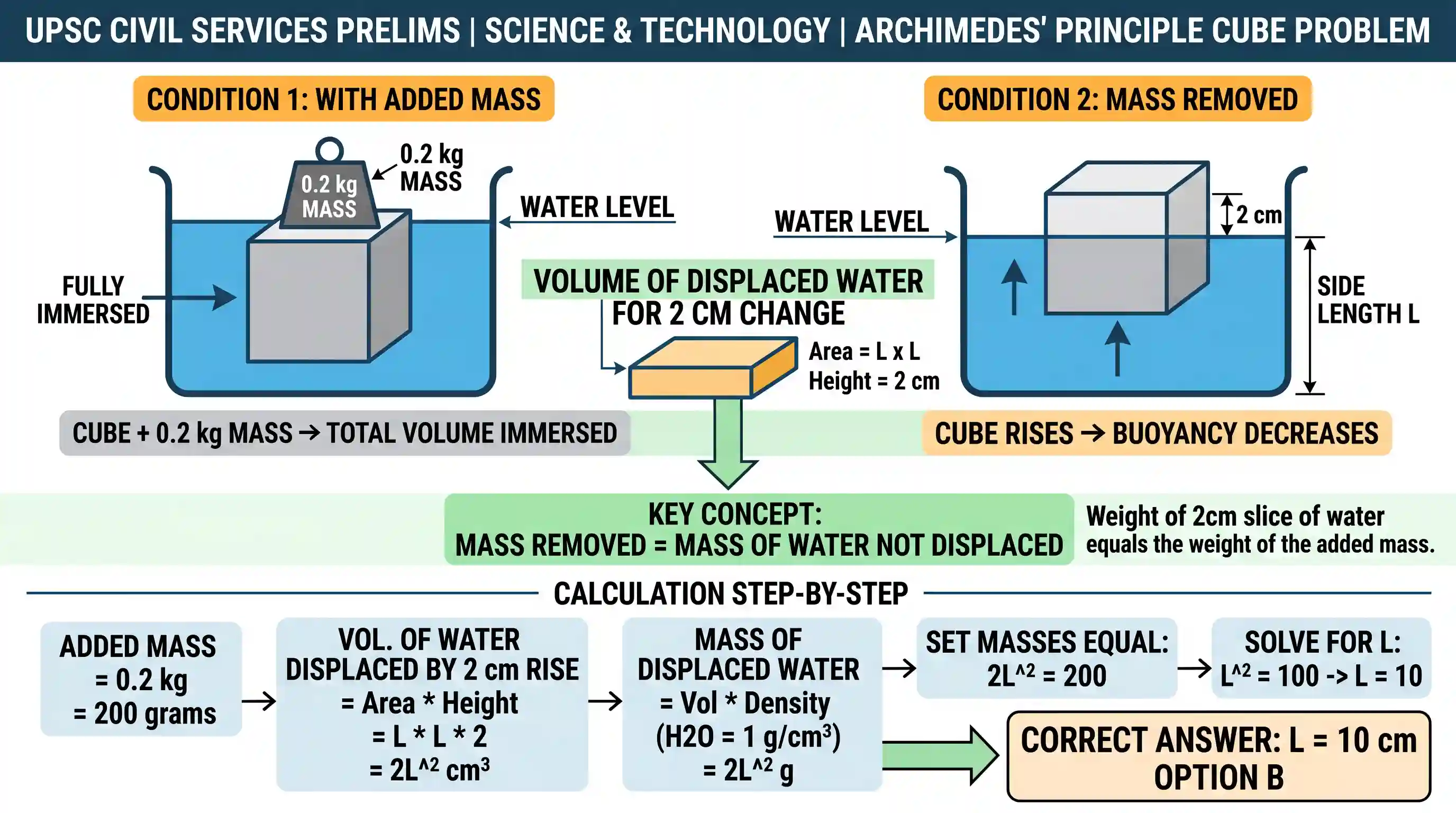
When the 0.2 kg mass is removed, the cube rises by 2 cm. This means that the weight of the 0.2 kg mass was exactly equal to the weight of the water displaced by that 2 cm height of the cube.
According to Archimedes Principle, the weight of the added mass equals the weight of the water displaced by the volume that submerged because of that mass.
The volume of the water displaced by the 2 cm height is the area of the base times the height, which is L times L times 2 cubic centimeters.
The mass of water displaced is its volume multiplied by its density. Since the density of water is 1 gram per cubic centimeter, the mass of the displaced water in grams is 2 times L squared.
The mass placed on the cube was 0.2 kg, which is 200 grams.
Setting the mass of the displaced water equal to the added mass: 2 times L squared equals 200. L squared equals 100. L equals 10.
Therefore, the length of each side of the cube is 10 cm.
Correct Answer: B
Related questions
More UPSC Prelims practice from the same subject and topic.
- Prelims 2002GS1science-and-technology
A complete cycle of a traffic light takes 60 seconds. During each cycle the light is green for 25 second, yellow for 5 second and red for 30 second. At a randomly chosen time, the probability that the…
- Prelims 2002GS1science-and-technology
Consider the volumes of the following: 1. A parallelepiped of length 5 cm, breadth 3 cm and height 4 cm 2. A cube of each side 4 cm 3. A cylinder of radius 3 cm and length 3 cm 4. A sphere of radius 3…
- Prelims 2002GS1science-and-technology
Ticks and mites are actually
- Prelims 2002GS1science-and-technology
With reference to the blood in a normal person, which one of the following statements is correct?
- Prelims 2002GS1science-and-technology
Which one of the following statements is correct?
- Prelims 2002GS1science-and-technology
Consider the following plants: 1. Bougainvillea 2. Carnations 3. Cocoa 4. Grapes Which of these plants are propagated by stem cuttings?