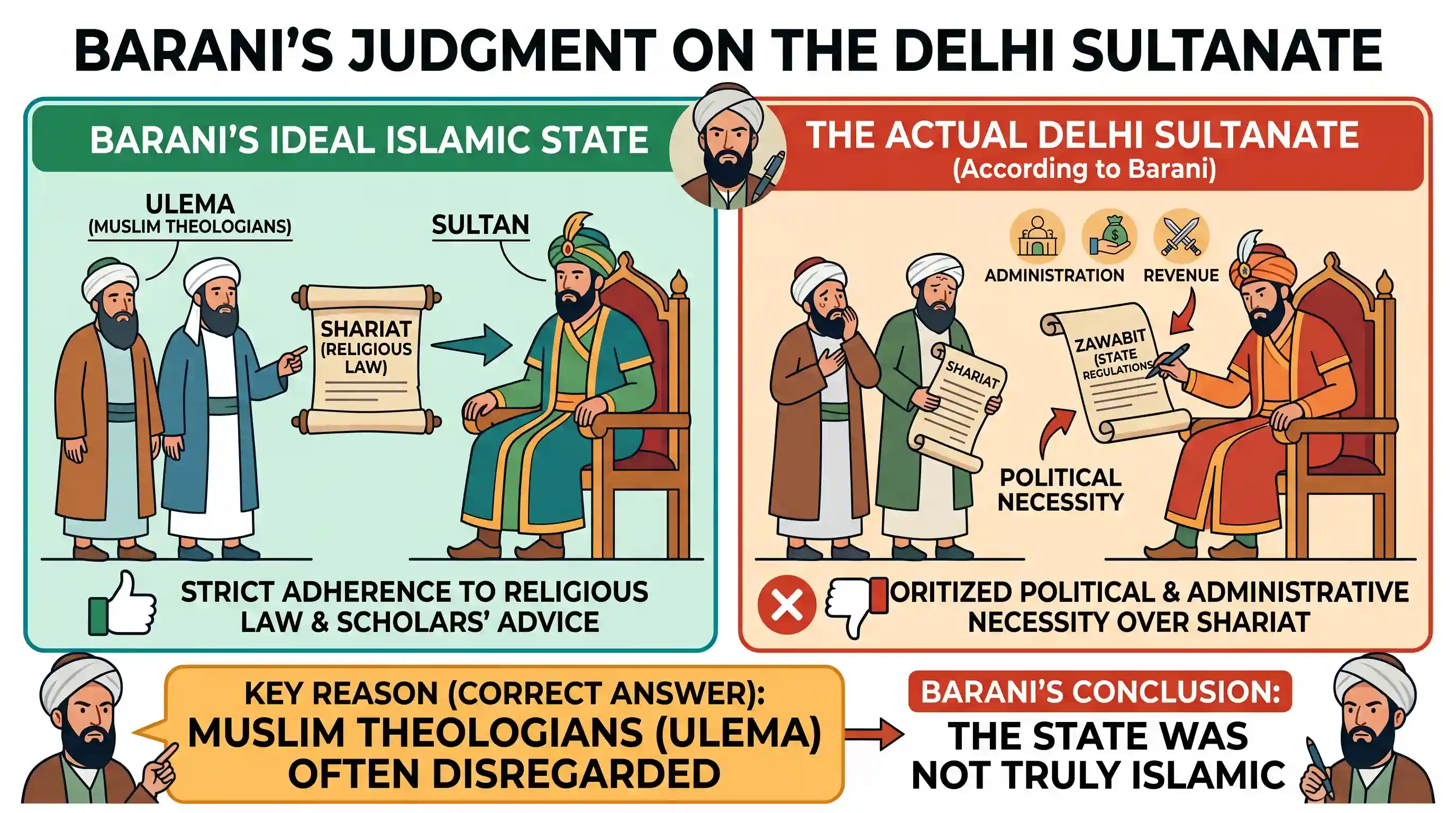
The historian Barani refused to consider the state in India under Delhi Sultans as truly Islamic because

- Athe majority of the population did not follow Islam
- Bthe Muslims theologists were often disregardedCorrect
- Cthe Sultan supplemented the Muslim law by framing his own regulations
- Dreligious freedom was accorded to non-Muslims
Explanation
Ziauddin Barani, a contemporary chronicler of the Delhi Sultanate, was a staunch conservative who believed that the state should be governed strictly according to the Shariat and the advice of the Ulema. He criticized the Delhi Sultans because they often prioritized political necessity and administrative stability over religious dictates. According to Barani, the Sultans were more concerned with secular state laws known as Zawabit and frequently ignored the opinions of Muslim theologians when making policy decisions. Therefore, he argued the state was not truly Islamic because the religious scholars did not hold the ultimate influence over the Sultans actions.
Related questions
More UPSC Prelims practice from the same subject and topic.
- Prelims 2002GS1history
With reference to Sufism in Indian history, consider the following statements: 1. Shaikh Ahmad Sarhandi was a contemporary of Ibrahim Lodi 2. Shaikh Nasiruddin Chirag-i-Dehlavi was a disciple of Shaik…
- Prelims 2002GS1history
With reference to medieval Indian rulers, which one of the following statements is correct?
- Prelims 2002GS1history
The motive behind Shahjahan’s Balkh campaign was to
- Prelims 2002GS1history
Assertion (A): Muhammad bin Tughlaq left Delhi, and, for two years lived in a camp called Swarga-dwari. Reason (R): At that time, Delhi was ravaged by a form of plague and many people died.
- Prelims 2002GS1history
The last opportunity to avoid the partition of India was lost with the rejection of
- Prelims 2002GS1history
Match List I (Ancient site) with List II (Archaeological finding) and select the correct answer using the codes given below: List I (Ancient site) (Archaeological finding) List I List II (Ancient site…