With reference to Sufism in Indian history, consider the following statements: 1. Shaikh Ahmad Sarhandi was a contemporary of Ibrahim Lodi 2. Shaikh Nasiruddin Chirag-i-Dehlavi was a disciple of Shaikh Nizamuddin Auliya 3. Aurangzeb was contemporary of Shaikh Salim Chisti 4. The Qadiri order of Sufis was first introduced in India by Shaikh Niamtullah and Makhdum Muhammad Jilani Which of these statements are correct?

- A1 and 2
- B1 and 3
- C2 and 3
- D2 and 4Correct
Explanation
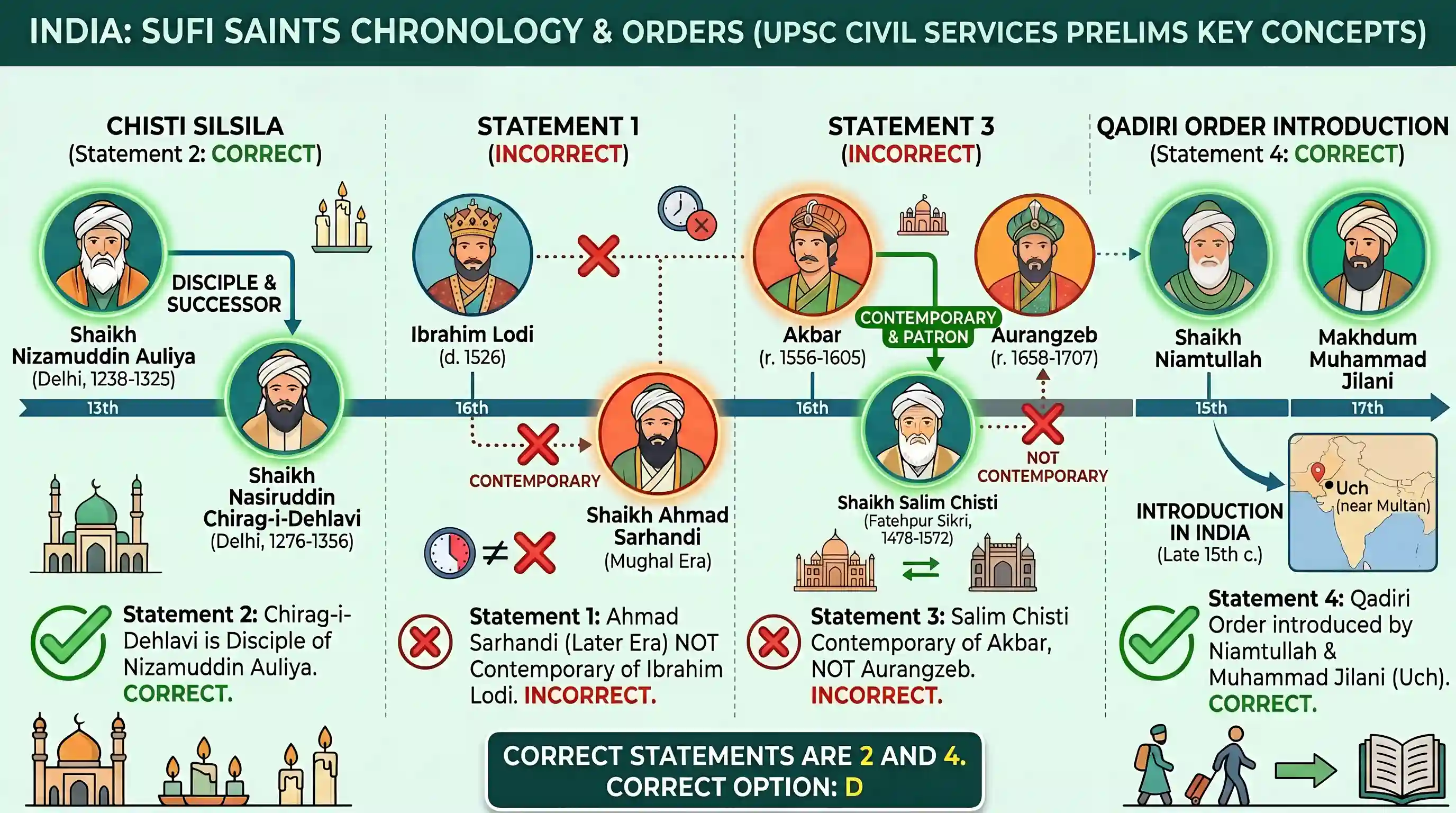
The correct answer is D because statements 2 and 4 are historically accurate, while statements 1 and 3 contain chronological errors.
Statement 1 is incorrect because Shaikh Ahmad Sarhandi lived during the reigns of Akbar and Jahangir in the late 16th and early 17th centuries, whereas Ibrahim Lodi ruled in the early 16th century and died in 1526.
Statement 2 is correct because Shaikh Nasiruddin Chirag-i-Dehlavi was indeed the prominent successor and disciple of the famous Chisti saint Shaikh Nizamuddin Auliya.
Statement 3 is incorrect because Shaikh Salim Chisti was a contemporary of Akbar. It was Akbar who built Fatehpur Sikri in his honor. Aurangzeb lived much later, in the 17th and early 18th centuries.
Statement 4 is correct because the Qadiri order was introduced to India in the late 15th century by Shaikh Niamtullah and Makhdum Muhammad Jilani, who established it primarily in the Uch region near Multan.
Related questions
More UPSC Prelims practice from the same subject and topic.
- Prelims 2002GS1history
The historian Barani refused to consider the state in India under Delhi Sultans as truly Islamic because
- Prelims 2002GS1history
With reference to medieval Indian rulers, which one of the following statements is correct?
- Prelims 2002GS1history
The motive behind Shahjahan’s Balkh campaign was to
- Prelims 2002GS1history
Assertion (A): Muhammad bin Tughlaq left Delhi, and, for two years lived in a camp called Swarga-dwari. Reason (R): At that time, Delhi was ravaged by a form of plague and many people died.
- Prelims 2002GS1history
The last opportunity to avoid the partition of India was lost with the rejection of
- Prelims 2002GS1history
Match List I (Ancient site) with List II (Archaeological finding) and select the correct answer using the codes given below: List I (Ancient site) (Archaeological finding) List I List II (Ancient site…