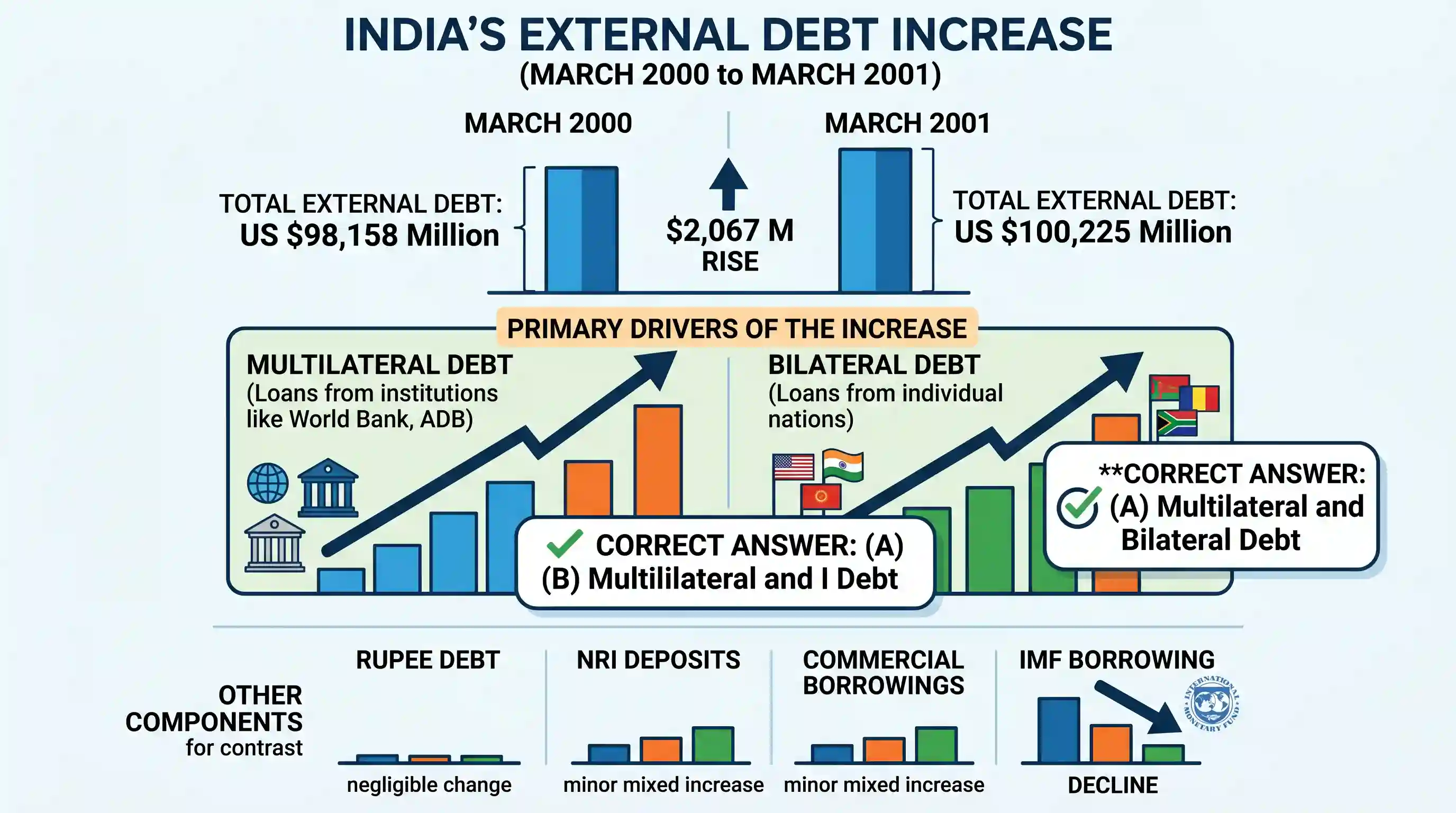
India’s external debt increased from US $98,158 million as at the end of March 2000 to US $100,225 million as at the end of March 2001 due to increase in

- Amultilateral and bilateral debtCorrect
- Brupee debt
- Ccommercial borrowings and NRI deposits
- Dborrowing from International Monetary Fund
Explanation
The correct answer is A because during the period between March 2000 and March 2001, the primary drivers for the marginal rise in India s external debt were multilateral and bilateral components. Multilateral debt refers to loans from international institutions like the World Bank and Asian Development Bank, while bilateral debt refers to loans from individual sovereign nations. While other components like NRI deposits also saw changes, the official economic data for that specific fiscal cycle attributed the majority of the debt increase to these two categories. Borrowings from the International Monetary Fund actually declined during this period as India was moving toward a more stable external position.
Related questions
More UPSC Prelims practice from the same subject and topic.
- Prelims 2002GS1economy
India has the maximum volume of foreign trade with
- Prelims 2002GS1economy
Global capital flows to developing countries increased significantly during the nineties. In view of the East Asian financial crisis and Latin American experience, which type of inflow is good for the…
- Prelims 2002GS1economy
In the year 2001, Germany approved a $32 million credit to India
- Prelims 2002GS1economy
Consider the following statements: Full convertibility of the rupee may mean 1. its free float with other international currencies. 2. its direct exchange with any other international currency at any …
- Prelims 2002GS1economy
A trader fixed the price of an article in such a way that by giving a rebate of 10% on the price fixed he made a profit of 15%. If the cost of the article is Rs 72, the price fixed on it is
- Prelims 2002GS1economy
“World Development Report” is an annual publication of