Consider the following statements: Full convertibility of the rupee may mean 1. its free float with other international currencies. 2. its direct exchange with any other international currency at any prescribed place inside and outside the country. 3. it acts just like any other international currency. Which of these statements are correct?

- A1 and 2
- B1 and 3
- C2 and 3
- D1, 2 and 3Correct
Explanation
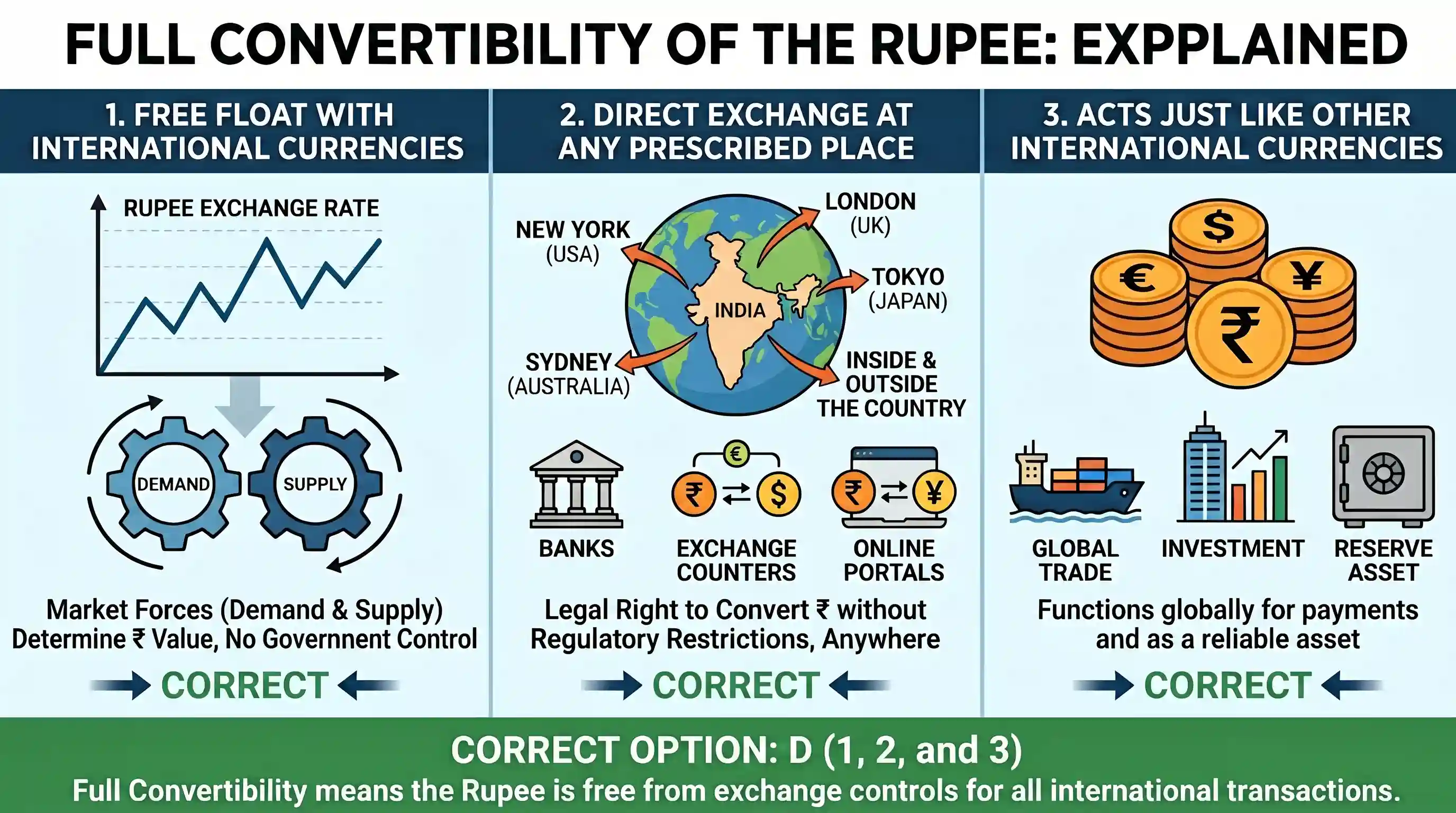
Full convertibility of the rupee implies that it can be freely exchanged for foreign currencies without any regulatory restrictions.
Statement 1 is correct because full convertibility allows the value of the rupee to be determined by market forces of demand and supply in the foreign exchange market, leading to a free float.
Statement 2 is correct because it implies the legal right to convert the local currency into any foreign currency at market rates at any location, whether domestic or international, without needing government approval.
Statement 3 is correct because once a currency is fully convertible, it attains the status of an international currency. It can be used globally for trade, investment, and as a reserve asset, functioning similarly to the US Dollar or the Euro.
Since all three statements accurately describe the implications of full convertibility, the correct answer is D.
Related questions
More UPSC Prelims practice from the same subject and topic.
- Prelims 2002GS1economy
India has the maximum volume of foreign trade with
- Prelims 2002GS1economy
India’s external debt increased from US $98,158 million as at the end of March 2000 to US $100,225 million as at the end of March 2001 due to increase in
- Prelims 2002GS1economy
Global capital flows to developing countries increased significantly during the nineties. In view of the East Asian financial crisis and Latin American experience, which type of inflow is good for the…
- Prelims 2002GS1economy
In the year 2001, Germany approved a $32 million credit to India
- Prelims 2002GS1economy
A trader fixed the price of an article in such a way that by giving a rebate of 10% on the price fixed he made a profit of 15%. If the cost of the article is Rs 72, the price fixed on it is
- Prelims 2002GS1economy
“World Development Report” is an annual publication of