The 93rd Constitutional Amendment Bill deals with the

- Acontinuation of reservation for backward classes in government employment
- Bfree and compulsory education for all children between the age of 6 and 14 yearsCorrect
- Creservation of 30 per cent posts for women in government recruitments
- Dallocation of a greater number of parliamentary seats for recently created States
Explanation
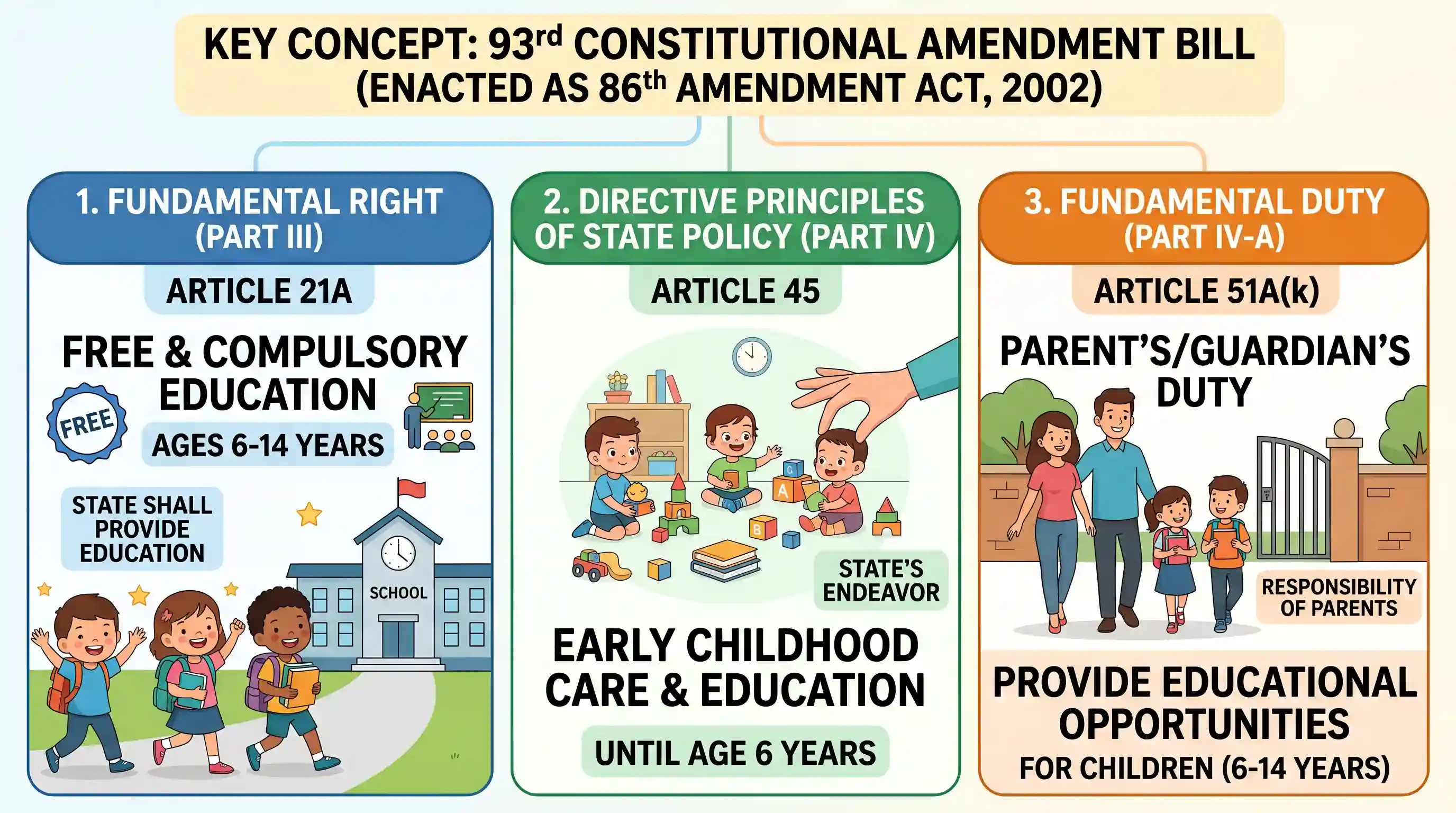
The 93rd Constitutional Amendment Bill, which later became the 86th Constitutional Amendment Act of 2002, is the legislation that made education a Fundamental Right. It inserted Article 21A into the Constitution, mandating that the State provide free and compulsory education to all children aged 6 to 14 years. It also modified the Directive Principles of State Policy and added a new Fundamental Duty for parents to provide educational opportunities to their children. Note that while it was introduced as the 93rd Amendment Bill, it was officially enacted as the 86th Amendment Act.
Related questions
More UPSC Prelims practice from the same subject and topic.
- Prelims 2002GS1polity-and-governance
Match List I (Article of Indian Constitution) with List II (Provisions) and select the correct answer using the codes given below the lists: List I List II (Article of Indian Constitution) (Provisions…
- Prelims 2002GS1polity-and-governance
The salaries and allowances of the Judges of the High Court are charged do the
- Prelims 2002GS1polity-and-governance
The members of the Constituent Assembly which drafted the Constitution of India were
- Prelims 2002GS1polity-and-governance
The purpose of the inclusion of Directive Principles of State Policy in the Indian Constitution is to establish:
- Prelims 2002GS1polity-and-governance
Which one of the following rights was described by Dr B R Ambedkar as the heart and soul of the Constitution?
- Prelims 2002GS1polity-and-governance
In the Indian Constitution, the Right to Equality is granted by Five Articles. They are