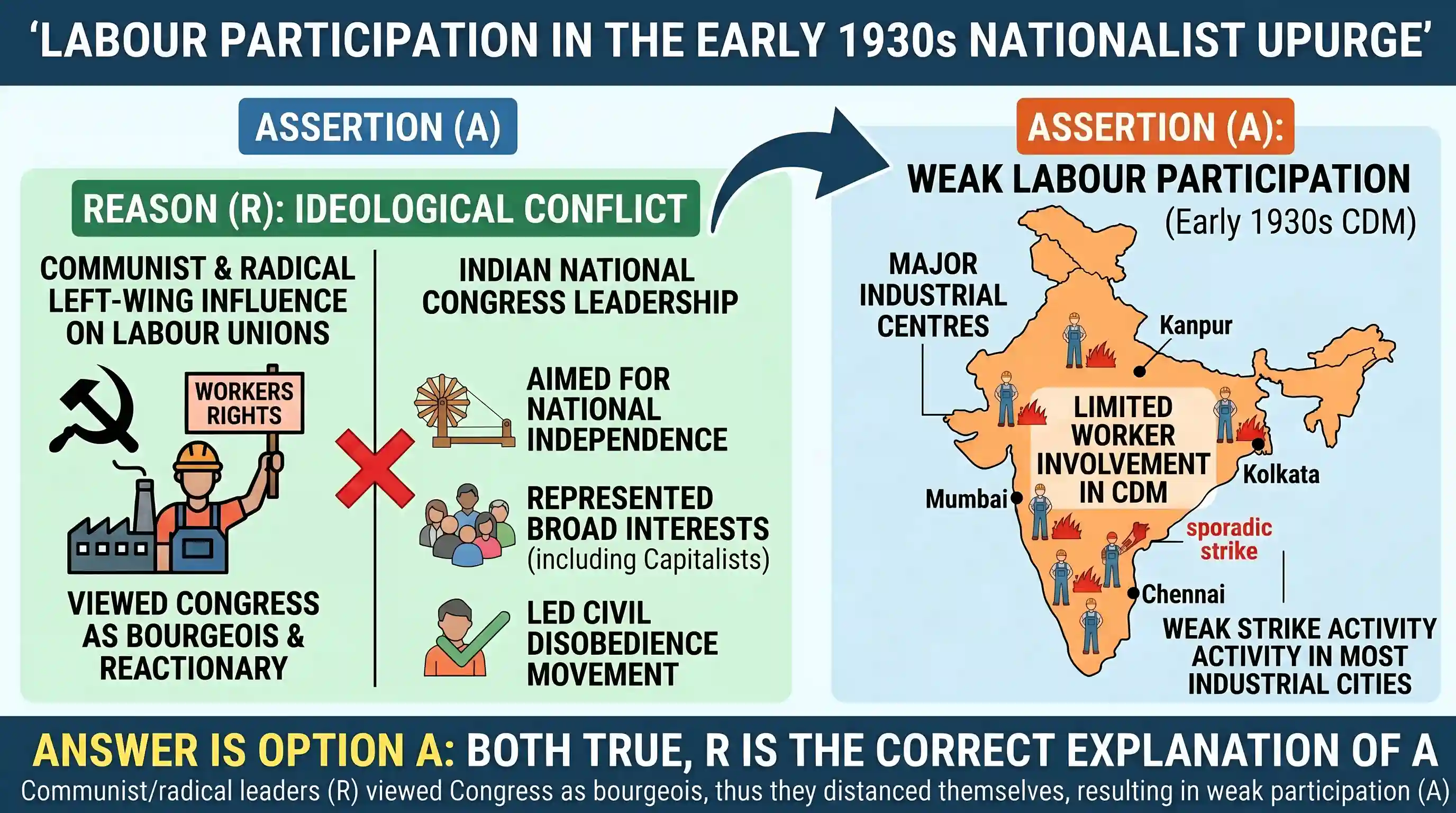
Assertion (A): The effect of labour participation in the Indian nationalist upsurge of the early 1930s was weak. Reason (R): The labour leaders considered the ideology of Indian National Congress as bourgeois and reactionary.

- ABoth A and R are individually true and R is not a correct explanation of ACorrect
- BBoth A and R are individually true but R is not a correct explanation of A
- CA is true but R is false
- DA is false but R is true
Explanation
The correct option is A because both statements are historically accurate and the reason directly explains the assertion.
Assertion A is true because during the Civil Disobedience Movement of the early 1930s, the participation of the working class was generally low compared to the Non Cooperation Movement. Major industrial centers like Mumbai saw some activity, but overall labor involvement remained limited.
Reason R is true and provides the explanation for this weak participation. During this period, the communist and radical left wing influence on labor unions was at its peak. These leaders viewed the Indian National Congress as a party representing the interests of the bourgeoisie or the capitalist class. They believed that the Congress leadership would compromise with British imperialism at the expense of workers rights. Consequently, the communist led unions officially distanced themselves from the Congress led nationalist struggle, leading to the weak participation mentioned in the assertion.
Related questions
More UPSC Prelims practice from the same subject and topic.
- Prelims 2002GS1history
The last opportunity to avoid the partition of India was lost with the rejection of
- Prelims 2002GS1history
Which one of the following submitted in 1875 a petition to the House of Commons demanding India’s direct representation in the British Parliament?
- Prelims 2002GS1history
The real intention of the British to include the princely states in the Federal Union proposed by the India Act of 1935 was to
- Prelims 2002GS1history
Match List I (Acts of Colonial Government of India) with List II (Provisions) and select the correct answer using the codes given below the lists: List I List II (Acts of colonial government of India)…
- Prelims 2002GS1history
Which one of the following Acts of British India strengthened the Viceroy’s authority over his executive council by substituting “portfolio” or departmental system for corporate functioning?
- Prelims 2002GS1history
The President of India National Congress as the time of partition of India was