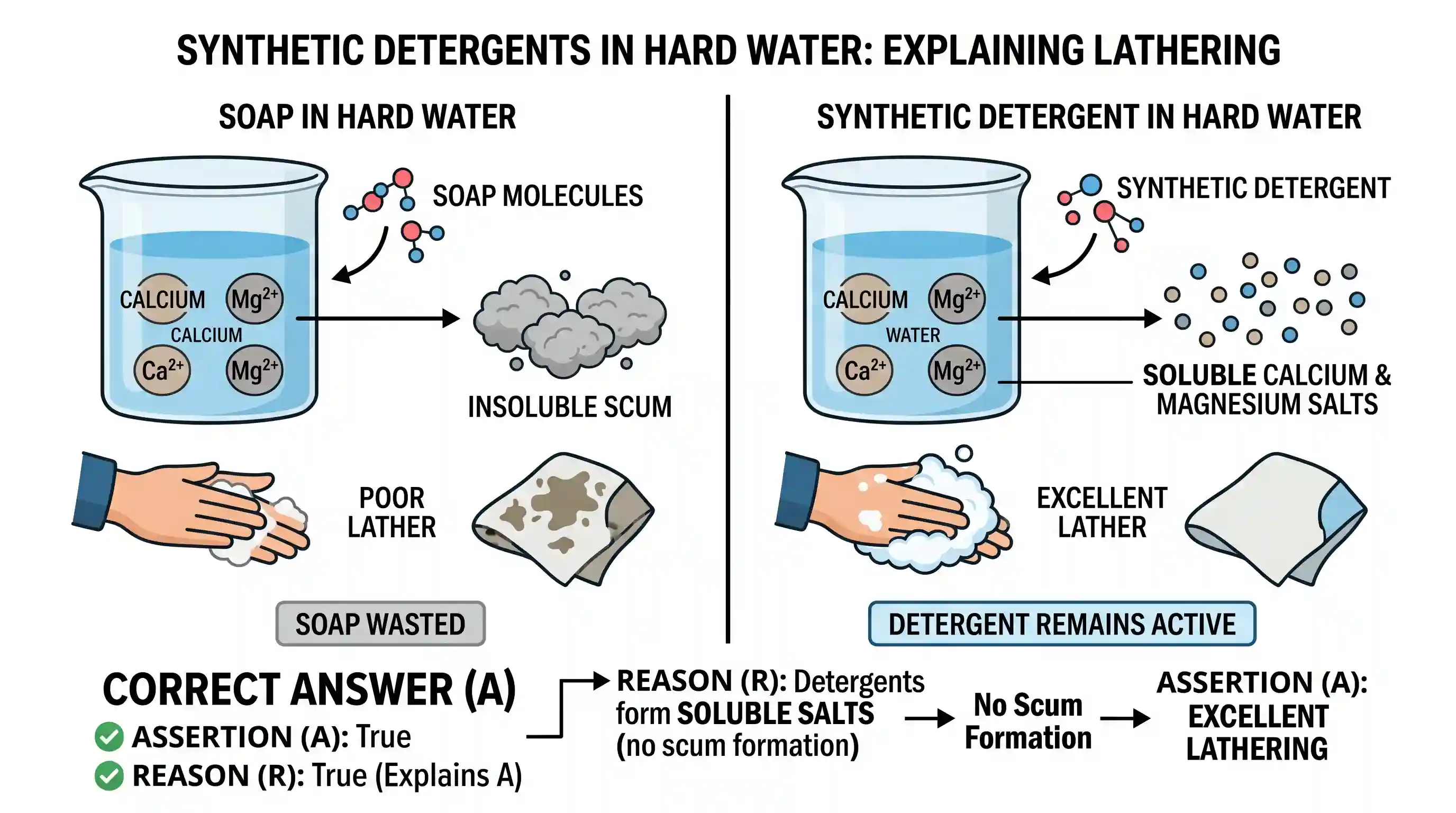
Assertion (A): Synthetic detergents can lather well in hard water. Reason (R): Synthetic detergents form soluble calcium and magnesium salts with hard water.

- ABoth A and R are individually true and R is the correct explanation of ACorrect
- BBoth A and R are individually true but R is not a correct explanation of A
- CA is true but R is false
- DA is false but R is true
Explanation
The correct answer is A because both the assertion and the reason are scientifically accurate and directly related.
Hard water contains calcium and magnesium ions. When ordinary soap is used in hard water, it reacts with these ions to form insoluble precipitates known as scum, which prevents lathering.
In contrast, synthetic detergents are designed to remain effective in hard water. The Reason provided is correct because the calcium and magnesium salts formed by synthetic detergents are soluble in water. Since these salts do not precipitate out as scum, the detergent molecules remain free to foam and clean, allowing them to lather well. Therefore, the reason perfectly explains why the assertion is true.
Related questions
More UPSC Prelims practice from the same subject and topic.
- Prelims 2002GS1science-and-technology
A complete cycle of a traffic light takes 60 seconds. During each cycle the light is green for 25 second, yellow for 5 second and red for 30 second. At a randomly chosen time, the probability that the…
- Prelims 2002GS1science-and-technology
A solid cube just gets completely immersed in water when a 0.2 kg mass is placed on it. If the mass is removed, the cube is 2 cm about the water level. What is the length of each side of the cube?
- Prelims 2002GS1science-and-technology
With reference to the latest developments in stem cell research, consider the following statements: 1. The only source of human stem cells are the embryos at blastocyst stage 2. The stem cells can be …
- Prelims 2002GS1science-and-technology
In the year 2001, NASA launched a spacecraft to Mars named
- Prelims 2002GS1science-and-technology
Consider the volumes of the following: 1. A parallelepiped of length 5 cm, breadth 3 cm and height 4 cm 2. A cube of each side 4 cm 3. A cylinder of radius 3 cm and length 3 cm 4. A sphere of radius 3…
- Prelims 2002GS1science-and-technology
Ticks and mites are actually