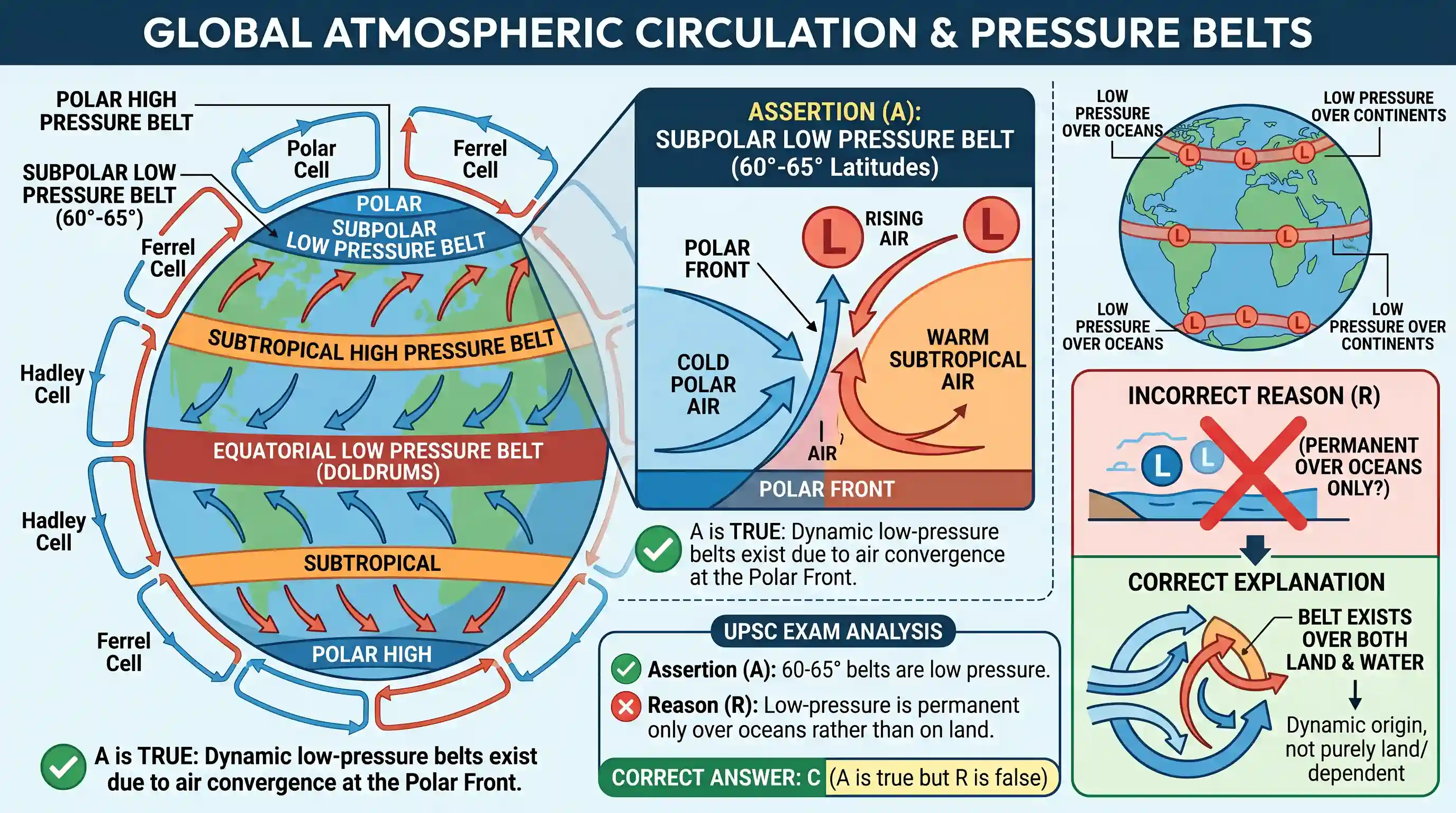
Assertion (A): 60°-65° latitudes in both the hemispheres have a low-pressure belt instead of high pressure. Reason (R): The low-pressure areas are permanent over oceans rather than on land.

- ABoth A and R are individually true and R is the correct explanation of A
- BBoth A and R are individually true but R is not a correct explanation of A
- CA is true but R is falseCorrect
- DA is false but R is true
Explanation
The correct option is C because Assertion A is true while Reason R is false.
Assertion A is true because the 60 to 65 degree latitude belts are known as the Subpolar Low Pressure Belts. These are formed due to the convergence of warm subtropical air and cold polar air, combined with the rotation of the earth which causes air to rise in these regions.
Reason R is false because the Subpolar Low Pressure belts are not permanent only over oceans. While pressure systems can be more intense over oceans due to less friction and more moisture, these low pressure belts are a global feature of the Earths atmospheric circulation and exist over both land and water. Furthermore, the reason for the low pressure at these latitudes is dynamic air movement rather than the underlying surface of ocean versus land.
Related questions
More UPSC Prelims practice from the same subject and topic.
- Prelims 2002GS1geography
Consider the following climatic and geographical phenomena: 1. Condensation 2. High temperature and humidity 3. Orography 4. Vertical wind Thunder Cloud development is due to which of these phenomena?
- Prelims 2002GS1geography
For short-term climate prediction, which one of the following events, detected in the last decade, is associated with occasional weak monsoon rains in the India subcontinent?
- Prelims 2002GS1geography
Consider the following natural phenomena: 1. Terrestrial heating 2. Reflection of light 3. Refraction of light 4. Diffraction of light Due to which of these phenomena is mirage formed?
- Prelims 2002GS1geography
Sun’s halo is produced by the refraction of light in
- Prelims 2002GS1geography
The average annual temperature of a meteorological station is 26oC, its average annual rainfall is 63 cm and the annual range of temperature is 9oC. The station in Q is
- Prelims 2002GS1geography
Consider the following statements: 1. In equatorial regions, the year is divided into four main seasons 2. In Mediterranean region, summer receives more rain 3. In China type climate, rainfall occurs …