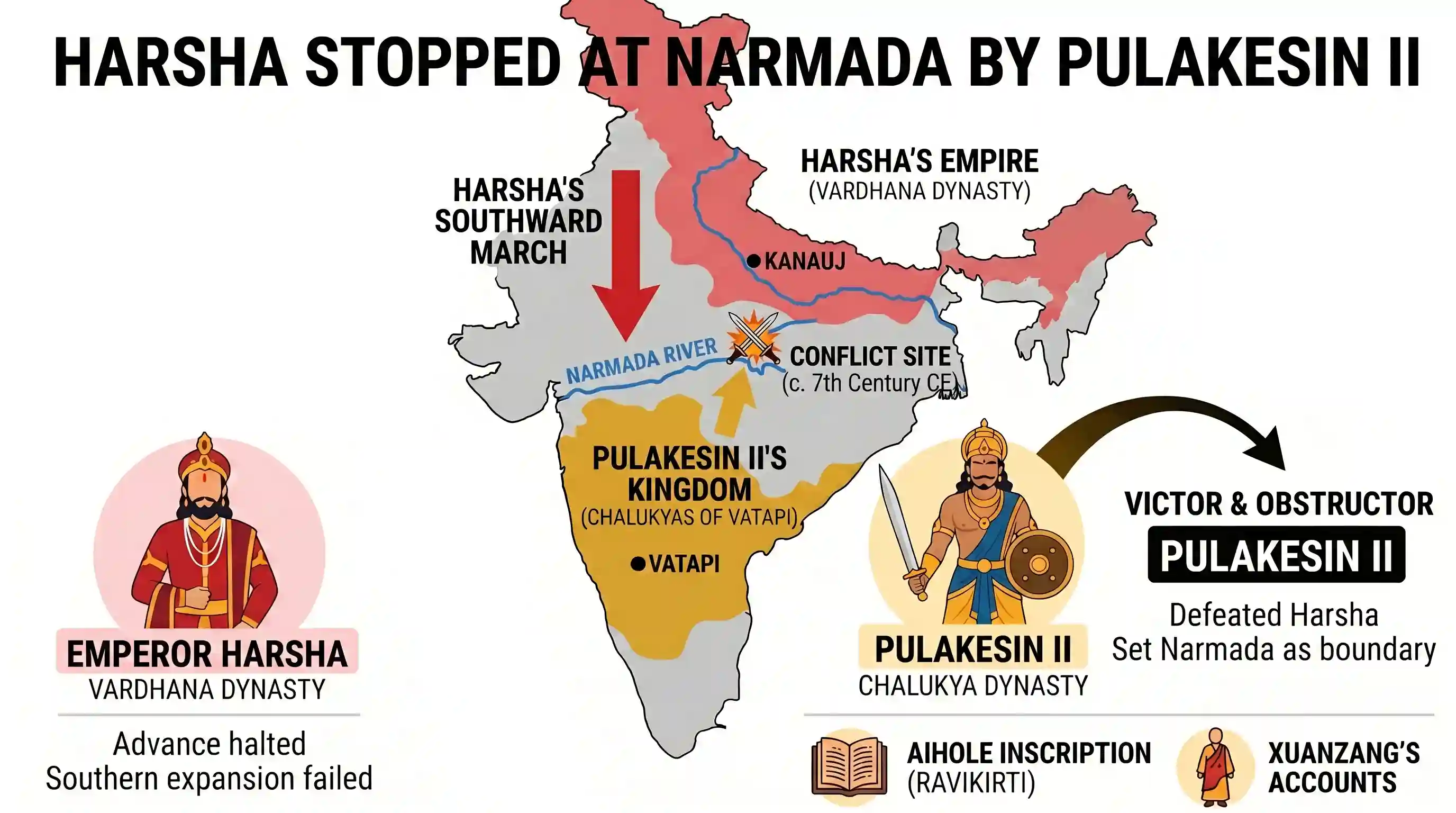
Emperor Harsha’s southward march was stopped on the Narmada River by

- APulakesin-I
- BPulakesin-IICorrect
- CVikramaditya-I
- DVilcramaditya-II
Explanation
The correct answer is B because Pulakesin II was the most powerful ruler of the Chalukya dynasty of Vatapi. During the 7th century, when Emperor Harshavardhana of Kanauj attempted to expand his empire into southern India, he was confronted by Pulakesin II on the banks of the Narmada River. Pulakesin II successfully defeated Harsha, forcing him to accept the Narmada as the southern boundary of his kingdom. This victory is documented in the Aihole Inscription composed by Ravikirti and is also mentioned in the accounts of the Chinese traveler Xuanzang.
Related questions
More UPSC Prelims practice from the same subject and topic.
- Prelims 2003GS1history
In India, among the following locations, the Dutch established their earliest factory at
- Prelims 2003GS1history
Consider the following statements: 1. The Cholas defeated Pandya and Chera rulers and established their domination over peninsular India in early medieval times. 2. The Cholas sent an expedition again…
- Prelims 2003GS1history
Consider the following statements 1. Vardhamana Mahavira’s mother was the daughter of Lichchhavi chief Chetaka. 2. Goutama Buddha’s mother was a princess from the Kosha-lan dynasty. 3. Parshvanatha, t…
- Prelims 2003GS1history
Consider the following statements: 1. The last Mauryan ruler, Brihadratha was assassinated by his commander-in-chief, Pushyamitra Sunga. 2. The last Sunga king, Devabhuti was assassinated by his Brahm…
- Prelims 2003GS1history
Alam Khan, one of those who invited Babar to invade India was
- Prelims 2003GS1history
The battle of Dharmat was fought between