Consider the following statements: 1. Abolition of diarchy in the Governors’ provinces 2. Power of the Governors to veto legislative action and to legislate on their own 3. Abolition of the principle of communal representation Which of the statements given above is are correct?

- A1 only
- B1 and 2Correct
- C2 and 3
- D1, 2 and 3
Explanation
The correct option is B because of the provisions introduced by the Government of India Act 1935.
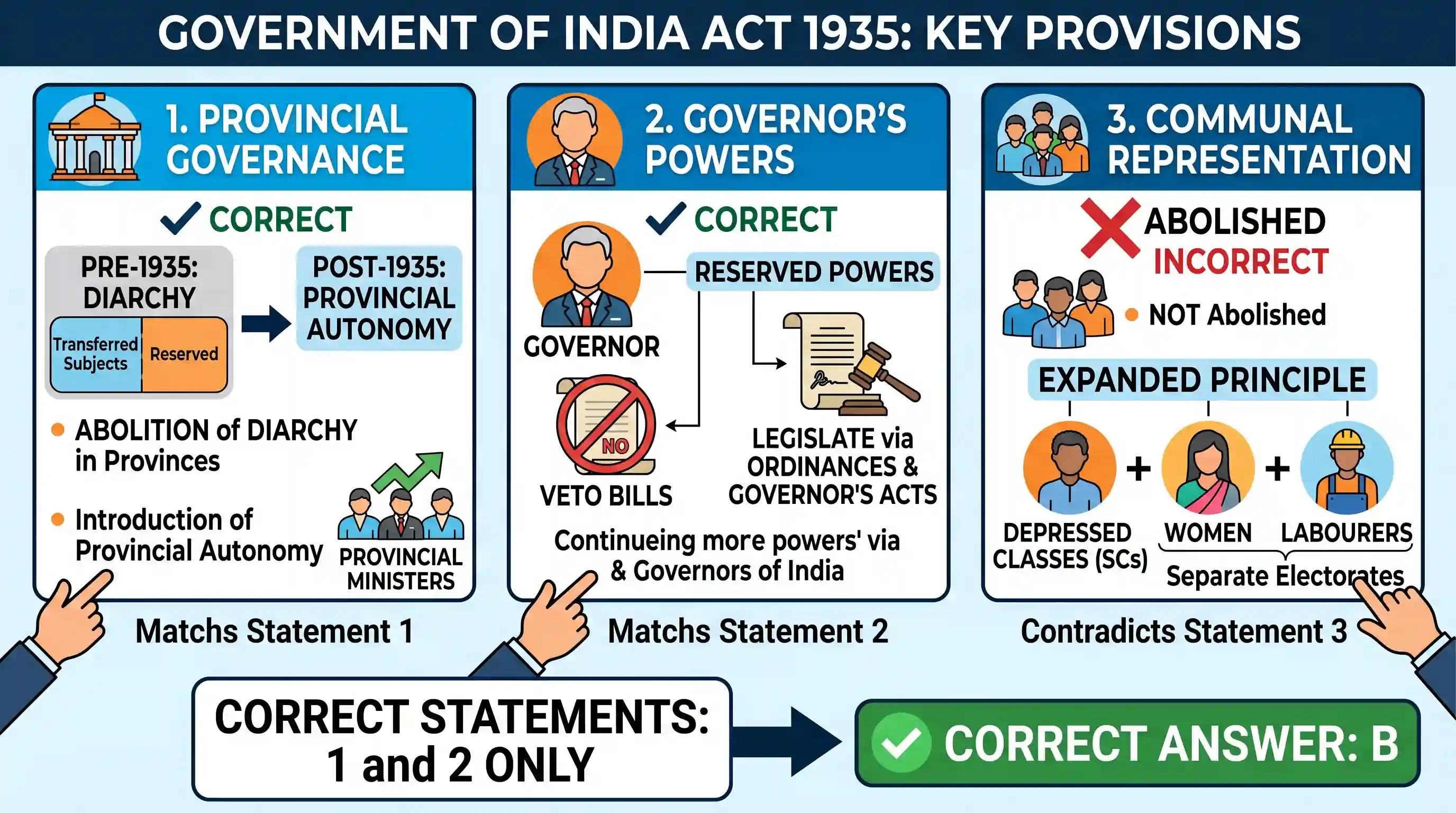
Statement 1 is correct. The Act of 1935 abolished diarchy at the provincial level and introduced provincial autonomy. Diarchy was instead introduced at the federal level.
Statement 2 is correct. Despite the introduction of provincial autonomy, the Governors retained significant reserve powers. They could veto bills passed by the provincial legislature and had the authority to issue ordinances and enact Governor Acts on their own.
Statement 3 is incorrect. The Act of 1935 did not abolish communal representation. Instead, it expanded the principle by providing separate electorates for depressed classes, women, and laborers.
Therefore, only statements 1 and 2 are correct.
Related questions
More UPSC Prelims practice from the same subject and topic.
- Prelims 2004GS1polity-and-governance
Which one of the following statements is correct?
- Prelims 2004GS1polity-and-governance
With reference to Indian Public Finance, consider the following statements: 1. Disbursements from Public Accounts of India are subject to the Vote of Parliament. 2. The Indian Constitution provides fo…
- Prelims 2004GS1polity-and-governance
Consider the following tasks: 1. Superintendence, direction and conduct of free and fair elections. 2. Preparation of electoral rolls for all elections to the Parliament, State Legislatures and the Of…
- Prelims 2004GS1polity-and-governance
Match List-I (Books) with List-II (Authors) and select the correct answer using the codes given below the Lists: List-I (Books) List-II (Authors) A. My Presidential Years 1. S. Radhakrishnan B. The Hi…
- Prelims 2004GS1polity-and-governance
Match List-I (Persons) with List-II (Positions) and select the correct answer using the codes given below the Lists: List-I (Persons) List-II (Positions) A. B.P. Mishra 1. Executive Director, IMF B. S…
- Prelims 2004GS1polity-and-governance
Consider the following statements: 1. The highest deciding body for planning in India is the Planning Commission of India. 2. The Secretary of the Planning Commission of India is also the Secretary of…