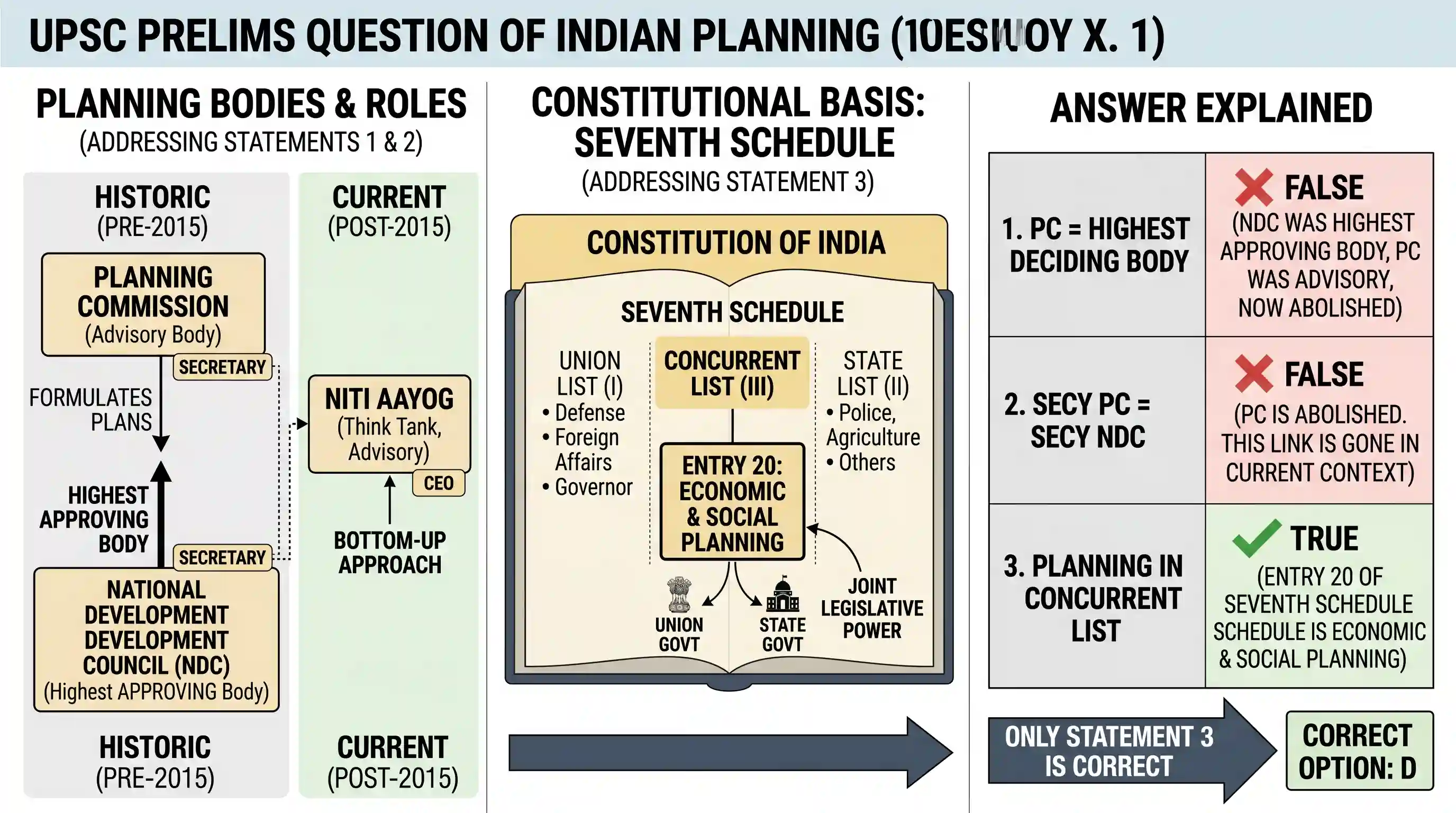
Consider the following statements: 1. The highest deciding body for planning in India is the Planning Commission of India. 2. The Secretary of the Planning Commission of India is also the Secretary of National Development Council. 3. The Constitution includes economic and social planning in the Concurrent List in the Seventh Schedule of the Constitution of India. Which of the statements given above is/are correct?

- A1 and 2
- B2 and 3
- C2 only
- D3 onlyCorrect
Explanation
The correct answer is D because only statement 3 is accurate.
Let's analyze each statement:
-
The highest deciding body for planning in India is the Planning Commission of India. This statement is incorrect. The Planning Commission was an advisory body responsible for formulating plans. The highest approving body for Five Year Plans was the National Development Council (NDC). Moreover, the Planning Commission itself was abolished in 2015 and replaced by NITI Aayog.
-
The Secretary of the Planning Commission of India is also the Secretary of National Development Council. This statement is incorrect in the current context. The Planning Commission no longer exists. Historically, when the Planning Commission was operational, its Secretary did indeed serve as the Secretary of the National Development Council. However, given the current institutional framework, this statement is outdated.
-
The Constitution includes economic and social planning in the Concurrent List in the Seventh Schedule of the Constitution of India. This statement is correct. Entry 20 of the Concurrent List (List III) of the Seventh Schedule explicitly mentions "Economic and social planning." This means both the Union and State governments can legislate on this subject.
Since only statement 3 is correct, option D is the correct answer.
Related questions
More UPSC Prelims practice from the same subject and topic.
- Prelims 2004GS1polity-and-governance
Consider the following statements: 1. Abolition of diarchy in the Governors’ provinces 2. Power of the Governors to veto legislative action and to legislate on their own 3. Abolition of the principle …
- Prelims 2004GS1polity-and-governance
Which one of the following statements is correct?
- Prelims 2004GS1polity-and-governance
With reference to Indian Public Finance, consider the following statements: 1. Disbursements from Public Accounts of India are subject to the Vote of Parliament. 2. The Indian Constitution provides fo…
- Prelims 2004GS1polity-and-governance
Consider the following tasks: 1. Superintendence, direction and conduct of free and fair elections. 2. Preparation of electoral rolls for all elections to the Parliament, State Legislatures and the Of…
- Prelims 2004GS1polity-and-governance
Match List-I (Books) with List-II (Authors) and select the correct answer using the codes given below the Lists: List-I (Books) List-II (Authors) A. My Presidential Years 1. S. Radhakrishnan B. The Hi…
- Prelims 2004GS1polity-and-governance
Match List-I (Persons) with List-II (Positions) and select the correct answer using the codes given below the Lists: List-I (Persons) List-II (Positions) A. B.P. Mishra 1. Executive Director, IMF B. S…