Which one of the following statements is correct?

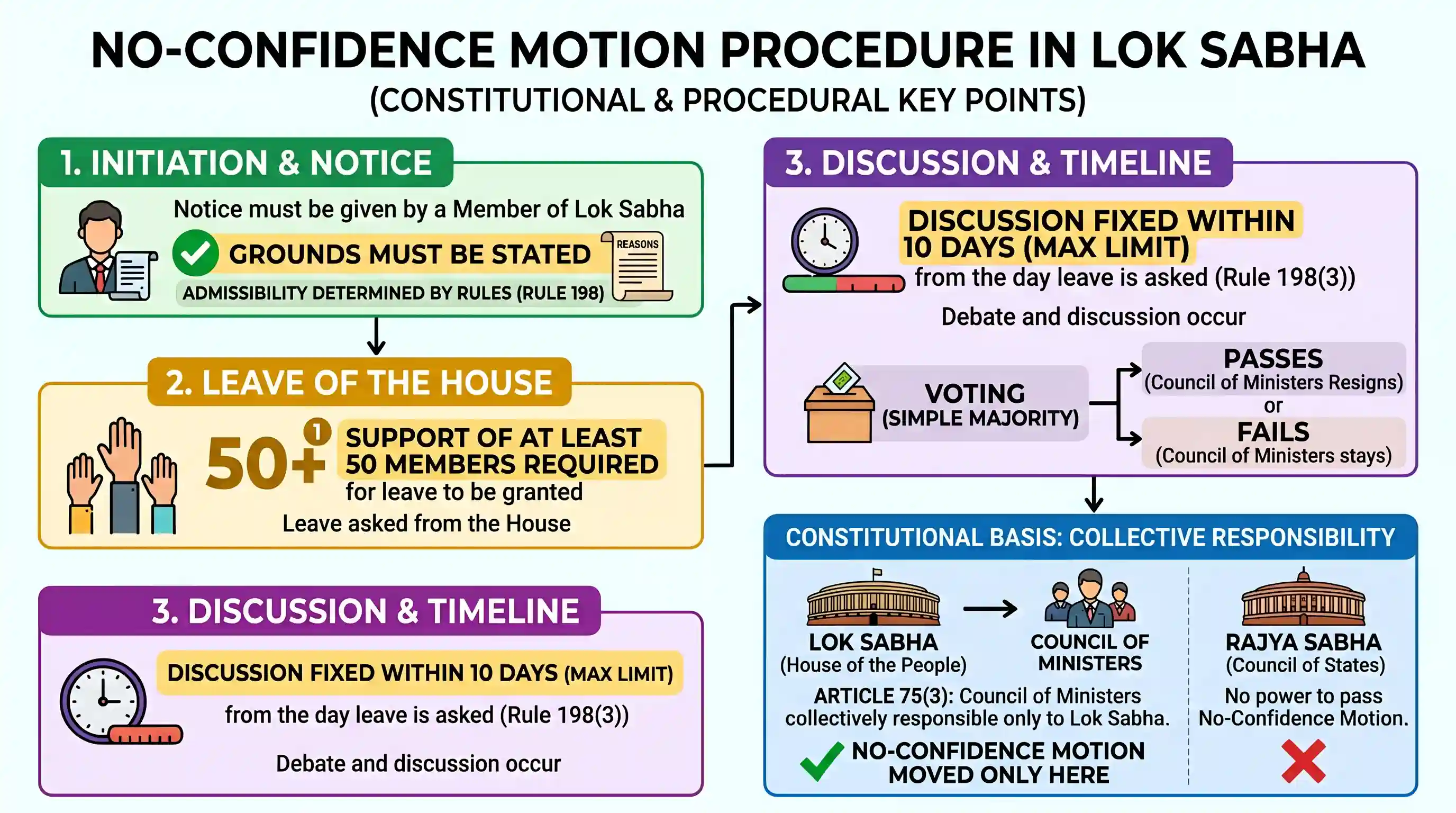
- AIn Lok Sabha, a no confidence motion has to set out the grounds on which it is based.Correct
- BIn the case of a no confidence motion in the Lok Sabha, no conditions of admissibility have been laid down in the Rules.
- CA motion of no confidence, once admitted, has to be taken up within ten days of the leave being granted.
- DRajya Sabha is not empowered to entertain a motion of no confidence.
Explanation
The correct answer is A. Here's an analysis of each statement:
A) In Lok Sabha, a no confidence motion has to set out the grounds on which it is based. Correct. As per parliamentary procedure, the notice given by a member to move a no-confidence motion must be accompanied by a brief statement of the grounds on which the motion is based. This ensures that the motion is not frivolous and the Speaker and the House are aware of the reasons for seeking no confidence. Therefore, the process of bringing a no-confidence motion requires the grounds to be stated.
B) In the case of a no confidence motion in the Lok Sabha, no conditions of admissibility have been laid down in the Rules. Incorrect. Rule 198 of the Rules of Procedure and Conduct of Business in Lok Sabha lays down several conditions for the admissibility of a no-confidence motion, such as requiring notice, and the support of at least 50 members for leave to be granted.
C) A motion of no confidence, once admitted, has to be taken up within ten days of the leave being granted. Incorrect. Rule 198(3) states that the motion "will be taken up on such day, not being more than ten days from the date on which leave is asked, as he may appoint." The phrasing "not being more than ten days" sets a maximum limit. However, the statement "has to be taken up" is too absolute. A motion can lapse if the House is prorogued or dissolved before it is taken up within that ten-day period, meaning it would not necessarily "have to be taken up."
D) Rajya Sabha is not empowered to entertain a motion of no confidence. Generally considered correct in a constitutional and procedural sense. Article 75(3) of the Constitution states that the Council of Ministers shall be collectively responsible to the House of the People (Lok Sabha). Therefore, a motion of no confidence, which tests this responsibility, can only be moved in the Lok Sabha. The Rajya Sabha has no power to pass such a motion. However, if A is the only correct answer, one might argue (though weakly) that "entertain" could be interpreted very broadly as merely receiving a notice, even if it is subsequently ruled out of order. But based on standard parliamentary practice, this statement is fundamentally correct. Given that A is the provided correct answer and C is demonstrably incorrect due to absolute phrasing, A is considered the most accurate statement among the options regarding the procedural requirements of a no-confidence motion.
Related questions
More UPSC Prelims practice from the same subject and topic.
- Prelims 2004GS1polity-and-governance
Consider the following statements: 1. The Speaker of Lok Sabha has the power to adjourn the House sine die but, on prorogation, it is only the President who can summon the House. 2. Unless sooner diss…
- Prelims 2004GS1polity-and-governance
The Speaker of Lok Sabha continues in office even after the dissolution of the House and until ‘immediately before the first meeting of the House’. Which of the statements given above are correct?
- Prelims 2004GS1polity-and-governance
The resolution for removing the Vice-president of India can be moved in the:
- Prelims 2004GS1polity-and-governance
With reference to Indian Parliament, which one of the following is not correct?
- Prelims 2004GS1polity-and-governance
Who among the following was never the Lok Sabha Speaker?
- Prelims 2004GS1polity-and-governance
Which one of the following is the correct sequence in the descending order of precedence in the warrant of precedence?