Consider the following statements: 1. The Speaker of Lok Sabha has the power to adjourn the House sine die but, on prorogation, it is only the President who can summon the House. 2. Unless sooner dissolved or there is an extension of the term, there is an automatic dissolution of the Lok Sabha by efflux of time, at the end of the period of five years, even if no formal order of dissolution is issued by the President. 3. The Speaker of Lok Sabha continues in office even after the dissolution of the House and until ‘immediately before the first meeting of the House’. Which of the statements given above are correct?

- Aa) 1 and 2
- B2 and 3
- C1 and 3
- D1, 2 and 3Correct
Explanation
All three statements are correct.
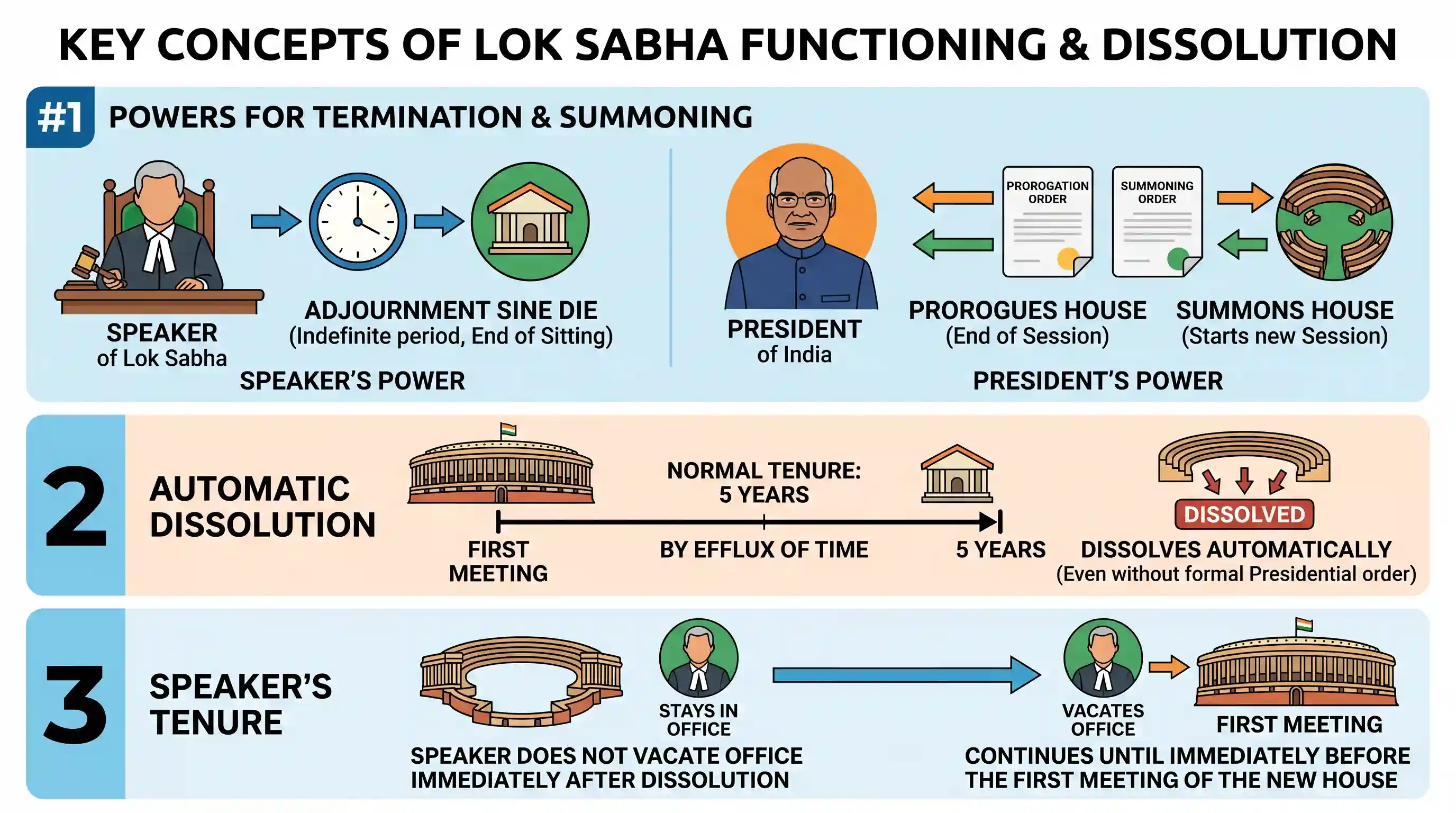
Statement 1 is correct. Adjournment sine die means terminating a sitting of Parliament for an indefinite period, which is a power exercised by the presiding officer, the Speaker. Prorogation means the termination of a session of the House, which is done by the President. Once prorogued, only the President has the power to summon the House for a new session.
Statement 2 is correct. The normal tenure of the Lok Sabha is five years from the date of its first meeting. At the end of this five year period, the House dissolves automatically by efflux of time, even without a formal Presidential order.
Statement 3 is correct. According to the Constitution, whenever the Lok Sabha is dissolved, the Speaker does not vacate his office immediately. He remains in office until immediately before the first meeting of the newly elected Lok Sabha.
Related questions
More UPSC Prelims practice from the same subject and topic.
- Prelims 2004GS1polity-and-governance
The Speaker of Lok Sabha continues in office even after the dissolution of the House and until ‘immediately before the first meeting of the House’. Which of the statements given above are correct?
- Prelims 2004GS1polity-and-governance
Which one of the following statements is correct?
- Prelims 2004GS1polity-and-governance
The resolution for removing the Vice-president of India can be moved in the:
- Prelims 2004GS1polity-and-governance
With reference to Indian Parliament, which one of the following is not correct?
- Prelims 2004GS1polity-and-governance
Who among the following was never the Lok Sabha Speaker?
- Prelims 2004GS1polity-and-governance
Which one of the following is the correct sequence in the descending order of precedence in the warrant of precedence?