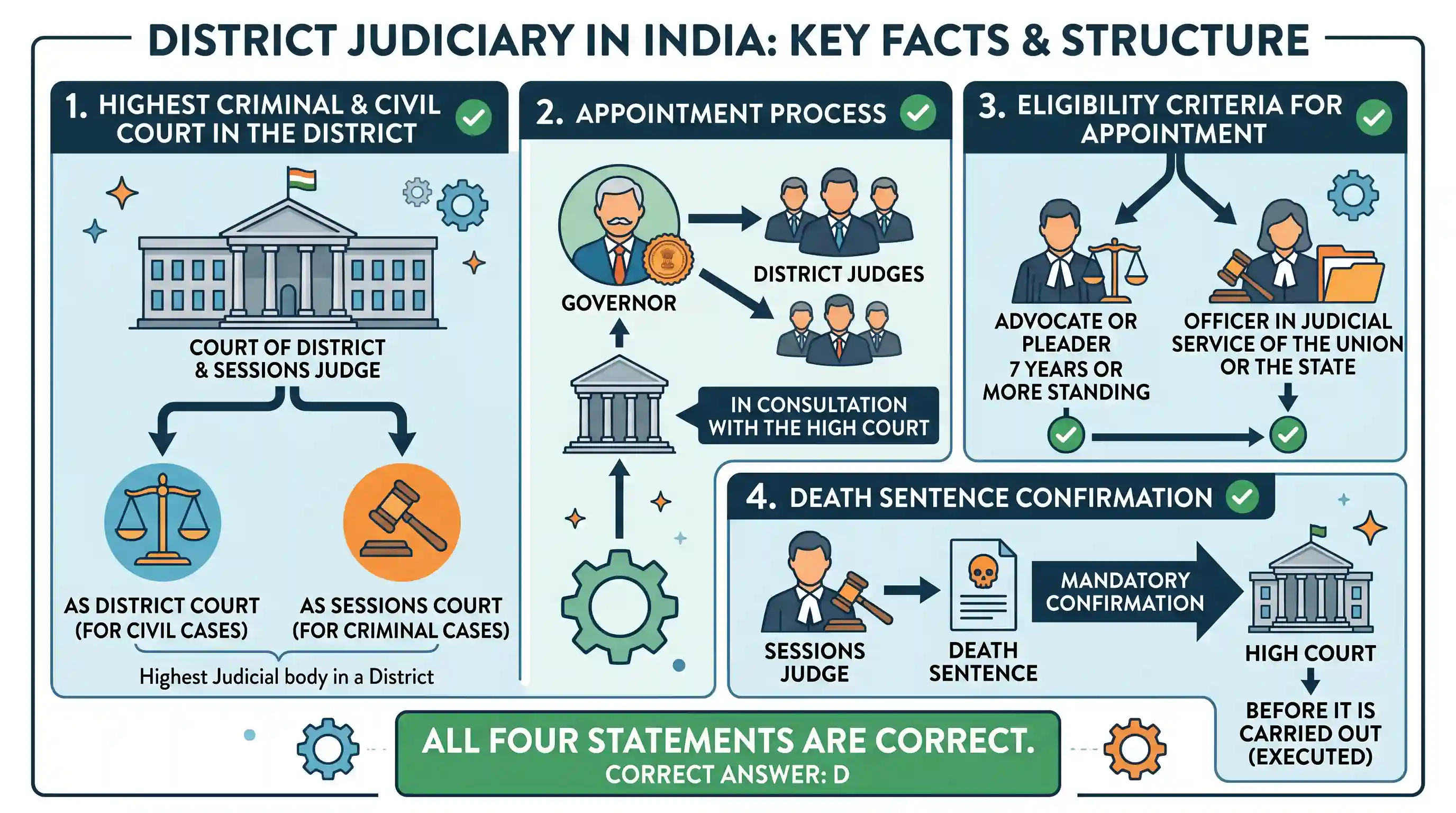
Consider the following statements: 1. The highest criminal court of the district is the Court of District and Sessions Judge. 2. The District Judges are appointed by the Governor in consultation with the High Court. 3. A person to be eligible for appointment as a District Judge should be an advocate or a pleader of seven years’ standing or more, or an officer in judicial service of the Union or the State. 4. When the Sessions Judge awards death sentence, it must be confirmed by the High Court before it is carried out. Which of the statements given above are correct?

- Aa) 1 and 2
- Bb) 2, 3 and 4
- Cc) 3 and 4
- Dd) 1, 2, 3, and 4Correct
Explanation
The correct answer is D because all four statements accurately describe the provisions regarding the District Judiciary in India under the Constitution and the Code of Criminal Procedure.
Statement 1 is correct because the Court of the District and Sessions Judge is the apex judicial body in a district. It is known as the District Court when dealing with civil cases and the Sessions Court when dealing with criminal cases.
Statement 2 is correct as per Article 233 of the Constitution. The Governor makes appointments, postings, and promotions of District Judges in direct consultation with the High Court of the respective state.
Statement 3 is correct according to the eligibility criteria mentioned in Article 233. A person must either have been an advocate or a pleader for at least seven years or must already be in the judicial service of the Union or the State to be appointed as a District Judge.
Statement 4 is correct under the Code of Criminal Procedure. While a Sessions Judge has the power to impose a death sentence, such a sentence cannot be executed unless it is confirmed by the High Court.
Related questions
More UPSC Prelims practice from the same subject and topic.
- Prelims 2004GS1polity-and-governance
Consider the following statements: 1. Abolition of diarchy in the Governors’ provinces 2. Power of the Governors to veto legislative action and to legislate on their own 3. Abolition of the principle …
- Prelims 2004GS1polity-and-governance
Which one of the following statements is correct?
- Prelims 2004GS1polity-and-governance
Consider the following statements: 1. The Speaker of Lok Sabha has the power to adjourn the House sine die but, on prorogation, it is only the President who can summon the House. 2. Unless sooner diss…
- Prelims 2004GS1polity-and-governance
Which one of the following statements is correct?
- Prelims 2004GS1polity-and-governance
With reference to Indian Public Finance, consider the following statements: 1. Disbursements from Public Accounts of India are subject to the Vote of Parliament. 2. The Indian Constitution provides fo…
- Prelims 2004GS1polity-and-governance
The Speaker of Lok Sabha continues in office even after the dissolution of the House and until ‘immediately before the first meeting of the House’. Which of the statements given above are correct?