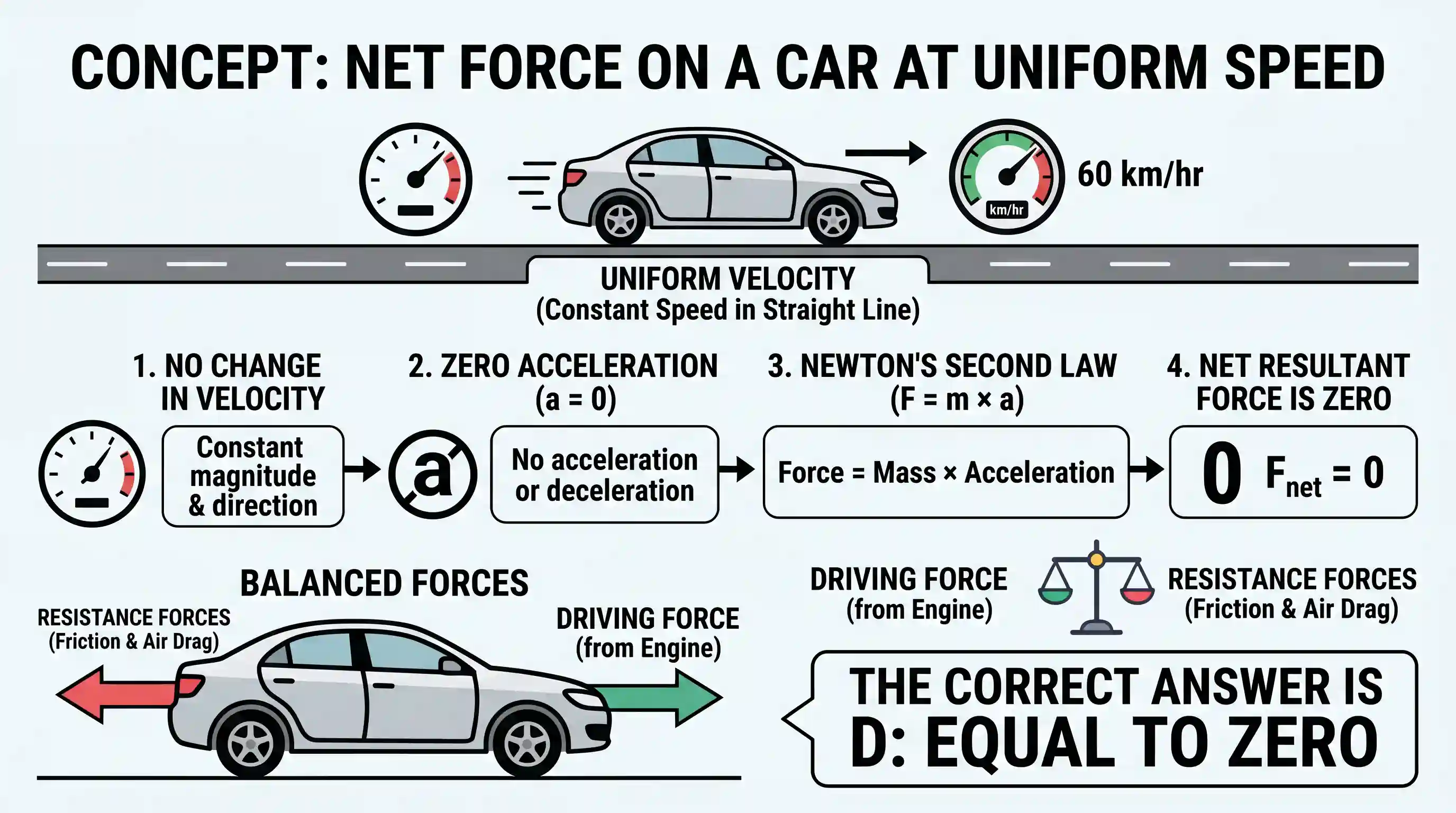
A car is running on a road at a uniform speed of 60 km/hr. The net resultant force on the car is:

- ADriving force in the direction of car’s motion
- BResistance force opposite to the direction of car’s motion
- CAn inclined force
- DEqual to zeroCorrect
Explanation
The correct answer is D because of Newtons First Law of Motion. According to this law, an object will continue to move at a constant velocity unless acted upon by a net external force.
Since the car is moving at a uniform speed of 60 km/hr in a straight line, its acceleration is zero. According to the formula Force equals Mass times Acceleration, if acceleration is zero, the net resultant force must also be zero. In this state, the driving force provided by the engine is exactly balanced by the opposing resistance forces like friction and air drag. Therefore, all forces acting on the car cancel each other out, resulting in a net force of zero.
Related questions
More UPSC Prelims practice from the same subject and topic.
- Prelims 2004GS1science-and-technology
Consider the following statements: 1. Non-function of lachrymal gland is an important symptom of deficiency of Vitamin A. 2. Deficiency of Vitamin B1 can lead to indigestion and heart enlargement. 3. …
- Prelims 2004GS1science-and-technology
In which organ of the human body are the lymphocyte cells formed?
- Prelims 2004GS1science-and-technology
Consider the following statements: 1. Adam Osborne produced the first portable computer. 2. Ian Wilmut created the first cloned sheep. Which of the statements given above is/ are correct?
- Prelims 2004GS1science-and-technology
Param Padma, which was in the news recently, is:
- Prelims 2004GS1science-and-technology
Assertion (A): In our houses, the current in AC electricity line changes direction 60 times per second. Reason (R): The frequency of alternating voltage supplied is 60 hertz.
- Prelims 2004GS1science-and-technology
Assertion (A): Fatty acids should be a part of the balanced human diet. Reason (R): The cells of the human body cannot synthesize any fatty acids.