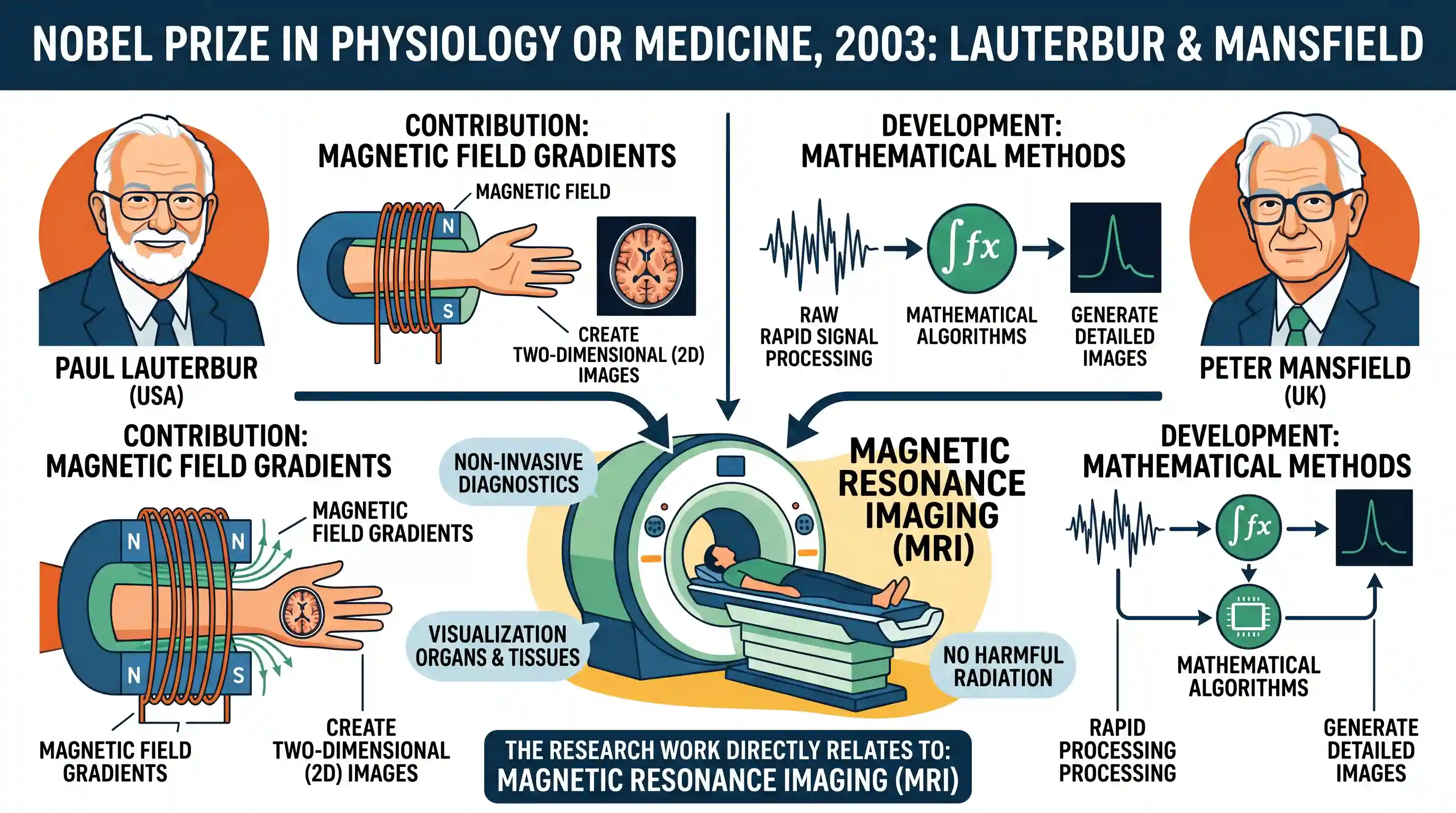
The research work of Paul Lauterbur and Peter Mansfield, the Nobel Prize winners for Medicine in 2003, relates to:

- AControl of AIDS
- BMagnetic resonance imagingCorrect
- CRespiratory diseases
- DGenetic engineering
Explanation
The correct answer is B because Paul Lauterbur and Peter Mansfield were awarded the Nobel Prize in Physiology or Medicine in 2003 for their pioneering discoveries concerning magnetic resonance imaging commonly known as MRI. Lauterbur discovered that magnetic field gradients could be used to create two dimensional images, while Mansfield developed the mathematical methods to transform these signals into usable images rapidly. Their combined work transformed medical diagnostics by allowing non invasive visualization of internal organs and tissues without using harmful radiation.
Related questions
More UPSC Prelims practice from the same subject and topic.
- Prelims 2004GS1science-and-technology
Consider the following statements: 1. Non-function of lachrymal gland is an important symptom of deficiency of Vitamin A. 2. Deficiency of Vitamin B1 can lead to indigestion and heart enlargement. 3. …
- Prelims 2004GS1science-and-technology
In which organ of the human body are the lymphocyte cells formed?
- Prelims 2004GS1science-and-technology
Consider the following statements: 1. Adam Osborne produced the first portable computer. 2. Ian Wilmut created the first cloned sheep. Which of the statements given above is/ are correct?
- Prelims 2004GS1science-and-technology
Param Padma, which was in the news recently, is:
- Prelims 2004GS1science-and-technology
Assertion (A): In our houses, the current in AC electricity line changes direction 60 times per second. Reason (R): The frequency of alternating voltage supplied is 60 hertz.
- Prelims 2004GS1science-and-technology
Assertion (A): Fatty acids should be a part of the balanced human diet. Reason (R): The cells of the human body cannot synthesize any fatty acids.