Consider the following statements: 1. Montenegro and Serbia agreed to a new structure for the Yugoslav Federation. 2. Croatia remained under the Hungarian Administration until the end of First World War. 3. Claims to Macedonia Territory have long been a source of contention between Belgium and Greece.

- A1 and 2Correct
- B1,2 and 3
- C2, 3 and 4
- D1,3 and 4
Explanation
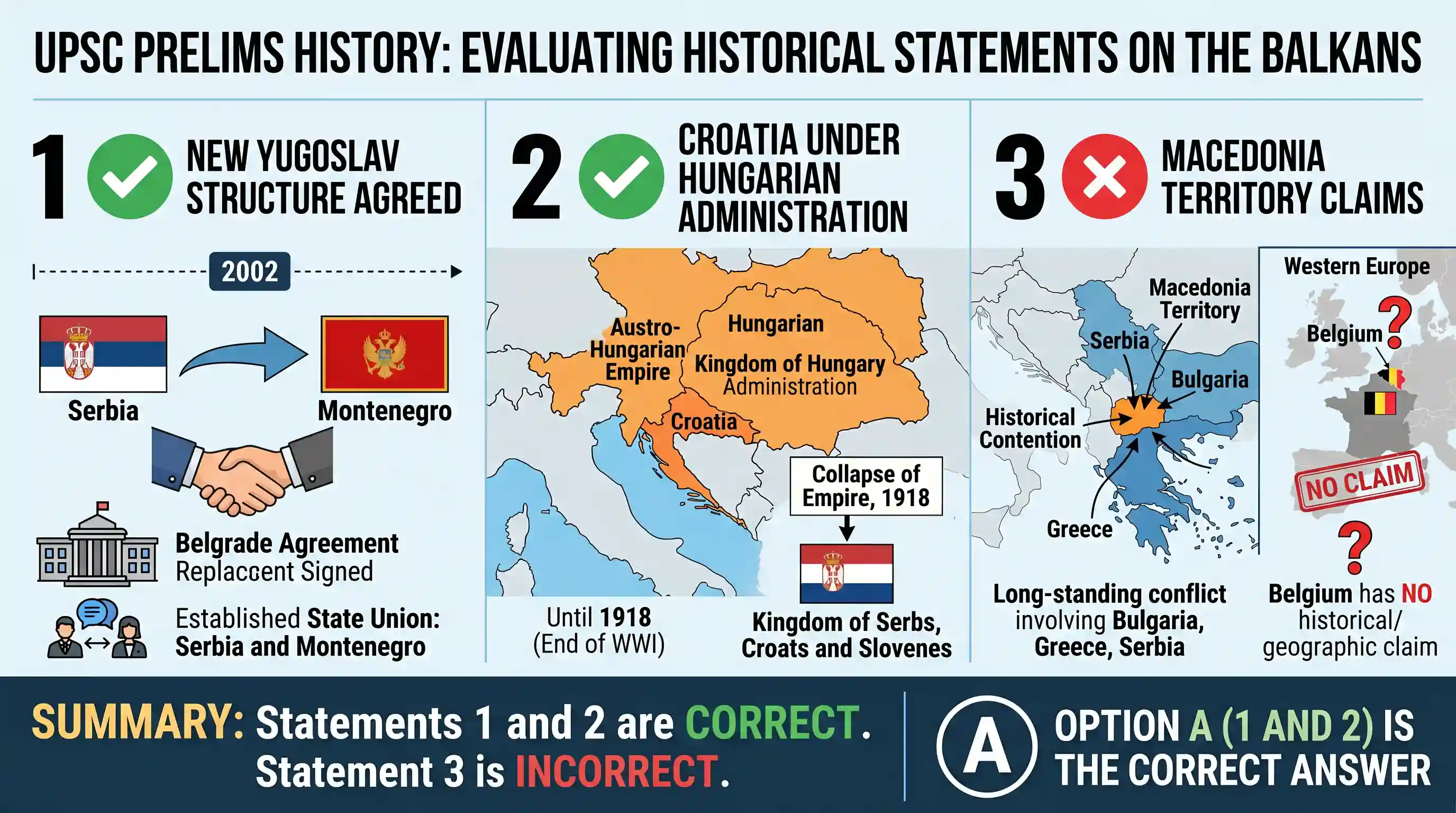
Statement 1 is correct because in 2002, Montenegro and Serbia signed the Belgrade Agreement, which replaced the Federal Republic of Yugoslavia with a loose state union called Serbia and Montenegro. This was a final attempt to restructure the remnants of the Yugoslav Federation before Montenegro eventually voted for independence in 2006.
Statement 2 is correct because Croatia was part of the Austro Hungarian Empire for centuries. It remained under Hungarian administration within that dual monarchy until the empire collapsed at the end of the First World War in 1918, leading to the formation of the Kingdom of Serbs, Croats, and Slovenes.
Statement 3 is incorrect because Belgium is a Western European nation and has no historical or geographic claim to the Macedonia territory. The long standing contention over Macedonia was actually between Bulgaria and Greece, as well as Serbia.
Since statements 1 and 2 are true and statement 3 is false, Option A is the correct answer. Note that the question mentions options with a 4, but since only three statements were provided and 1 and 2 are historically accurate, A is the only logical choice.
Related questions
More UPSC Prelims practice from the same subject and topic.
- Prelims 2004GS1history
Consider the following statements: 1. The First Session of the Indian National Congress was held in Calcutta. 2. The Second Session of the Indian National Congress was held under the presidentship of …
- Prelims 2004GS1history
The Montague Chelmsford Report formed the basis of:
- Prelims 2004GS1history
During the Indian Freedom Struggle, who among the following proposed that Swaraj should be defined as complete independence free from all foreign control?
- Prelims 2004GS1history
Consider the following Princely States of the British rule in India: 1. Jhansi 2. Sambalpur 3. Satara The correct chronological order in which they were annexed by the British is:
- Prelims 2004GS1history
The name of the famous person of India who returned the Knighthood conferred on him by the British Government as a token of protest against the atrocities in Punjab in 1919 was:
- Prelims 2004GS1history
Which of the following pairs are correctly matched? List-I List-II (Period) (Wars) 1. AD 1767-69 First Anglo Maratha War 2. AD 1790-92 Third Mysore War 3. AD 1824-26 First Anglo Burmese War 4. AD 1845…