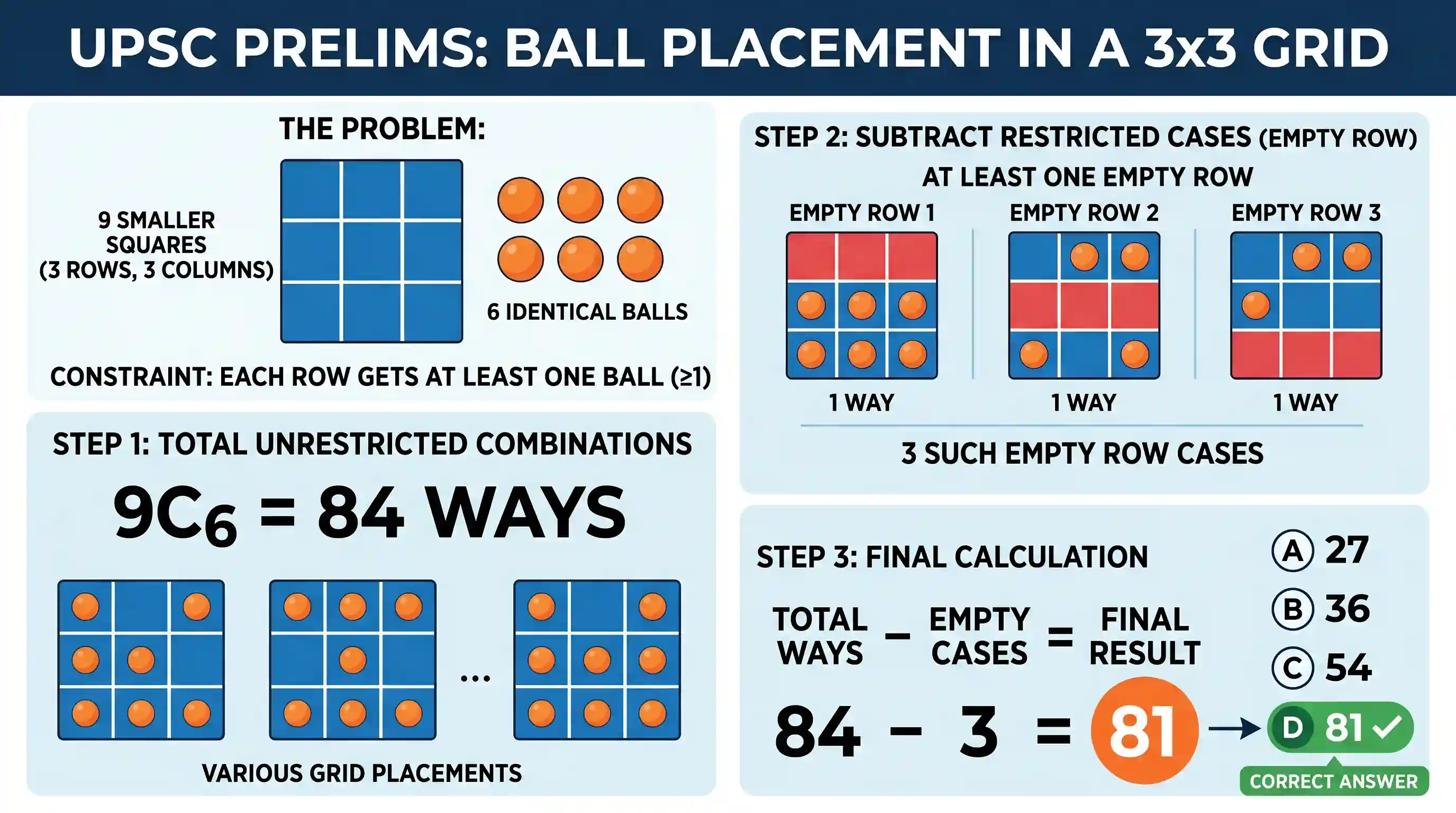
A square is divided into 9 identical smaller squares. Six identical balls are to be placed in these smaller squares such that each of the three rows gets at least one ball (one ball in one square only). In how many different ways can this be done?

- A27
- B36
- C54
- D81Correct
Explanation
To find the total number of ways to place 6 identical balls in 9 squares such that each row has 3 squares and receives at least one ball, we follow these steps:
-
Total combinations: First, calculate the total ways to choose 6 squares out of 9 without any restrictions. This is 9C6, which is equal to 9C3. Calculation: (9 x 8 x 7) / (3 x 2 x 1) = 84 ways.
-
Identify restricted cases: We must subtract the cases where one or more rows remain empty. Since there are 6 balls to be placed in 9 squares, it is impossible for two rows to be empty because one row only has 3 squares, and we have 6 balls. Therefore, we only need to subtract cases where exactly one row is empty.
-
Calculate empty row cases: If one row is empty, all 6 balls must be placed in the remaining two rows. Since the remaining two rows have exactly 6 squares combined, there is only 1 way to fill them (1 ball in each square).
-
Apply the subtraction: There are 3 possible rows that could be the empty one (Row 1, Row 2, or Row 3). So, there are 3 such cases where a row remains empty.
-
Final result: Total ways minus restricted ways = 84 minus 3 = 81.
Thus, there are 81 different ways to place the balls such that each row gets at least one ball. Correct option is D.
Related questions
More UPSC Prelims practice from the same subject and topic.
- Prelims 2005GS1science-and-technology
Ten identical particles are moving randomly inside a closed box. What is the probability that at any given point of time all the ten particles will be lying in the same half of the box?
- Prelims 2005GS1science-and-technology
Consider the following statements: 1. During the process of osmosis, the solvent travels from the concentrated solution to the dilute solution.
- Prelims 2005GS1science-and-technology
Assertion (A): All the proteins in our food are digested in small intestine only. Reason (R): The Protein digesting enzymes from pancreas are released into small intestine.
- Prelims 2005GS1science-and-technology
Assertion (A): Amoeba is reproduced by fission. Reason (R): All unicellular organisms are reproduced by asexual methods.
- Prelims 2005GS1science-and-technology
Assertion (A): The main constituent of the Liquefied Petroleum Gas is methane. Reason (R): Methane can be used directly for burning in homes and factories where it can be supplied through pipelines.
- Prelims 2005GS1science-and-technology
Assertion (A): The person with diabetes insipidus feels thirsty. Reason (R): A person with diabetes insipidus suffers from excess secretion of vasopressin.