There are 6 persons, B, C, D, E and F. They are to be seated in a row such that B never sits anywhere ahead of A and C never sits anywhere ahead of B. In how many different ways can this be done?

- A60
- B72
- C120Correct
- DNone of the above
Explanation
The total number of ways to arrange 6 distinct people in a row is 6 factorial, which equals 720.
The problem imposes a specific relative order between three people: A, B, and C. The condition states that B cannot be ahead of A and C cannot be ahead of B. This means their relative positions must strictly be in the order A followed by B followed by C.
In any random arrangement of 6 people, there are 3 factorial (which is 6) possible ways A, B, and C can be positioned relative to each other. These ways are:
- A-B-C
- A-C-B
- B-A-C
- B-C-A
- C-A-B
- C-B-A
Out of these 6 possible relative orders, only 1 satisfies the condition (A-B-C). Since every relative order is equally likely across all 720 permutations, we simply divide the total arrangements by the number of possible relative orders of the three restricted individuals.
Calculation: 720 divided by 6 equals 120.
Therefore, there are 120 ways to arrange the 6 people such that the relative order A-B-C is maintained. Correct answer is C.
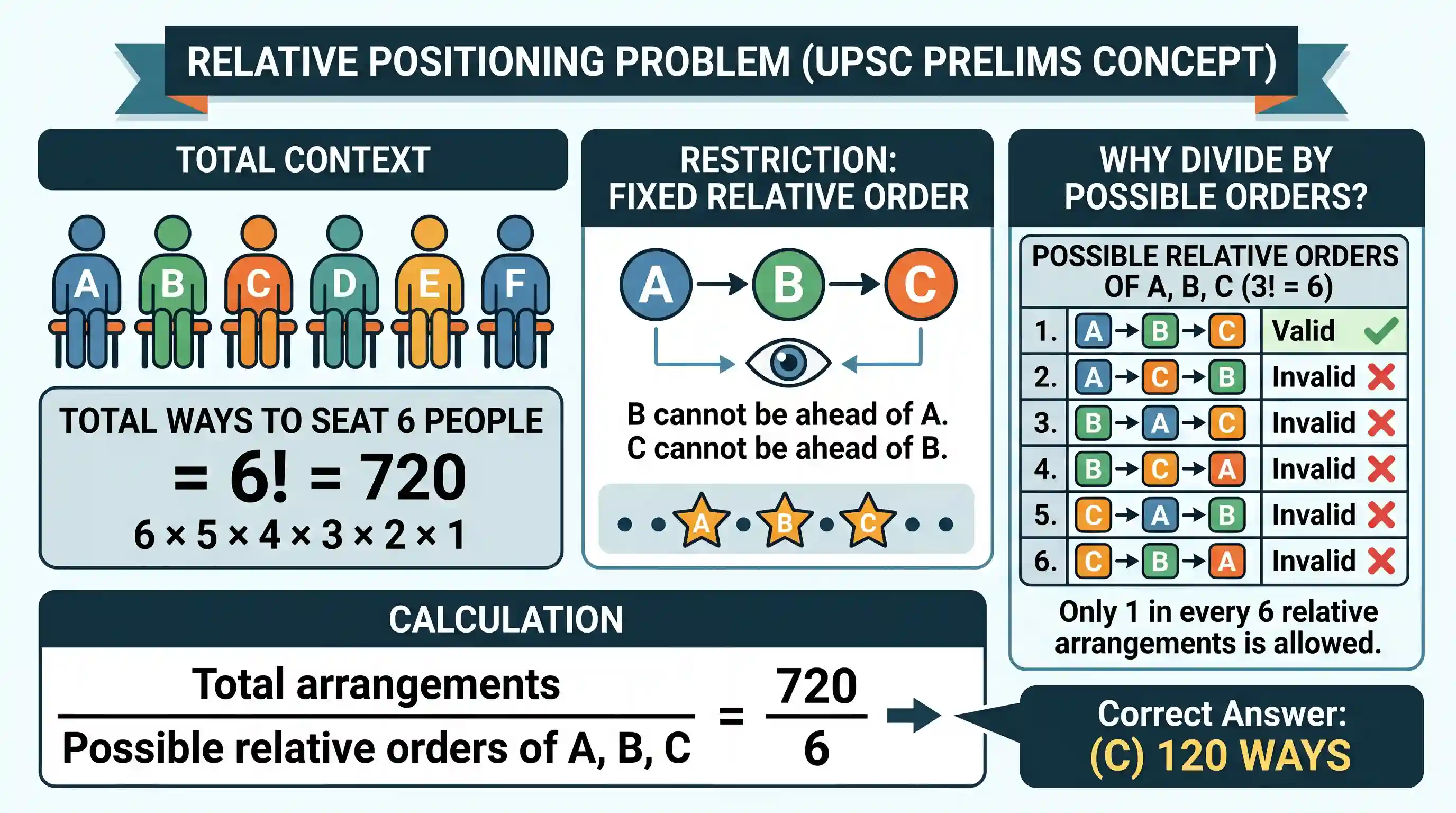
Related questions
More UPSC Prelims practice from the same subject and topic.
- Prelims 2005GS1polity-and-governance
300 persons are participating in a meeting, out of which 120 are foreigners, and the rest are Indians. Out of the Indians, there are 110 men who are not judges; 160 are men or judges, and 35 are women…
- Prelims 2005GS1polity-and-governance
There are 6 persons: A, B, C, D, E and F A has 3 items more than C D has 4 items less than B E has 6 items less than F C has 2 items more than E F has 3 items more than D Which one of the following fi…
- Prelims 2005GS1polity-and-governance
Which one of the following cities is the seat of Parliament of South Africa?
- Prelims 2005GS1polity-and-governance
In which one of the following countries, is Tamil a major language?
- Prelims 2005GS1polity-and-governance
Consider the following statements: 1. The constitution of the United States of America came into force in the year 1810. 2. All revenue bills must originate in the House of the Representatives of the …
- Prelims 2005GS1polity-and-governance
Consider the following statements: 1. The Parliament of Russia is called Federal Assembly. 2. Council of the Federation in the Russian Parliament is the lower house. 3. The name of the upper house in …