Which one of the following is the correct chronological order of the battles fought in India in the 18th Century?

- ABattle of Wandiwash-Battle of Buzar-Battle of Ambur-Battle of Plassey
- BBattle of Ambur-Battle of Plassey- Battle of Wandiwash-Battle of BuxarCorrect
- CBattle of Wandiwash-Battle of Plassey-Battle of Ambur-Battle of Buxar
- DBattle of Ambur-Battle of Buxar- Battle of Wandiwash-Battle of Plassey
Explanation
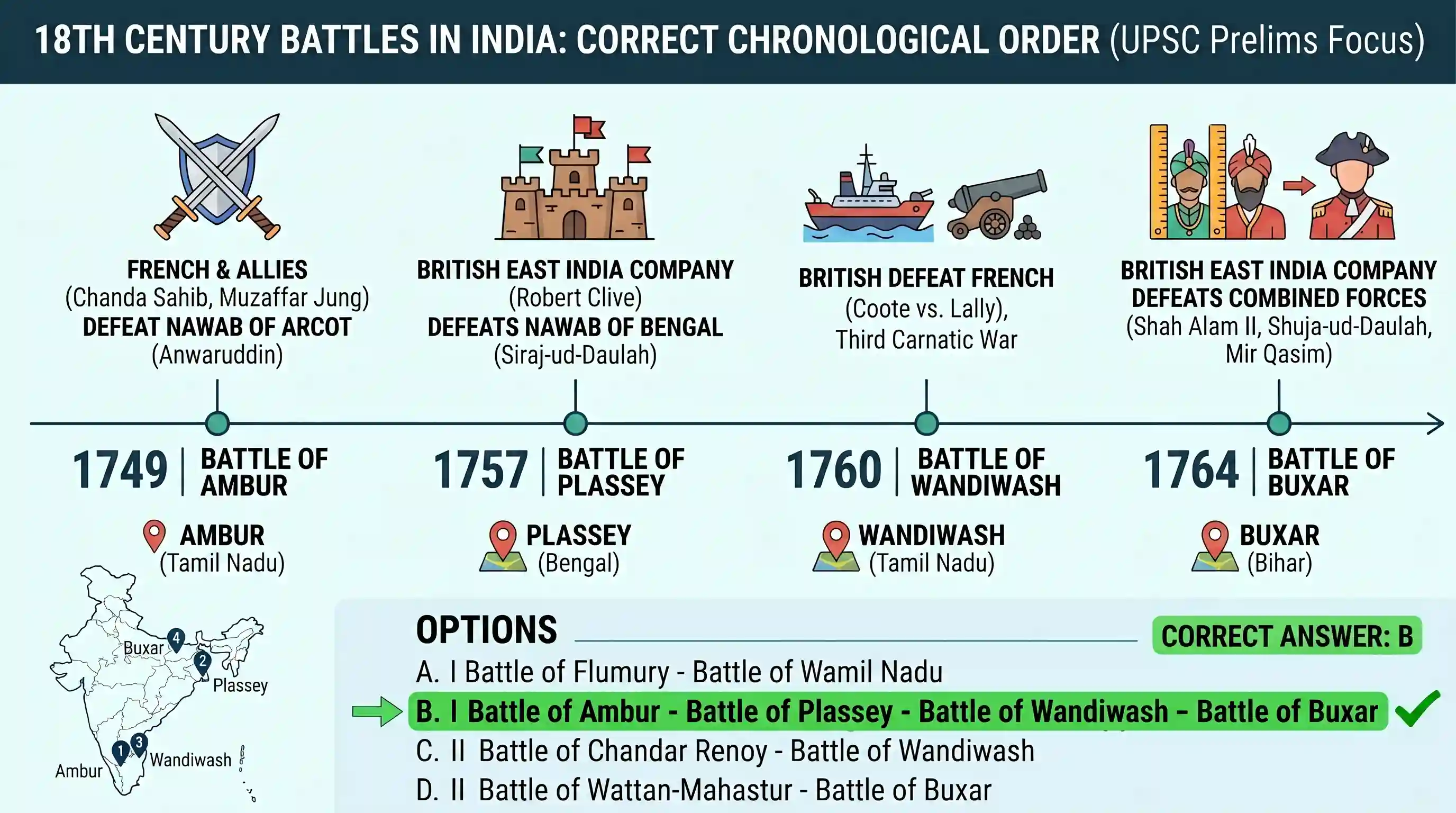
The correct answer is B because of the following timeline of the four key battles:
-
Battle of Ambur (1749): This was a major battle of the Second Carnatic War where the French forces along with Muzaffar Jung and Chanda Sahib defeated the Nawab of Arcot.
-
Battle of Plassey (1757): The British East India Company led by Robert Clive defeated the Nawab of Bengal, Siraj-ud-Daulah, establishing British influence in Bengal.
-
Battle of Wandiwash (1760): A decisive battle during the Third Carnatic War where the British forces defeated the French, effectively ending French colonial ambitions in India.
-
Battle of Buxar (1764): The British East India Company defeated the combined forces of Mir Qasim, Shuja-ud-Daulah, and Shah Alam II, solidifying British rule over North India.
The chronological sequence 1749, 1757, 1760, and 1764 corresponds exactly to option B.
Related questions
More UPSC Prelims practice from the same subject and topic.
- Prelims 2005GS1history
Which one of the following pairs is not correctly matched? British Prime Minister Political Party
- Prelims 2005GS1history
Consider the following statements: 1. Ishwar Chandra Vidyasagar founded the Bethune School at Calcutta with the main aim of encouraging education for women. 2. Bankim Chandra Chattopadhyay was the fir…
- Prelims 2005GS1history
Who among the following repealed the Vernacular Press Act?
- Prelims 2005GS1history
In which country is Bandung, where the conference of African and Asian nations was held which led to establishing Non-Aligned Movement (NAM) situated?
- Prelims 2005GS1history
Consider the following: 1. Warren Hastings was the first Governor General who established a regular police force in India on the British pattern.
- Prelims 2005GS1history
Consider the following statements: The Government of India Act, 1935 provided for