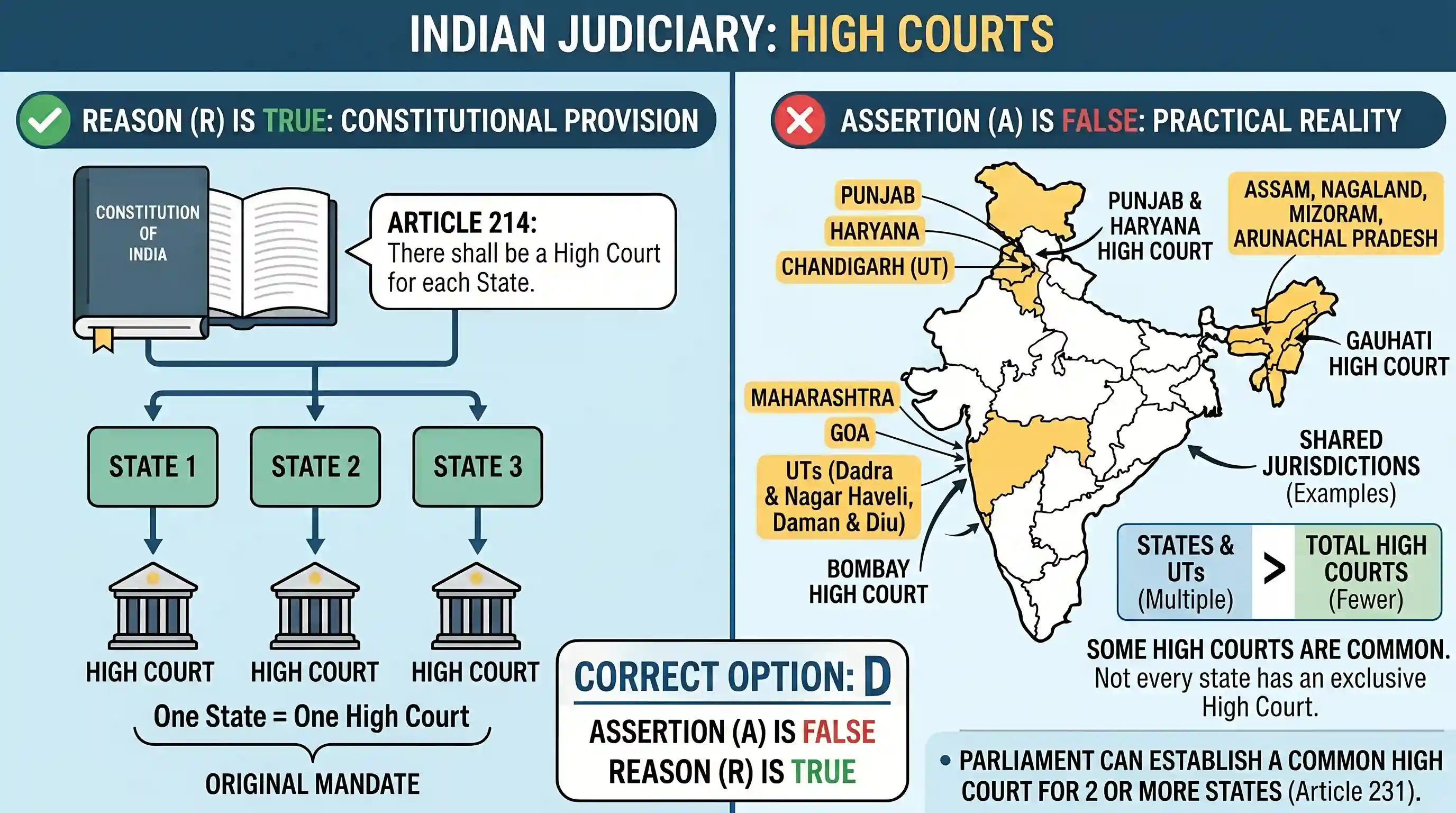
Assertion (A): In India, every state has a High Court in its territory. Reason (R): The Constitution of India provides for a High Court in each state.

- ABoth A and R are true and R is the correct explanation of A
- BBoth A and R are true but R is not the correct explanation of A
- CA is true but R is false
- DA is false but R is trueCorrect
Explanation
Assertion (A) is false. Not every state in India has an exclusive High Court located within its territory. For example, the Bombay High Court has jurisdiction over Maharashtra, Goa, and the Union Territories of Dadra and Nagar Haveli and Daman and Diu. The Punjab and Haryana High Court serves both Punjab and Haryana.
Reason (R) is true. Article 214 of the Constitution of India states, "There shall be a High Court for each State." While Article 231 allows for the establishment of a common High Court for two or more States or for two or more States and a Union territory, the fundamental provision for a High Court for each state exists in the Constitution.
Since A is false and R is true, option D is the correct answer.
Related questions
More UPSC Prelims practice from the same subject and topic.
- Prelims 2006GS1polity-and-governance
Consider the following statements: 1. A person who has held office as a permanent as a permanent Judge of a High Court cannot plead or act in any court or before any authority in India except the Supr…
- Prelims 2006GS1polity-and-governance
Who was the Chief Justice of India when public interest litigation (PIL) was introduced to the Indian Judicial System?
- Prelims 2006GS1polity-and-governance
Which one of the following subjects is under the Union List in the Seventh Schedule of the Constitution of Indian?
- Prelims 2006GS1polity-and-governance
Consider the following statements: 1. No provision in Constitution to encourage equal pay for equal work for men and women. 2. Constitution does not define backward classes. Which of the statements gi…
- Prelims 2006GS1polity-and-governance
Consider the following statements: 1. Rajya Sabha alone can declare it's in national interest for Parliament to legislate on State List matters. 2. Resolutions approving Emergency Proclamations are pa…
- Prelims 2006GS1polity-and-governance
Consider the following statements in respect of welfare schemes launched by the Ministry of Rural Development, Government of India. 1. Drinking water for rural areas in one of the components of the Bh…