Assertion (A): Cellulose is used in making shatter proof glass. Reason (R): Polysaccharides are not soluble in water.

- ABoth A and R are true and R is the correct explanation of ACorrect
- BBoth A and R are true but R is not the correct explanation of A
- CA is true but R is false
- DA is false but R is true
Explanation
The correct answer is A. Let's analyze each statement:
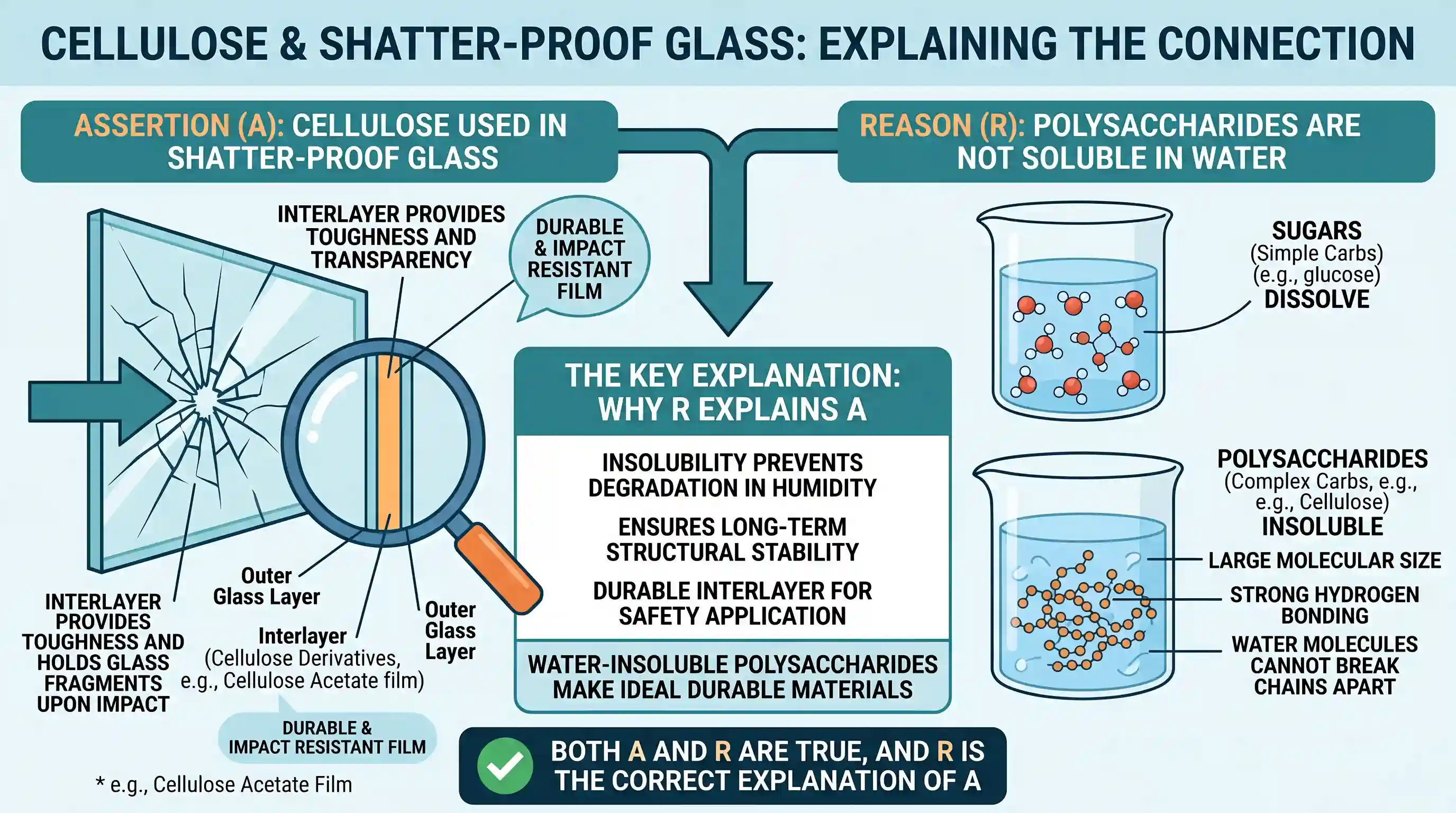
Assertion (A): Cellulose is used in making shatter proof glass. This statement is TRUE. While polyvinyl butyral (PVB) is the most common interlayer in modern shatterproof glass, cellulose derivatives, particularly cellulose acetate, have been and are used in some safety films and laminates due to their toughness, transparency, and impact resistance. So, "cellulose" here refers to its modified forms or derivatives.
Reason (R): Polysaccharides are not soluble in water. This statement is TRUE. Polysaccharides like cellulose, starch (in cold water), and chitin are generally insoluble or sparingly soluble in water due to their large molecular size and strong intermolecular hydrogen bonding, which prevents water molecules from effectively solvating them.
Now, let's determine if R is the correct explanation for A. Shatterproof glass requires materials that are durable, stable, and resistant to environmental degradation, including moisture. If the material used in the laminate were water-soluble, it would degrade upon exposure to humidity or rain, losing its structural integrity and protective properties. The insolubility of polysaccharides (and their derivatives like cellulose acetate) in water is a crucial property that contributes to their durability and stability, making them suitable for long-term applications in environments where moisture is present, such as in shatterproof glass. Therefore, the insolubility of polysaccharides is a key reason why cellulose-based materials are considered for such applications.
Conclusion: Both A and R are true, and R provides a valid reason for why cellulose (or its derivatives) would be a suitable material for shatterproof glass due to its inherent durability and resistance to water.
Related questions
More UPSC Prelims practice from the same subject and topic.
- Prelims 2006GS1science-and-technology
A box contains 5 sets of balls while there are 3 bails in each set. Each set of balls has one colour which is different from every other set. What is the least number of balls that must be removed fro…
- Prelims 2006GS1science-and-technology
Which are the materials generally employed as solder in soldering operation in electronics?
- Prelims 2006GS1science-and-technology
To which one of the following processes is term CMYK related?
- Prelims 2006GS1science-and-technology
In which one among the following is the speed of sound maximum?
- Prelims 2006GS1science-and-technology
Consider the following chemicals: 1. Benzene 2. Carbon tetrachloride 3. Sodium Carbonate 4. Trichloroethylene Which of the above is/are used as dry-cleaning chemicals?
- Prelims 2006GS1science-and-technology
Consider the following statements: 1. Caffeine, a constituent of tea and coffee is a diuretic. 2. Citric acid is used in soft drinks. 3. Ascorbic acid is essential for the formation of bones and teeth…