Which are the materials generally employed as solder in soldering operation in electronics?

- AIron and tin
- BLead and tinCorrect
- CAluminium and lead
- DAluminium and iron
Explanation
The correct answer is B) Lead and tin.
Explanation:
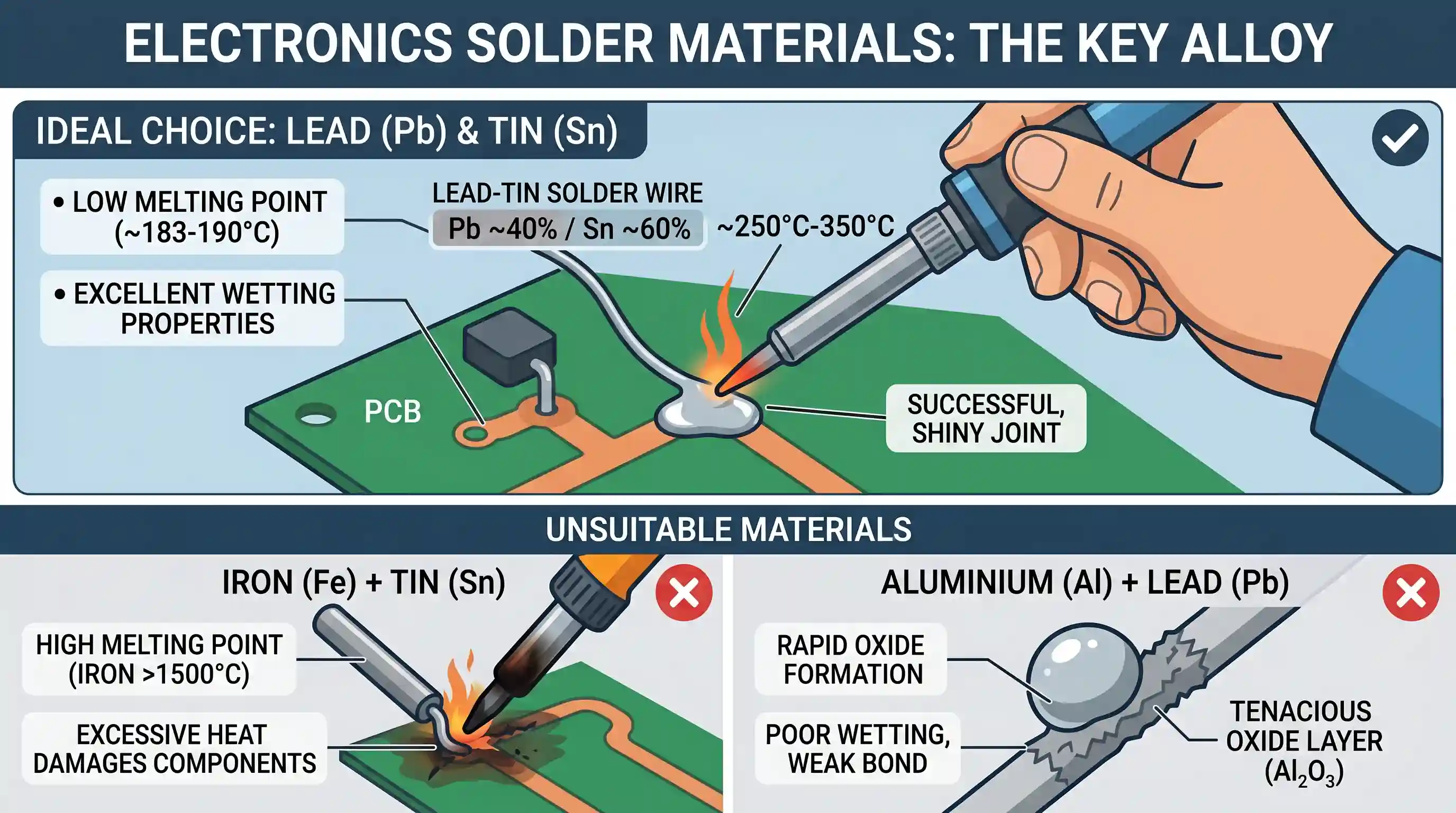
- B) Lead and tin: Traditionally, and still commonly, solder used in electronics is an alloy of lead and tin. A typical composition is 60% tin and 40% lead (or 63% tin and 37% lead for eutectic solder). This alloy has a low melting point, good electrical conductivity, and excellent wetting properties, making it ideal for joining electronic components. While lead-free solders are now prevalent due to environmental concerns, lead-tin was the standard for a very long time and is still "generally employed" in many contexts.
- A) Iron and tin: Iron has a very high melting point (1538 °C) and is not suitable for solder, which requires a low melting point (typically below 300 °C).
- C) Aluminium and lead: Aluminium is generally difficult to solder due due to the rapid formation of a tenacious oxide layer. It is not a common component in electronic solders.
- D) Aluminium and iron: Both aluminium and iron have high melting points and are not suitable as solder materials for electronics.
Related questions
More UPSC Prelims practice from the same subject and topic.
- Prelims 2006GS1science-and-technology
Assertion (A): Cellulose is used in making shatter proof glass. Reason (R): Polysaccharides are not soluble in water.
- Prelims 2006GS1science-and-technology
A box contains 5 sets of balls while there are 3 bails in each set. Each set of balls has one colour which is different from every other set. What is the least number of balls that must be removed fro…
- Prelims 2006GS1science-and-technology
To which one of the following processes is term CMYK related?
- Prelims 2006GS1science-and-technology
In which one among the following is the speed of sound maximum?
- Prelims 2006GS1science-and-technology
Consider the following chemicals: 1. Benzene 2. Carbon tetrachloride 3. Sodium Carbonate 4. Trichloroethylene Which of the above is/are used as dry-cleaning chemicals?
- Prelims 2006GS1science-and-technology
Consider the following statements: 1. Caffeine, a constituent of tea and coffee is a diuretic. 2. Citric acid is used in soft drinks. 3. Ascorbic acid is essential for the formation of bones and teeth…