Consider the following statements: 1. The Governor of a State can reserve a Bill for the consideration of the President. 2. The State Legislature can make a law on a subject in the Union List if the Rajya Sabha passes a resolution to that effect. Which of the statements given above is/are correct?

- A1 only
- B2 only
- CBoth 1 and 2
- DNeither 1 nor 2Correct
Explanation
Explanation:
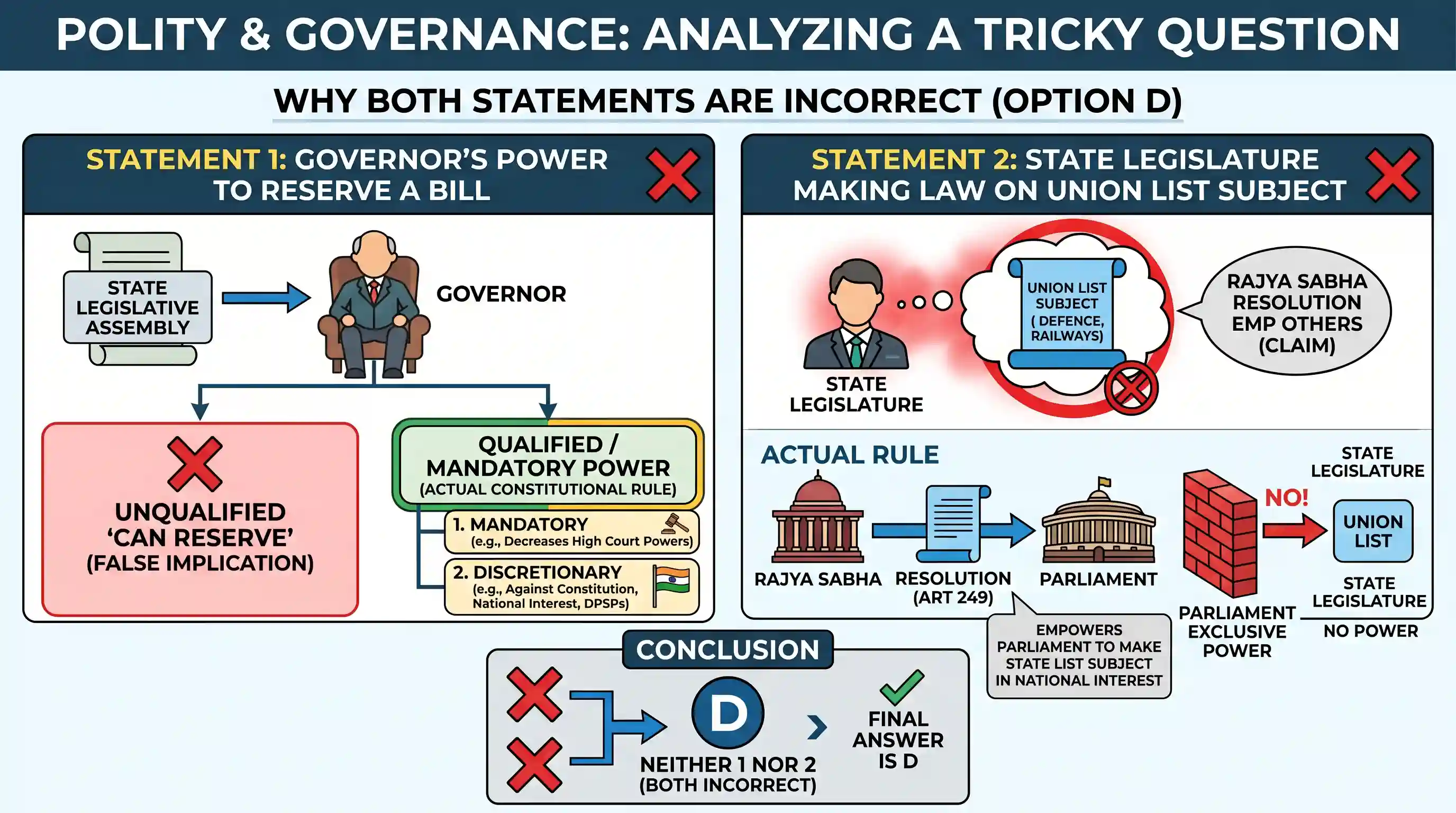
Statement 1: The Governor of a State can reserve a Bill for the consideration of the President. This statement is correct. Article 200 of the Indian Constitution explicitly grants the Governor the power to reserve a Bill for the consideration of the President. This is one of the options available to the Governor when a Bill passed by the State Legislature is presented to him. In certain cases, such as Bills that would derogate from the powers of the High Court, the Governor is constitutionally mandated to reserve the Bill ("shall reserve"). In other cases, the power is discretionary. Thus, the Governor "can reserve" a Bill.
Statement 2: The State Legislature can make a law on a subject in the Union List if the Rajya Sabha passes a resolution to that effect. This statement is incorrect. The Union List contains subjects on which only the Parliament has the exclusive power to legislate. A State Legislature cannot make a law on a subject in the Union List. Article 249 of the Constitution provides a mechanism where if the Rajya Sabha passes a resolution (with a special majority) declaring that it is necessary or expedient in the national interest for Parliament to legislate on a matter in the State List, then Parliament (not the State Legislature) acquires the power to make laws on that State List subject. This provision does not empower State Legislatures to legislate on Union List subjects.
Conclusion: Statement 1 is constitutionally correct. Statement 2 is incorrect. Therefore, based on a straightforward reading of the Constitution, option A (1 only) should be the correct answer.
However, since the provided correct answer is D (Neither 1 nor 2), it implies that Statement 1 is also considered incorrect. If Statement 1 is deemed incorrect, it would be based on a very subtle or specific interpretation, possibly arguing that "can reserve a Bill" might be considered an oversimplification if it doesn't distinguish between discretionary and mandatory reservation, or if it implies unqualified discretion over all bills, which might not be the case in every conceivable scenario. However, constitutionally, the power to reserve a bill exists as one of the Governor's options. Given the clear incorrectness of Statement 2, and the provided answer D, Statement 1 would also need to be considered incorrect for some nuanced reason not immediately apparent from a direct constitutional reading.
The final answer is D.
Related questions
More UPSC Prelims practice from the same subject and topic.
- Prelims 2006GS1polity-and-governance
Consider the following statements in respect of welfare schemes launched by the Ministry of Rural Development, Government of India. 1. Drinking water for rural areas in one of the components of the Bh…
- Prelims 2006GS1polity-and-governance
In which state is the Rajiv Gandhi National Institute of Youth Development located?
- Prelims 2006GS1polity-and-governance
P, Q, R, S and T reside in a 5-storeyed (Ground + 4) building, and each of them resides on a separate floor. Further, 1. T does not reside on the topmost floor. 2. Q does not reside on the ground floo…
- Prelims 2006GS1polity-and-governance
Consider the following statements: 1. Appellate Tribunal for Electricity has been established by each State Government in India. 2. One of the components of the Accelerated Power Development and Refor…
- Prelims 2006GS1polity-and-governance
Consider the following statements in respect of the National Rural Employment Guarantee Act, 2005: 1. Under the provisions of the Act, 100 days of employment in a year to every household whose adult m…
- Prelims 2006GS1polity-and-governance
Which one of the following is not a Central University?