P, Q, R, S and T reside in a 5-storeyed (Ground + 4) building, and each of them resides on a separate floor. Further, 1. T does not reside on the topmost floor. 2. Q does not reside on the ground floor. 3. S resides on one storey above that of P and one storey below that of R. To know as to which of the 5 persons resides on the ground floor which of the above statements are sufficient/insufficient?

- A1 and 3 are sufficient
- B2 and 3 are sufficient
- C1, 2 and 3 are sufficient
- D1, 2 | 3 are insufficientCorrect
Explanation
The problem asks to identify who resides on the ground floor using the given statements. There are 5 floors (Ground, 1, 2, 3, 4) and 5 persons (P, Q, R, S, T).
Let's analyze the statements:
- T does not reside on the topmost floor (Floor 4).
- Q does not reside on the ground floor.
- S resides on one storey above P and one storey below R. This means R, S, P must reside on consecutive floors in that order (R-S-P block).
Now, let's combine all three statements and check the possibilities for the R-S-P block:
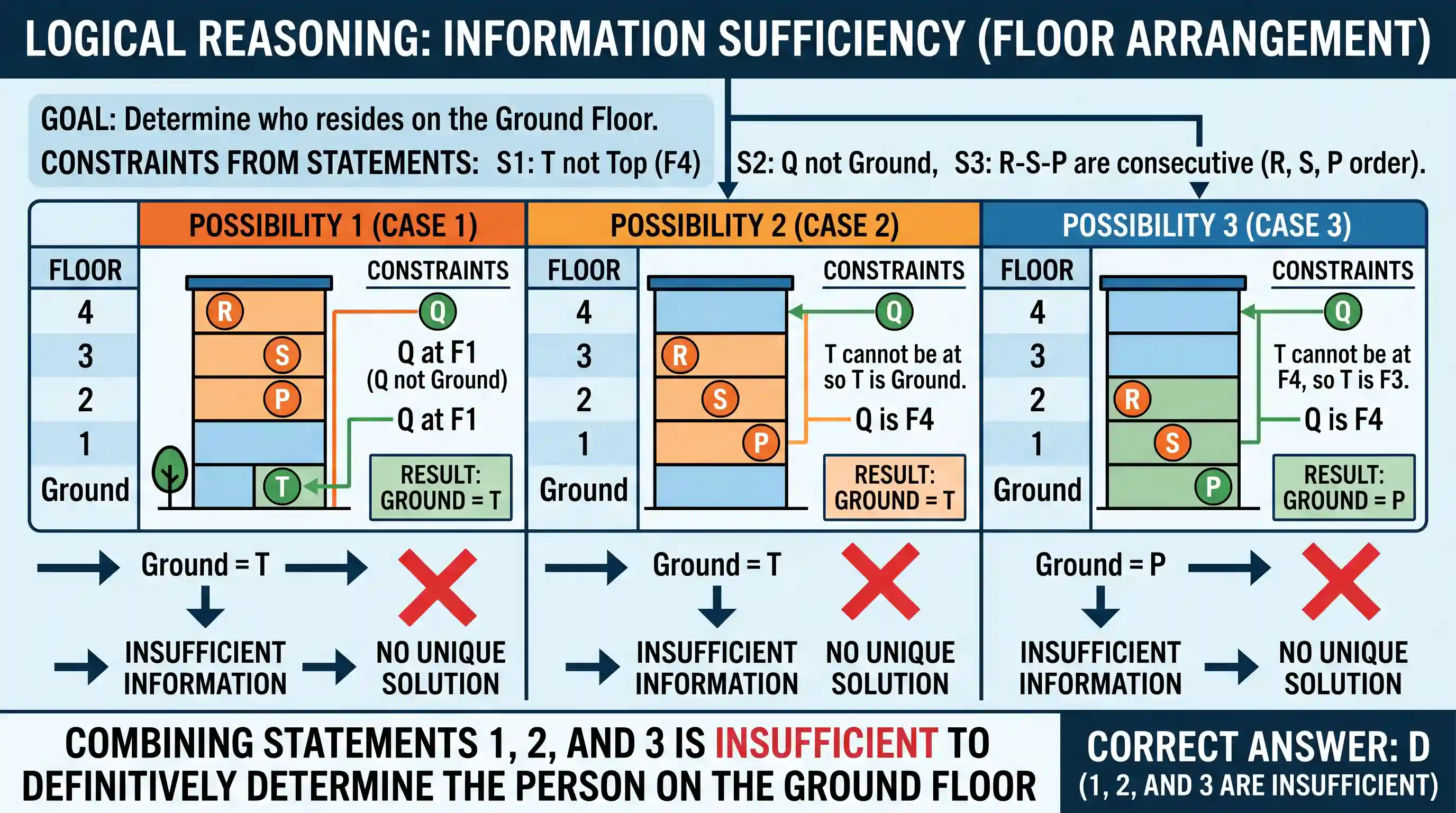
Possibility 1: R-S-P occupies floors 4, 3, 2. Floor 4: R Floor 3: S Floor 2: P Remaining persons: Q, T Remaining floors: 1, Ground Applying statement 1 (T not on Floor 4) is satisfied as T is not R. Applying statement 2 (Q not on Ground Floor): If Q cannot be on the ground floor, Q must be on Floor 1. This leaves T for the Ground Floor. In this case, T resides on the Ground Floor.
Possibility 2: R-S-P occupies floors 3, 2, 1. Floor 3: R Floor 2: S Floor 1: P Remaining persons: Q, T Remaining floors: 4, Ground Applying statement 1 (T not on Floor 4): T cannot be on Floor 4. So, T must be on the Ground Floor. Applying statement 2 (Q not on Ground Floor) is satisfied as T is on Ground. This leaves Q for Floor 4. In this case, T resides on the Ground Floor.
Possibility 3: R-S-P occupies floors 2, 1, Ground. Floor 2: R Floor 1: S Ground: P Remaining persons: Q, T Remaining floors: 4, 3 Applying statement 1 (T not on Floor 4): T cannot be on Floor 4. So, T must be on Floor 3. Applying statement 2 (Q not on Ground Floor) is satisfied as P is on the Ground Floor. This leaves Q for Floor 4. In this case, P resides on the Ground Floor.
Since combining all three statements leads to two different possibilities for the person on the ground floor (T in Possibility 1 and 2, or P in Possibility 3), the statements are insufficient to definitively determine who resides on the ground floor.
Therefore, statements 1, 2 and 3 are insufficient.
The final answer is D
Related questions
More UPSC Prelims practice from the same subject and topic.
- Prelims 2006GS1polity-and-governance
Consider the following statements in respect of welfare schemes launched by the Ministry of Rural Development, Government of India. 1. Drinking water for rural areas in one of the components of the Bh…
- Prelims 2006GS1polity-and-governance
In which state is the Rajiv Gandhi National Institute of Youth Development located?
- Prelims 2006GS1polity-and-governance
Consider the following statements: 1. The Governor of a State can reserve a Bill for the consideration of the President. 2. The State Legislature can make a law on a subject in the Union List if the R…
- Prelims 2006GS1polity-and-governance
Consider the following statements: 1. Appellate Tribunal for Electricity has been established by each State Government in India. 2. One of the components of the Accelerated Power Development and Refor…
- Prelims 2006GS1polity-and-governance
Consider the following statements in respect of the National Rural Employment Guarantee Act, 2005: 1. Under the provisions of the Act, 100 days of employment in a year to every household whose adult m…
- Prelims 2006GS1polity-and-governance
Which one of the following is not a Central University?