With reference to the evolution of living organisms, which one of the following sequences is correct?

- AOctopus – Dolphin – Shark
- BPangolin – Tortoise – Hawk
- CSalamander – Python – KangarooCorrect
- DFrog – Crab – Prawn
Explanation
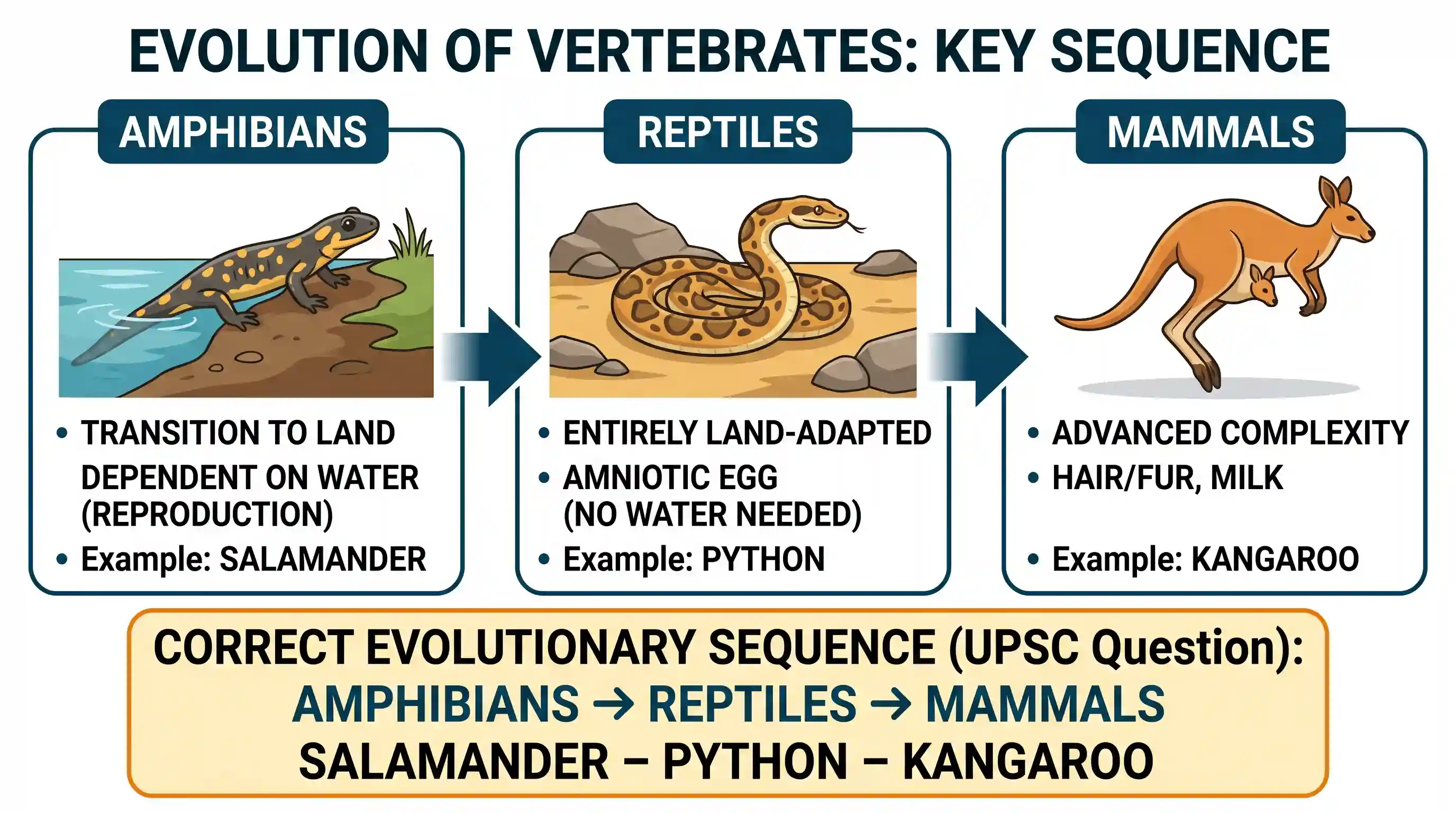
The correct sequence is Salamander, Python, Kangaroo because it follows the evolutionary order of vertebrates moving from water to land and increasing in biological complexity.
Salamanders are amphibians, which were the first group of vertebrates to transition from water to land. Pythons are reptiles, which evolved after amphibians and developed the ability to live entirely on land. Kangaroos are mammals, which represent a more recent and complex evolutionary stage compared to amphibians and reptiles.
The other options are incorrect because they do not follow a chronological evolutionary timeline. For example, in option A, the Octopus is an invertebrate while Dolphins and Sharks are vertebrates, but Sharks evolved long before Dolphins. In option D, the sequence is reversed as Crabs and Prawns are invertebrates that appeared before Frogs. Therefore, only option C represents a correct progression from Amphibian to Reptile to Mammal.
Related questions
More UPSC Prelims practice from the same subject and topic.
- Prelims 2009GS1science-and-technology
In a dry cell (battery), which of the following are used as electrolytes?
- Prelims 2009GS1science-and-technology
Consider the following statements: 1. Sweet orange plant is propagated by grafting technique. 2. Jasmine plant is propagated by layering technique. Which of the statements given above is/are correct?
- Prelims 2009GS1science-and-technology
Which one of the following types of waves are used in a night vision apparatus?
- Prelims 2009GS1science-and-technology
How many numbers lie between 300 and 500 in which 4 comes only one time?
- Prelims 2009GS1science-and-technology
How many letters of the English alphabet (capitals) appear same when looked at in a mirror?
- Prelims 2009GS1science-and-technology
How many three-digit numbers can be generated from 1, 2, 3, 4, 5, 6, 7, 8, 9 such that the digits are in ascending order?